
What mental tips help with your first snowboard lesson?
Mental preparation is crucial for your first snowboard lesson, as it boosts your confidence and accelerates the learning process. The right mindset helps you overcome fears, accept falling as part of learning, and stay focused on progress rather than perfection. With the right mental tips, you can enjoy your snowboarding experience more and achieve faster results.
Why is mental preparation so important for your first snowboard lesson?
Mental preparation largely determines how successful and enjoyable your first snowboard lesson will be. Your mindset directly influences how quickly you learn new movements, how you handle challenges, and how much fun you have during the process.
Beginners often experience mental blocks because snowboarding initially feels counter-intuitive. You stand sideways on a board, which feels unnatural for most people. This uncertainty can lead to tension in your body, making it difficult to learn fluid movements.
A positive mindset significantly accelerates the learning process. When you’re mentally prepared, you can:
- Absorb new movement patterns faster
- Listen better to your instructor
- Waste less energy on unproductive worries
- See falls as learning moments instead of failures
Proper mental preparation makes your snowboard lesson not only safer, but also much more fun. You can focus on the joy of the new experience instead of your fears.
What fears are most common among snowboarding beginners?
The most common fears among snowboarding beginners are falling, being unable to control speed, getting hurt, and feeling like they have no control over the board. These fears are completely normal and are experienced by virtually all beginners.
Fear of falling tops the list. Beginners are afraid of falling hard and hurting themselves. This fear is understandable, but can make your movements stiff and unnatural, which actually increases the chance of falling.
Fear of speed is also very common. The idea that you can’t stop or slow down when you want to can cause panic. This often leads to leaning backward, which is counterproductive for good snowboarding technique.
Other common fears include:
- Losing control of the snowboard
- Hitting other skiers or snowboarders
- Falling off the lift
- Not being able to handle terrain that’s too steep
- Looking foolish in front of other people
These fears affect your learning process because they make your body tense and distract your attention from the instructions. The good news is that they can all be overcome with the right mental approach and guidance.
How can you build confidence before stepping on the snowboard?
Building confidence starts at home with mental preparation and visualization exercises. By mentally rehearsing your snowboard lesson before you’re on the slope, you prepare your brain for new experiences and reduce uncertainty.
Visualization is a powerful technique. Imagine how you successfully make your first turns, how you fall safely and get back up, and how you enjoy gliding over the snow. Repeat these positive images regularly in the days before your lesson.
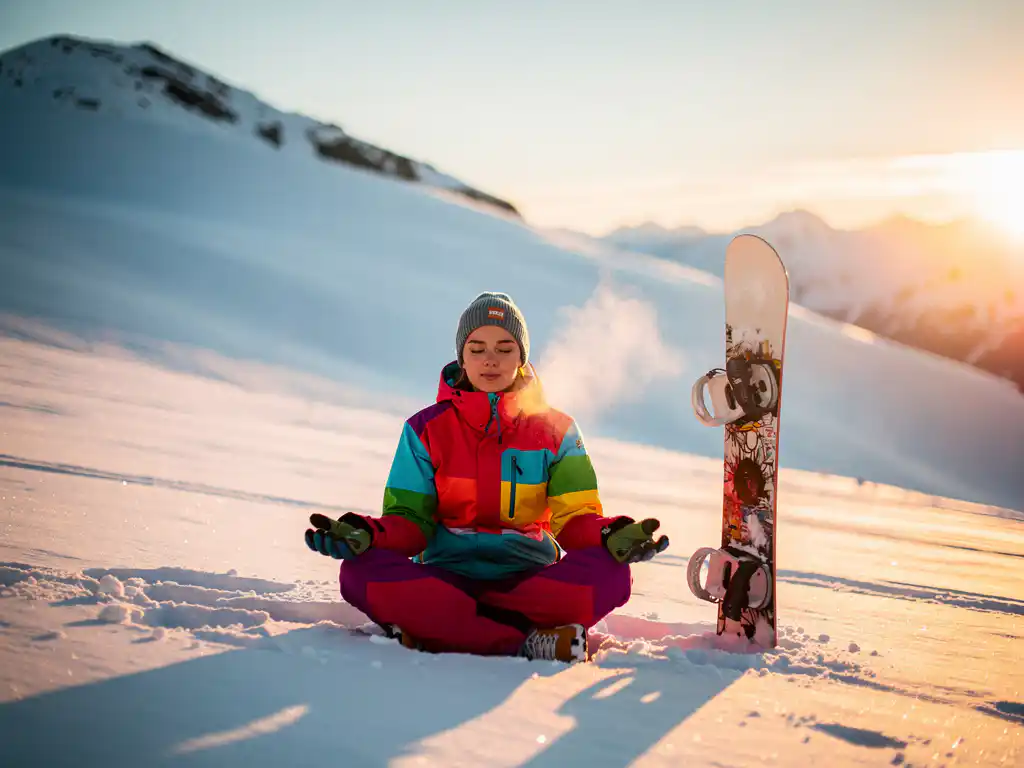
Breathing exercises help you stay calm. Practice deep belly breathing: breathe in for four counts, hold for four counts, and breathe out for eight counts. You can also use this technique during your lesson when you get tense.
Practical preparation tips:
- Watch instructional videos to familiarize yourself with the movements
- Practice your balance on a wobble board or skateboard
- Repeat positive affirmations: “I’m learning step by step and that’s fine”
- Set realistic expectations: nobody becomes an expert in one day
Positive self-talk is essential. Replace thoughts like “I’ll never be able to do this” with “I’m going to learn this step by step.” This mental shift has a huge impact on your confidence and willingness to learn.
What are the best mental strategies during your first snowboard lesson?
The best mental strategies during your first snowboard lesson are focusing on small, achievable goals, accepting falls as part of the learning process, and maintaining open communication with your instructor. This approach keeps you motivated and reduces frustration.
Set micro-goals for yourself. Instead of thinking: “I need to be able to snowboard,” focus on: “During this run I want to make one good turn” or “Now I’m going to glide straight calmly.” These small successes build your confidence step by step.
Accept falling as a natural part of the learning process. Experienced snowboarders also fell when they were learning. Every fall teaches you something new about balance, timing, or technique. Get up, brush off the snow, and try again.
Mental strategies for during the lesson:
- Stay in the moment: focus on what you’re doing now
- Use positive self-talk between runs
- Take breaks when you get frustrated
- Celebrate small progress: every improvement counts
- Listen actively to your instructor and ask questions
Communication with your instructor is crucial. Be honest about your fears or concerns. Good instructors can adjust their approach to your mental needs and provide extra reassurance when needed.
Why Ski-Pro is the best choice for your first snowboarding experience?
Ski-Pro is the ideal choice for your first snowboarding experience, because we connect you with certified instructors who specialize in beginner lessons and mental support. Our instructors understand the importance of the right mindset and can help you overcome your fears.
Through our platform, you can easily compare more than 350 snowboard schools in the Alps. You can view prices, lesson types, group versus private lessons and availability in one place. This saves you time and stress when planning your first snowboarding adventure.
We work exclusively with certified and reputable snowboard schools, which guarantees quality and safety. Our partners have experience guiding beginners and know how important mental support is during those crucial first lessons.
The benefits of booking through Ski-Pro:
- Quick, transparent and secure booking procedure
- Instructors specialized in beginner lessons
- Choice of different teaching styles that match your personality
- Possibility of private lessons for extra mental support
- Help finding the best option for your level and budget
As a tribe of powder-spotting, first-track-hunting snow lovers, we understand the magic of your first snowboarding experience. We ensure you find the perfect match with an instructor who conveys not only technique, but also confidence.
How do you deal with disappointments and frustration while learning to snowboard?
Dealing with disappointments while learning to snowboard requires realistic expectations, self-compassion, and focus on your personal progress rather than comparison with others. Frustration is normal and can be transformed into learning motivation with the right mental techniques.
Set realistic expectations from the beginning. Snowboarding is a complex sport that takes time to master. Most people need multiple lessons before they can comfortably go down the mountain. This is completely normal and says nothing about your talent or potential.
When frustration arises, use the “reset technique”: stop for a moment, take three deep breaths, and remind yourself why you wanted to learn this. Focus on the joy of being outside, the beautiful surroundings, and the challenge you’re taking on.
Strategies for dealing with setbacks:
- Only compare yourself to your own previous performance
- Take regular breaks to mentally reset
- Celebrate small progress: every improvement is valuable
- Use humor: laugh at your own falls and mistakes
- Remember that everyone learns at their own pace
Stay motivated by focusing on the long-term goal: the freedom and joy of snowboarding. Every difficult lesson brings you closer to that goal. With patience, the right mental attitude, and good guidance, snowboarding becomes a source of pleasure and pride.
The key to success lies in embracing the learning process, including the challenges. With proper mental preparation and support from experienced instructors through Ski-Pro, you’re well equipped for a fantastic first snowboarding experience in the Alps.
Frequently Asked Questions
How long does it take before I feel comfortable on a snowboard?
Most beginners feel more comfortable on their snowboard after 2-3 lessons, but this varies per person. Some have fun after just one lesson, while others need 4-5 lessons. The most important thing is to be patient with yourself and focus on small improvements each lesson.
What should I do if my fear becomes too overwhelming during the lesson?
Stop immediately and communicate with your instructor about your feelings. Take a break, use breathing exercises (breathe in for 4 counts, breathe out for 8 counts) and go to calmer terrain. A good instructor will adjust the pace and provide extra mental support to make you feel comfortable again.
Is it normal to still fall frequently after my first lesson?
Yes, this is completely normal! Even after multiple lessons snowboarders still fall regularly - it's part of the sport. The most important thing is that you learn how to fall safely and get back up. Every fall teaches you something new about balance and control, so see it as part of your learning process.
How do I prepare mentally if I'm very perfectionist?
Focus on the process instead of the result and set micro-goals like 'this run I want to make one stable turn'. Accept that making mistakes is part of learning and that nobody snowboards perfectly from day one. Use positive self-talk and celebrate every small progress - this helps transform your perfectionist tendencies into constructive learning.