
Why do you learn the pizza slice technique first when skiing?
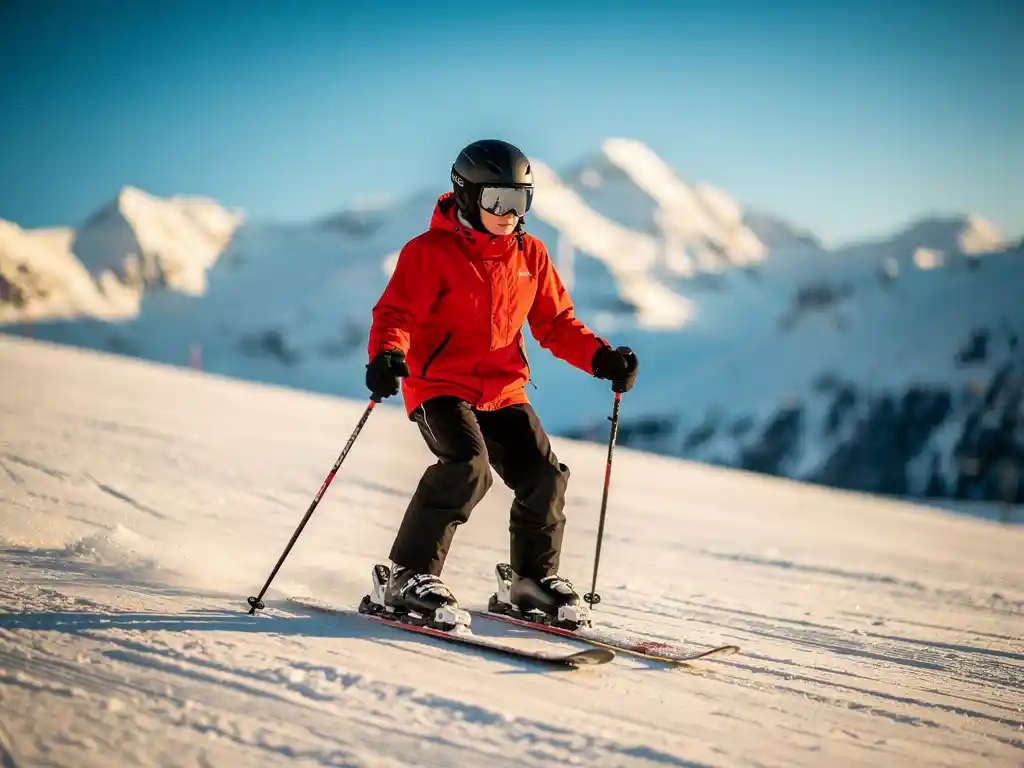
The pizza wedge is the first technique you learn in skiing because it is the safest and most effective way to control your speed and come to a stop. By bringing the tips of your skis together and keeping the tails apart, you create resistance against the snow. This gives beginners immediate control over their movements, even before they learn any other techniques.
The technique is deliberately the first step in every ski education: without the ability to brake, you cannot safely practice any other aspect of skiing. In this article, we answer the most frequently asked questions about the pizza wedge, from exactly how the stance works to which type of ski lesson will get you comfortable with it the fastest.
How does the pizza wedge technique actually work?
With the pizza wedge technique, you bring the tips of your skis toward each other while keeping the tails spread wide apart. This forms a triangle — the shape of a pizza slice. By pressing the inner edges of your skis into the snow, you create friction that slows your speed. The narrower the wedge, the more you brake.
The stance works on a simple principle: you increase the contact surface of your skis with the snow by angling them. This is also known as “edging” the ski. As a beginner, you use this to brake in a controlled manner or even come to a complete stop without falling.
In addition to braking, you can also steer with the pizza wedge. By shifting slightly more weight onto the left ski, you turn to the right. By shifting your weight to the right, you go to the left. This makes the technique not just a braking method, but also your first introduction to steering on skis. You learn early on how to choose your own line on the slope, even if it is still in its most basic form.
Why does every ski technique build on the pizza wedge?
The pizza wedge is the foundation of all further ski techniques because it provides your first experience with two fundamental skills: balance and edge control. Every advanced technique — from parallel turns to carving — requires exactly those two skills in a more refined form. Without a solid foundation in the pizza wedge, you are building on shaky ground.
Once you have mastered the pizza wedge stance, you understand how to shift your weight to change direction. This principle holds true at every stage of your skiing career. In parallel turns, you are essentially doing the same thing, but with both skis parallel and at greater speed. The transition from the pizza wedge to a parallel stance is a logical evolution, not a revolution.
Instructors deliberately structure their lessons in this order: first control, then speed, then refinement. By starting with the pizza wedge, you learn to ski from a safe position where you can slow yourself down at any moment. That builds confidence, and confidence is the key to rapid progress on the slope. Beginners who have a solid grasp of the pizza wedge make the move to advanced techniques considerably faster than those who skip the basics.
How long does it take to master the pizza wedge?
Most beginners have a reasonable handle on the basic pizza wedge form after half a day to a full day of practice. Within two to three days on the slope, most people can already brake comfortably and make simple turns with it. The exact time varies from person to person, depending on athletic experience, age, and how intensively you practice.
Children often learn the pizza wedge faster than adults. They have a lower center of gravity, less fear, and are accustomed to picking up new movements intuitively. Adults sometimes overthink every step, which can slow down the body’s natural response. That is not a problem, but it helps to be aware of this difference.
What influences the learning curve the most is the quality of guidance at the start. With a good instructor who provides direct feedback, you learn the correct weight shifts and edge control faster than if you try it on your own. Practicing regularly on a quiet, gentle slope accelerates the learning process far more than occasionally attempting a steep run.
What are the most common mistakes in the pizza wedge stance?
The most common mistake with the pizza wedge is pressing the knees inward without actually edging the skis. This makes the stance look correct, but the real friction with the snow is missing. Other frequent mistakes include leaning too far back, keeping the arms too low, and making the wedge too narrow, which causes you to brake too sharply and lose control.
Below are the mistakes instructors most commonly see in beginners:
- Leaning back: Many beginners are afraid of falling forward and instinctively lean backward. This actually reduces control, because your weight is no longer properly distributed over the skis.
- Standing too stiff: Bent knees are essential for balance and shock absorption. A straight, rigid posture makes it harder to respond to changes in the slope.
- Arms at your sides: Your arms should point slightly forward and to the sides, like a balancing bar. Keeping your arms at your sides throws off your balance.
- Closing the wedge too much: If the ski tips come nearly or completely together, you lose speed too abruptly and can fall. A moderate triangle gives you more control.
- Not shifting weight when turning: Beginners sometimes forget that steering requires consciously putting weight on one ski. Without that shift, the skis go straight ahead.
Fortunately, these mistakes can be corrected quickly with the right guidance. An instructor can see at a glance what is going wrong and provides targeted exercises to ingrain the correct posture.
Which type of ski lesson helps beginners learn the pizza wedge the fastest?
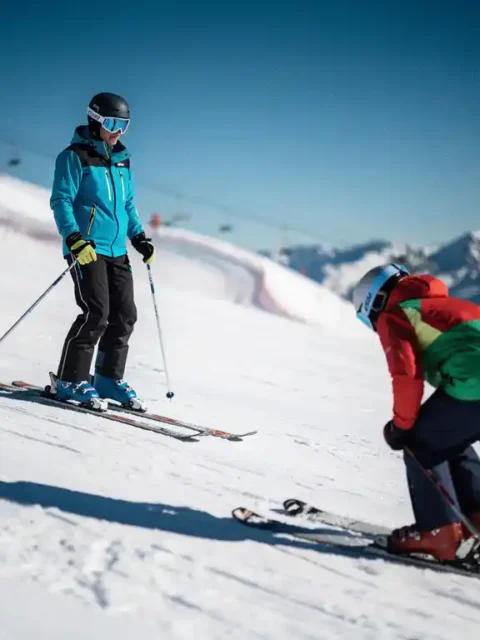
A private lesson helps beginners learn the pizza wedge the fastest. The instructor focuses entirely on your posture, pace, and specific mistakes, without having to account for a group. Group lessons are a good alternative for those who value the social aspect or have a smaller budget, but the individual attention in a private lesson significantly accelerates the learning curve.
In a group lesson, you also learn by watching others, which has its own advantages. You see what mistakes others make and how the instructor corrects them. The atmosphere in a group is also often enjoyable and motivating, especially for children and teenagers. For families skiing together for the first time, a group lesson for the children combined with a private lesson for the parents can be a smart choice.
The choice of slope also makes a big difference. Lessons on a gentle, wide beginner slope give you the space to practice the pizza wedge at your own pace without the pressure of steepness or crowds. The best ski schools deliberately plan their beginner lessons at this type of location.
How Ski-Pro helps you find the perfect ski lesson
Whether you choose a private lesson or a group lesson, the right ski school makes the difference between a frustrating first day and a flying start on the slope. We understand better than anyone how overwhelming it can be to choose from hundreds of options, especially if you have never been on skis before.
Through our platform, you can easily compare ski schools and instructors based on what matters to you:
- Level: Search specifically for lessons for absolute beginners, including pizza wedge lessons on gentle slopes
- Lesson type: Choose between private lessons for rapid progress or group lessons for a social experience
- Location: From Winterberg to Tyrol and the French Alps, we cover more than 250 certified ski schools
- Price and availability: Compare rates transparently and book directly at a time that suits you
All you need to do is decide where you want to go and what you want to learn. We take care of the rest. Compare and book your ski lesson through our platform and step onto the slope with confidence.
Frequently Asked Questions
Can I practice the pizza wedge on artificial snow or an indoor ski slope?
Yes, an indoor ski slope or artificial snow run is actually an excellent place to practice the pizza wedge for the first time. The conditions are predictable and the slopes are gentle, which is ideal for beginners. The only difference is that artificial snow can be slightly harder and more compact than powder snow, which sometimes makes edging the skis a little less smooth. However, this is no obstacle to learning the basic technique.
When is it time to move from the pizza wedge to parallel turns?
You are ready to make the move to parallel turns when you can brake and steer comfortably and in a controlled manner using the pizza wedge on a blue (easy) run. It is not about how quickly you make that transition, but whether you have truly mastered the fundamental skills such as weight shifting and edge control. An instructor can tell you exactly when you are technically ready for the next step, so you do not carry any bad habits into more advanced techniques.
Does it matter which skis I use as a beginner learning the pizza wedge?
Absolutely — equipment plays an important role. Shorter, softer skis are much easier for beginners to maneuver and make edging in the pizza wedge considerably simpler. Most ski schools and rental shops will automatically recommend the right beginner level, but ask about it explicitly when renting skis. Well-fitting ski boots are just as important: boots that are too loose will significantly reduce your control over the skis.
Is it normal for my legs to tire quickly with the pizza wedge?
Yes, this is completely normal and nearly every beginner experiences it. The pizza wedge stance requires constant, active muscle tension in your thighs and calves — muscles you rarely use this intensively in everyday life. As you accumulate more days on the slopes, your muscles adapt to the load and it takes longer before fatigue sets in. In the meantime, it helps to take regular short breaks and to stop skiing when you notice that your posture is deteriorating due to fatigue, as this increases the risk of mistakes and injuries.