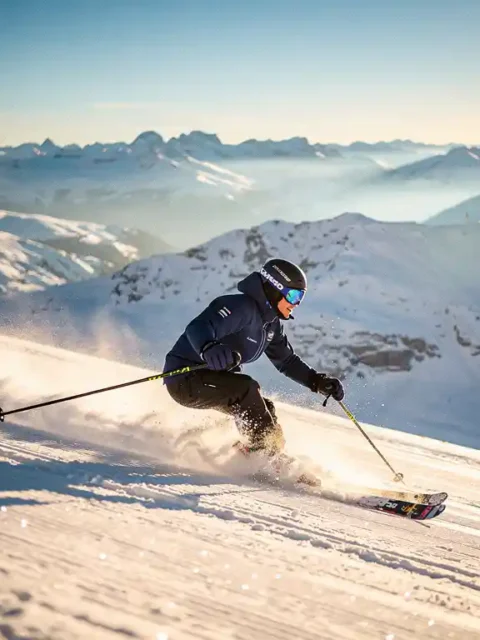

How difficult is a blue run?

A blue run is the second easiest category in the slope color system and is designed for skiers who have already mastered the absolute basics. The gradient typically ranges between 9 and 25 percent, which amounts to a fairly gradual descent. For complete beginners, a blue run is often just one step too far, but after a few good ski lessons it is certainly achievable.
In this article, we answer the most frequently asked questions about blue runs: from what the slope colors actually mean to which blue runs are most suitable for first-timers.
What do the ski slope colors mean?
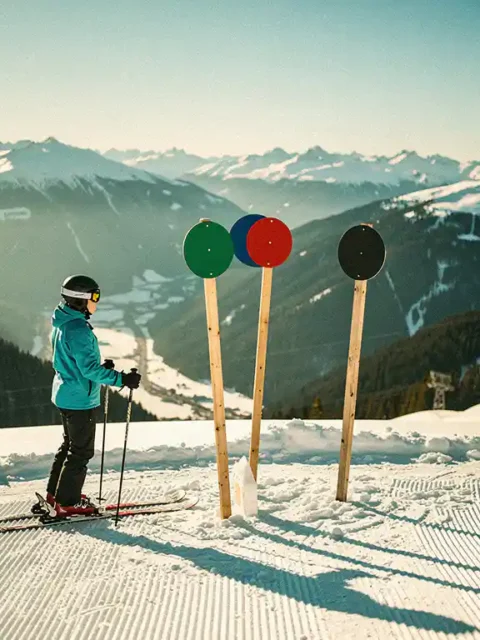
Ski slope colors are an international system that indicates the difficulty level of a run. In Europe, four colors are used: green (easiest), blue (intermediate), red (advanced), and black (expert). This system helps skiers see at a glance which slopes match their ability level.
The meaning of slope colors does vary slightly by country. In most European countries, such as Austria, Switzerland, and France, the system is nearly identical. Green is reserved for the widest, flattest slopes — ideal for those first wobbly steps on skis. Blue follows as a relaxed, well-groomed descent with a gentle gradient. Red already demands considerable technique and confidence, while black is truly intended for experienced skiers.
One important detail: the color classification is relative to each ski resort. A blue run in a large, steep resort can easily be more challenging than a red run in a smaller, flatter area. The colors therefore provide a comparison within the resort itself, not an absolute standard across all resorts.
How steep is a blue run, exactly?
A blue run typically has a gradient of 9 to 25 percent, which corresponds to an angle of approximately 5 to 14 degrees. That may sound modest, but on skis even a 15 percent slope can feel quite challenging when you are just starting out.
For comparison: a green run has a gradient of less than 10 percent, while a red run starts at 25 percent or more. Blue runs sit right in the middle — enough slope to pick up speed and practice turns, but without the steep sections you encounter on red or black runs.
The width of the slope and the quality of the snow also play a role. A wide, well-groomed blue run feels far more accessible than a narrow blue descent with an icy surface. Keep this in mind when choosing a slope to practice on.
Is a blue run suitable for complete beginners?
In most cases, a blue run is not suitable for complete beginners. Anyone stepping onto skis for the first time is best off starting on a green run or a practice slope, where speeds remain low and there is plenty of space. Only once you can stop, steer, and make small turns is a blue run a logical next step.
The transition from green to blue happens surprisingly quickly for most people when they have good guidance. After one or two days of intensive lessons on a green slope, many beginners are ready to cautiously try a blue run — preferably alongside an instructor who knows the terrain and can correct your technique.
Children sometimes make this step even faster than adults, as they tend to have less fear and are closer to the ground. But for adult beginners too, the rule holds: with the right lessons, a blue run is well within reach within a week of skiing.
Why does a blue run sometimes feel harder than expected?
A blue run can feel more difficult than expected due to a combination of factors you simply do not encounter on a practice slope. Think of busy slopes, variable snow conditions, narrower sections, or unexpected bumps. The color classification says something about the gradient, but nothing about the surrounding conditions.
A few common reasons why a blue run can feel tougher than hoped:
- Icy surface: In freezing temperatures or after heavy use, snow becomes hard and slippery, making steering and braking much more difficult.
- Crowded slope: Lots of other skiers on the run create distractions and leave less room to calmly choose your own line.
- Narrow sections: Some blue runs have stretches that are narrower or run along an edge, which can have a significant psychological impact.
- Variation in gradient: A run that averages out as blue may contain short steeper sections that momentarily feel like red.
- Fatigue: Muscles that are not yet accustomed to skiing tire quickly, causing your technique to deteriorate and everything to feel harder.
The good news: knowing what can make a blue run more challenging means you can approach it more consciously. Ideally, choose a blue run early in the morning, when the snow is still fresh and the slopes are less crowded.
How many ski lessons do you need for a blue run?
Most beginners need two to four days of ski lessons to ride a blue run comfortably. This varies from person to person and depends on your fitness level, how quickly you learn, the quality of the lessons, and how many hours a day you spend on skis.
In a group lesson, the pace is generally more relaxed and progress depends on the group as a whole. In a private lesson, progress is faster because the instructor focuses entirely on you and tailors the exercises to what you need at that moment. For beginners who want to advance quickly to blue runs, a private lesson is therefore a smart investment.
A realistic schedule for a first ski week looks something like this:
- Days 1 and 2: Practice slope or green run — learning to stop, steer, and make small turns.
- Day 3: First experience on an easy blue run, preferably with an instructor.
- Days 4 and 5: Skiing blue runs independently, refining your technique further.
Bear in mind that this is an average. Some people are on a blue run by day two; others need five days. Both are completely normal.
Which blue runs are ideal for beginner skiers?
The best blue runs for beginners are wide, well-groomed, not too busy, and have a consistent gradient without abrupt steep sections. Popular beginner-friendly resorts with excellent blue runs include Söll in Austria’s SkiWelt, Saas-Fee in Switzerland, and Les Gets in the French Alps.
In Austria, resorts such as Mayrhofen, Zell am See, and the Stubai Valley are particularly popular among beginner skiers. These areas combine good infrastructure, friendly instructors, and a wide selection of blue runs genuinely designed for beginners. In Switzerland, Grindelwald comes highly recommended, while in France, La Plagne and Alpe d’Huez have excellent beginner sections.
When choosing a resort, also pay attention to the proportion of blue and green runs relative to the total offering. A resort with a large number of green and blue runs is logically better suited to beginners than one that is predominantly red and black.
How Ski-Pro helps you tackle your first blue run
Now that you know you are ready for a blue run but are not yet sure which ski lesson fits best, you have come to the right place. Through Ski-Pro, you can easily compare ski lessons from more than 250 certified ski schools and instructors in the Alps, so you find the perfect match for your level, destination, and budget.
Whether you opt for a group lesson in a sociable setting or a private lesson for faster progress, we help you keep a clear overview. Here is what you will find with us:
- More than 250 ski schools and instructors in Austria, Switzerland, France, and Germany
- Transparent pricing and honest reviews from fellow skiers
- Lessons for all levels, from complete beginner to advanced skier
- Easy online booking, so you have more time for the slopes
- Personal advice for anyone unsure which type of lesson suits them best
Your first blue run starts with the right preparation. Compare and book your ski lesson today and head to the mountain fully prepared!
Frequently Asked Questions
Can I try a blue run without ski lessons?
It is technically possible, but not recommended. Without lessons, you will lack the basic skills to stop and steer safely, which can quickly become dangerous on a blue run with more gradient and other skiers around. A few lessons on a green slope will give you the control and confidence you need to ski a blue run safely and enjoyably.
What is the difference between a group lesson and a private lesson when I am ready for a blue run?
In a group lesson you practice in a sociable setting, but progress depends on the level of the whole group. A private lesson is ideal if you want to advance quickly to blue runs, as the instructor focuses entirely on your technique and adjusts the pace to what you need. For beginners with a specific goal — such as skiing a blue run independently as soon as possible — a private lesson is therefore the most efficient choice.
How do I know whether a blue run in a new resort really matches my level?
Because the color classification is relative to each resort, it is wise to always study the trail map upon arrival and ask your instructor or the ski school for local advice. In any new resort, always start with a shorter or more familiar blue run to get a feel for the terrain before tackling longer or more remote descents. This way you avoid any unpleasant surprises.
What equipment do I need to ski a blue run safely?
For a blue run you will need at minimum well-fitting skis (preferably beginner or all-mountain skis suited to your level), ski boots that are comfortable yet supportive, and a helmet. Wrist guards and a good pair of ski goggles or sunglasses are a smart addition, especially while you are still learning. If in doubt, rent your equipment from a certified rental shop in the resort so you receive advice tailored to your weight, height, and ability level.