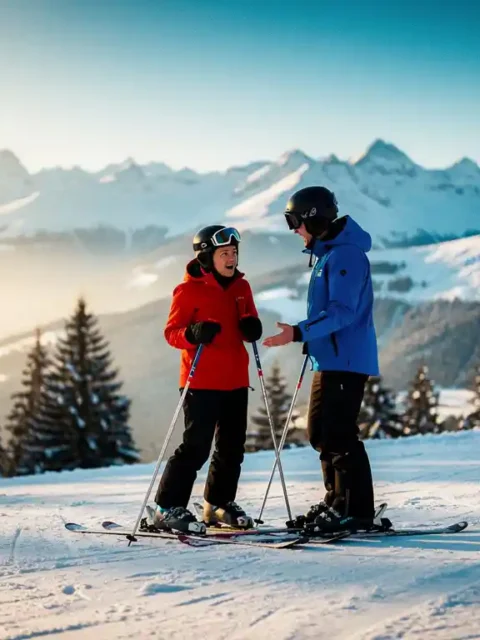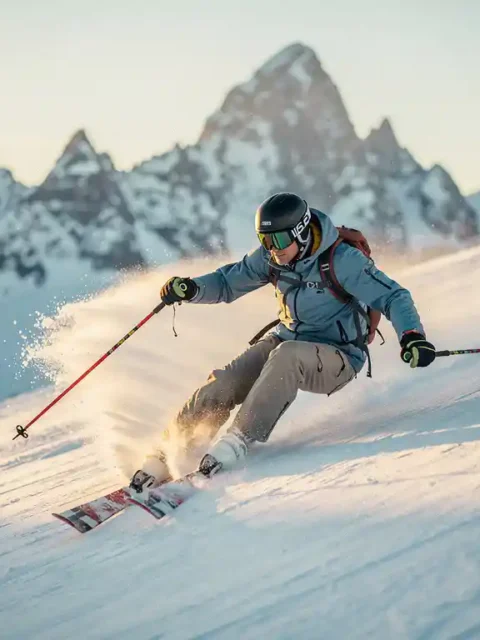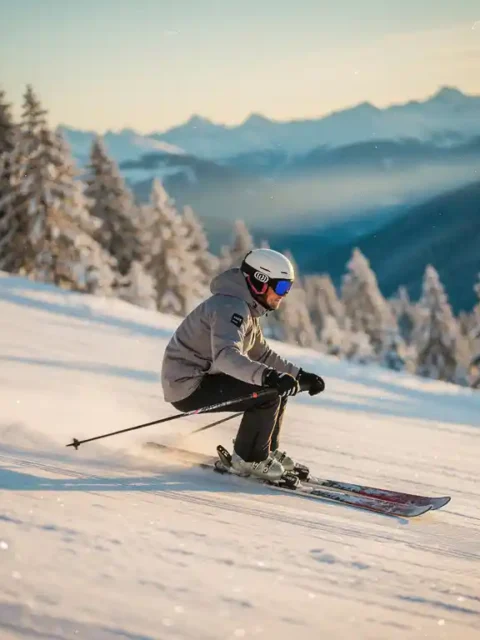

How do you stay in control while skiing?
Staying in control while skiing comes down to managing your speed, maintaining proper body position, and reading the slope before you descend. For beginners, that’s easier said than done — but a few basic principles go a long way. In this article, we answer the most common questions about staying in control on the slopes, from braking to falling safely.
How do you brake as a beginner on skis?
As a beginner, you brake by using the snowplow position: push the heels of your skis outward so the tips point toward each other, forming a V-shape. The wider the V, the more resistance you create and the faster you lose speed. This is the most reliable braking method for those just starting out.
The snowplow — also called the pizza position — gives you direct control over your speed without requiring any complex technique. It works on virtually any slope and gives you time to react to whatever lies ahead.
A common mistake is leaning back when your speed picks up. It feels instinctively safe, but it actually shifts your weight off the front of your skis, reducing your control. Instead, stay slightly forward, keep your knees bent, and actively use the snowplow. Practice this on a quiet, wide slope until it becomes second nature.
What is the correct body position to stay in control?
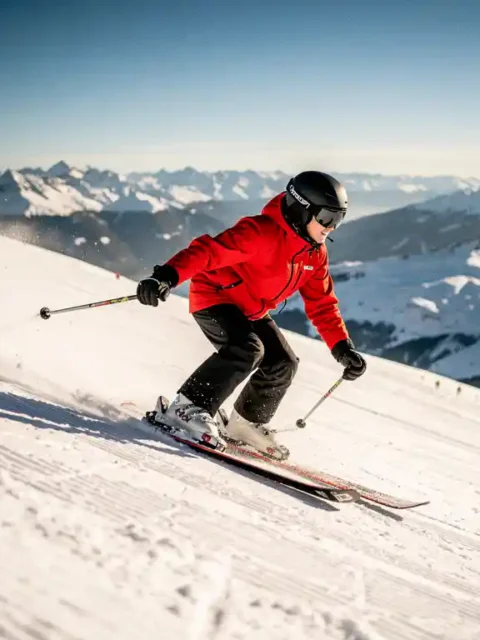
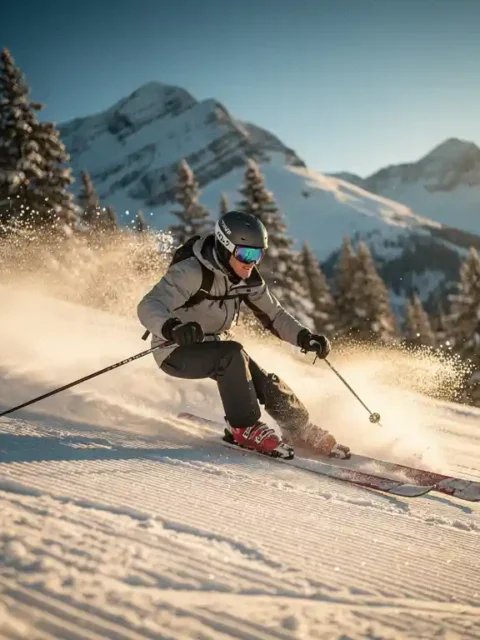
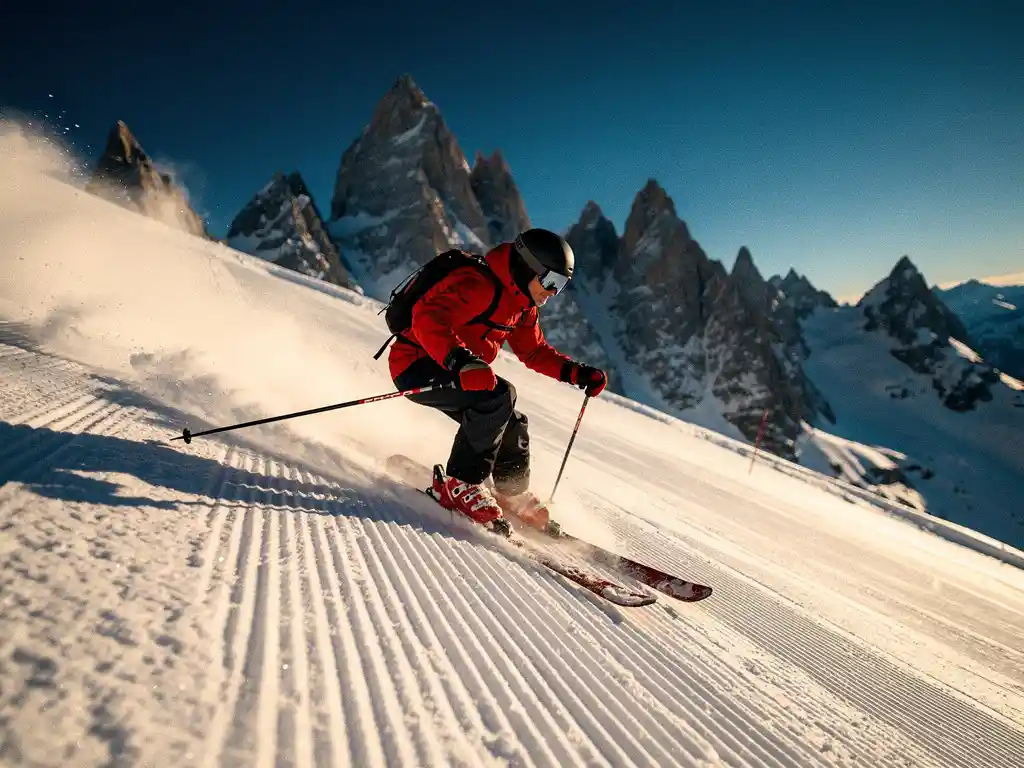
The correct body position for staying in control is a slightly crouched stance with your knees softly bent, your torso leaning slightly forward, and your arms relaxed in front of your body. Distribute your weight evenly across both skis, with a slight emphasis on the front foot. This basic stance gives you stability and responsiveness on the slope.
Think of your body as a spring: loaded but not stiff. Rigid legs don’t absorb shocks, meaning even small bumps in the snow can throw you off balance. Bent knees act as shock absorbers and keep you connected to the slope.
Always look a few meters ahead — not down at your skis. Looking forward allows you to spot turns and obstacles in time and prepare your body accordingly. Your head and gaze unconsciously guide your entire body position, so staring downward will automatically cause you to lose directional control.
How do you use your line on the slope to control speed?
You control your speed by not skiing straight down the slope, but instead taking turns or diagonal lines. By traversing across the slope at an angle or making wide turns, you increase the distance you travel and reduce the amount of direct downhill gradient you’re covering. This automatically lowers your speed.
Imagine drawing a winding path through the snow rather than a straight line to the bottom. The wider the curves, the more you reduce your speed. More advanced skiers use the same principle, but with shorter, quicker turns that they actively execute to manage their pace.
For beginners, it’s smart to opt for wide, gentle turns, using the snowplow at the end of each turn to brake a little extra. This way you combine two techniques and always have a safety net available. Practice this on green or blue runs where you have plenty of space.
Why do you lose control more quickly on steep slopes?
On steep slopes you lose control more quickly because gravity pulls you down harder, causing your speed to build up much faster than on a gentler slope. You have less time to react, mistakes in your posture are amplified, and the psychological pressure of the steepness can lead to muscle tension and poor decisions.
Fear of heights while skiing plays a major role here. Many beginners who find themselves on a steep slope instinctively freeze: they lean back, pull their shoulders up, and are afraid to move. That very reaction makes things more dangerous, because a stiff body has no control over the skis.
What helps on steeper slopes is controlling your speed at the top before you build up too much momentum. Start with a wide traversing line, brake using the snowplow, and only continue when your speed is low enough. Never attempt a slope that is clearly above your ability level — that is the fastest route to losing control and risking injury.
How do you fall safely when you lose control?
When you lose control, the safest way to fall is to deliberately sit down to the side — toward the edge of the slope — with your arms close to your body. Try not to land on your hands and don’t extend your legs out in front of you. A controlled fall to the side is always better than an uncontrolled fall forward or backward.
The reflex to reach out your hands when falling is understandable, but it often leads to wrist injuries. Consciously practice keeping your arms where they are and letting your body drop sideways as a whole. Skis and poles won’t protect themselves, but a good falling technique will protect you.
- Always fall to the side, not forward or backward
- Keep your arms close to your body
- Try not to catch yourself with your hands
- Let your body relax into the fall rather than tensing up
- Once you’ve stopped, check whether your skis are still on and whether you have enough room to stand up
Good protective gear such as a helmet and wrist guards significantly reduces the risk of injury. Especially as a beginner, protective equipment is an absolute necessity, not a luxury.
Does a ski lesson really help with learning control?
Yes, a ski lesson makes an enormous difference when it comes to learning control, because a certified instructor gives you immediate feedback on your posture, technique, and timing. Things you’d barely notice yourself are spotted instantly by an instructor. This means you learn faster and avoid developing bad habits that are hard to break later on.
Practicing on the slopes by yourself has value, but without guidance you don’t always know what you’re doing wrong. An instructor can see whether you’re leaning too far back, keeping your knees too stiff, or not opening your snowplow wide enough. Those small corrections make a huge difference in how quickly you build control.
For beginners who feel nervous or fearful on the slopes, a lesson is especially valuable. A good instructor builds things up gradually, starts on flat terrain, and only increases the difficulty when you’re ready. That builds confidence and helps you see the mountain not as a threat, but as a playground.
How Ski-Pro helps you stay in control on the slopes
Want to learn to ski as a beginner with the right technique and confidence? You’ve come to the right place. Through Ski-Pro, you can easily compare and book ski lessons with more than 250 certified ski schools and instructors throughout the Alps. Whether you’re looking for your first lesson in Winterberg or a full week of powder skiing in Tyrol, we’ll help you find the perfect match.
- Compare hundreds of ski schools by location, price, and level
- Choose between private lessons for personal attention or group lessons for a social experience
- Book easily online, without any hassle
- Find instructors with experience teaching beginners and those who feel anxious on the slopes
Good guidance is the quickest path to control and enjoyment on skis. Find your ski lesson and start your winter sports adventure fully prepared!
Frequently Asked Questions
How quickly can I learn to control my speed on the slopes as a beginner?
Most beginners develop reliable basic speed control after 2 to 3 days of practice on green runs. With professional guidance, this process goes considerably faster, as an instructor will immediately correct mistakes in your posture and braking technique. Consistency and building up gradually are more important than rushing to harder slopes.
What equipment helps me ski more safely and with greater control as a beginner?
As a beginner, a well-fitting helmet and wrist guards are the absolute basics for protection. In addition, ski boots that have been professionally fitted make a huge difference: poorly fitting boots reduce the feel and control you have over your skis. Consider a back protector as well if you plan to practice on steeper slopes.
What should I do if I notice I'm picking up too much speed and start to panic?
Focus immediately on the snowplow and force yourself to lean slightly forward rather than sitting back. Deliberately choose a diagonal line toward the edge of the slope to increase your distance and reduce your speed. If that’s not enough, a controlled fall to the side is always a safer choice than waiting until you’ve completely lost control.
What type of slope is best for practicing control before moving on to harder runs?
Practice control on green (beginner) slopes that are wide, quiet, and relatively flat. Once you’ve fully mastered the snowplow and turns on a green slope without having to think about it, you can carefully move on to blue runs. Never skip the blue stage and jump straight to red or black: each step up in difficulty requires new adjustments in technique and reaction time.