
How do you overcome fear of skiing?
Overcoming ski anxiety means building up gradually, gaining confidence in small steps, and finding the right guidance. Fear on the slopes is completely normal — especially for beginners stepping onto skis for the first time, or for skiers heading back out after a bad fall. In this article, we answer the most frequently asked questions about fear of heights while skiing and share practical tips to help you hit the slopes with greater confidence.
What are the most common causes of ski anxiety?
Ski anxiety usually develops from a combination of fear of heights, a lack of control over speed, and uncertainty about one’s own abilities. For beginners, the unfamiliar environment also plays a major role: steep slopes, busy runs, and the fear of falling can combine to create an overwhelming feeling that gets in the way of enjoyment.
The most common causes are:
- Fear of heights while skiing: Many people underestimate how intense it feels to stand at the top of a slope and look down. That perspective can trigger a panic response, even in people who are not normally afraid of heights.
- Fear of falling: Skiing involves the risk of falling, and that sense of losing control is at the heart of many people’s anxiety.
- Bad early experiences: Anyone who has had an unpleasant fall — as a child or as an adult — carries that memory with them onto the slope.
- Progressing too quickly: Being put on a slope that is too difficult too soon can trigger anxiety. This happens regularly when beginners ski without proper guidance.
- Social pressure: Impatient friends or family, or the feeling that you are holding others back, only makes the anxiety worse.
The good news: all of these causes can be addressed. And the first step is simply recognizing them.
How do you know if you have ski anxiety or are just being cautious?
Ski anxiety differs from ordinary caution in that it prevents you from moving or enjoying yourself at all, whereas caution is a healthy response that keeps you safe. If you are standing at the top of a slope and your body freezes, your breathing stops, or you feel tears welling up, it goes beyond simply paying attention.
A few signs that point to genuine ski anxiety:
- You are literally frozen in place and cannot go up or down the slope, even though you want to.
- You have been mentally avoiding certain slopes or situations for weeks in advance.
- Your heart rate shoots up at the mere thought of putting on skis.
- You panic at small, unexpected movements, such as a slight slip.
Caution, on the other hand, is functional. You ski more slowly, deliberately choose an easier route, or take a short break. That is smart skiing, not anxiety. The difference lies in whether the response helps you or blocks you. Ski anxiety blocks; caution protects.
What techniques help reduce ski anxiety?
The most effective techniques for reducing ski anxiety are controlled exposure, breathing exercises, and consciously breaking challenges down into smaller steps. By gradually expanding your comfort zone, you get used to the feeling of speed and height without becoming overwhelmed.
Mental techniques
Start every ski day with calm breathing before you get on the lift. Breathe in deeply through your nose, hold for four seconds, and breathe out slowly. This calms your nervous system and helps your body come out of fight-or-flight mode. Also visualize your descent before you begin: picture yourself skiing down calmly and in control. That may sound a little abstract, but elite athletes use this technique every day.
Practical techniques on the slope
Deliberately choose slopes that are slightly easier than what you can handle. That feeling of success is invaluable for your confidence. Also practice braking and stopping until it becomes second nature, because much of ski anxiety is fundamentally a fear of not being able to stop. It also helps to keep your gaze horizontal rather than looking down. The slope will appear less steep, and you will maintain your balance more easily.
Does a private ski lesson help with overcoming ski anxiety?
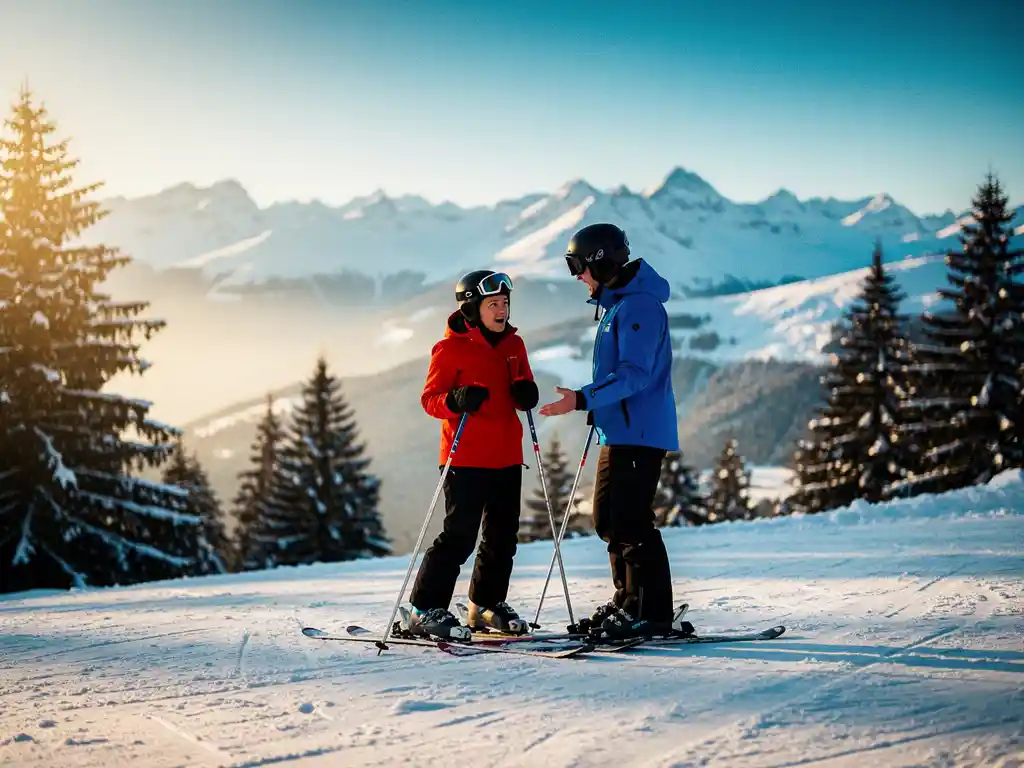
Yes, a private ski lesson is one of the most effective ways to overcome ski anxiety. A private instructor adapts the pace entirely to your level, provides direct feedback, and works with you to build confidence in a safe, personalized environment — without the pressure of a group.
In a group lesson, the pace is set by the group, not by you. If you are anxious, that can create additional stress. In a private lesson, your experience is the priority. A good instructor recognizes when you hesitate, adjusts the exercise accordingly, and encourages you at exactly the right moment. That makes a world of difference.
In addition, a private lesson allows you to work specifically on the situations that trigger the most anxiety for you — whether that is a particular type of slope, speed, or the feeling of height on an open run. That targeted approach accelerates your progress enormously.
What should you do if you freeze with fear in the middle of a slope?
If you freeze with fear in the middle of a slope, stop, turn your skis across the fall line so you can no longer slide, and focus on your breathing first. Do not try to force anything. Give yourself permission to pause and take stock of the situation before continuing.
Steps to get through a moment like that:
- Turn your skis across the slope. This immediately gives you stability and prevents you from sliding further.
- Breathe deliberately. Three deep breaths in and out. This breaks the panic response in your body.
- Look horizontally, not down. Fix your gaze on a point straight ahead, not on the drop below.
- Break the descent into small sections. Do not look at the entire slope — instead, pick a single point ten meters ahead as your goal.
- Ask for help. Slope patrol, instructors, and fellow skiers are happy to assist. There is absolutely nothing to be embarrassed about.
Remember: everyone has a moment of doubt on the slopes at some point. It is not failure — it is human.
How do you rebuild your confidence after a fall?
After a fall, the best way to rebuild your confidence is to get back on skis as soon as possible on a slope that is clearly within your ability. That may sound too simple, but breaking the negative association is crucial. The longer you wait, the larger the fear grows in your mind.
After a fall, always start on a blue or even a green run — even if you normally ski red. Give yourself the space to prove that you can do it, without the pressure of a challenging descent. Consciously celebrate small wins: every good turn, every smooth stop is a victory.
Talk about your fall as well — with friends, family, or an instructor. It helps to process the experience and put the feeling in perspective. A fall is part of skiing, even for advanced skiers. It is not proof that you cannot do it; it is proof that you are trying.
Give yourself time, too. Recovering from ski anxiety after a fall does not always happen in a single day. Sometimes it takes a few ski trips to fully regain your confidence, and that is completely normal.
How Ski-Pro helps you overcome ski anxiety
Overcoming ski anxiety starts with the right guidance — and finding that guidance is exactly what we do best. Through Ski-Pro, you can easily compare and book lessons with more than 250 certified ski schools and instructors across the Alps. Whether you are looking for a patient private instructor in Tyrol or a beginner course in Switzerland, we help you find the perfect match.
Here is what we do for you when you want to tackle ski anxiety:
- Compare private and group lessons by location, price, and availability, so you can choose exactly the lesson that suits your situation.
- Filter by level, including specific options for beginners and people returning to skiing after a long break.
- Read reviews from other skiers to see which instructors are patient and understanding — including with people who experience fear of heights while skiing.
- Book quickly and transparently, with no surprises afterward in price or availability.
Ready to leave that fear behind and truly enjoy the slopes? Find your perfect ski lesson and start your adventure fully prepared.
Frequently Asked Questions
How long does it take to fully overcome ski anxiety?
It varies from person to person and depends on the cause and severity of your anxiety. Some skiers notice a significant difference after just one or two private lessons, while others need several ski trips to fully regain their confidence. The most important thing is to work at your own pace and celebrate small wins, because consistent, positive experiences on the slopes are the fastest route to recovery.
Can I overcome ski anxiety without professional guidance?
It is possible to work on your ski anxiety on your own, but professional guidance significantly speeds up the process and prevents you from unknowingly developing bad habits. A certified instructor can identify exactly where your block lies and tailor exercises specifically to your anxiety. If you do prefer to start independently, deliberately choose easy green or blue runs and never go alone.
What is the difference between a private lesson and a group lesson when I have ski anxiety?
In a group lesson, the pace is set by the group, which can create extra pressure and stress for someone with ski anxiety. A private lesson revolves entirely around you: the instructor adapts the pace, the slope, and the exercises to how you are feeling in that moment. For people with ski anxiety, a private lesson is therefore almost always the better choice, especially at the beginning.
Is it a good idea to give anxious children private lessons, or does a children's group lesson work better?
For anxious children, a small children’s group lesson can actually work well, because the social dynamic with peers is motivating and the feeling of ‘I’m not the only one’ is reassuring. That said, the same principle applies here: if a child is truly stuck or blocked, a private lesson offers more room for individual attention and a calm pace. Always discuss your child’s situation with the ski school beforehand so they can advise on the best approach.