
How do you find peace and relaxation while skiing?
Finding calm while skiing comes down to breathing deliberately, maintaining a relaxed posture, and adjusting your pace to what your body can handle. Tension on the slopes is completely normal, especially as a beginner, but with the right techniques that nervousness quickly fades into the background. In this article, we answer the most frequently asked questions about relaxed skiing, from breathing and posture to the role of ski lessons.
Why are beginner skiers so tense on the slopes?
Beginner skiers are tense on the slopes because everything feels new and unpredictable. You’re standing on two narrow planks, the slope drops away beneath you, and your brain sends a clear signal: watch out. That tension is a natural response to an unfamiliar situation, and for many people it’s also tied to a fear of heights while skiing or a fear of speed and falling.
The slope looks steeper than it actually is at first. Eyes judge inclines on snow differently than on flat ground, which amplifies the sense of danger. On top of that, you’re wearing unfamiliar equipment, your feet are locked into your skis, and you have little control over your movements. That’s a combination that’s guaranteed to create tension.
Social pressure also plays a role. On the slope, others around you glide down effortlessly, and comparing yourself to them is counterproductive. Many beginners are afraid of falling in front of others, which tightens the muscles even further and actually increases the chance of falling. Relaxation, then, also starts in your head.
Which breathing techniques help you relax while skiing?
Conscious, deep breathing is the fastest way to calm your nervous system while skiing. Many beginners unconsciously hold their breath out of fear, causing muscles to tighten and control to decrease. By breathing rhythmically — exhaling through turns and inhaling during the rest phase — you restore your focus and relax your body immediately.
A simple technique is so-called diaphragmatic breathing. Inhale through your nose, let your belly expand, and slowly exhale through your mouth. Do this deliberately before starting a descent, and repeat it throughout. After just a few breaths, you’ll notice your shoulders drop and your grip on your poles becomes less tense.
Combine breathing with an internal rhythm. Mentally say “out” as you initiate a turn and “in” as you complete it. This gives you something to focus on, draws your attention away from fear, and synchronizes your movements in a natural way. Ski instructors frequently use these kinds of rhythm techniques with nervous beginners who experience a fear of heights while skiing.
How does good posture help you ski more calmly?
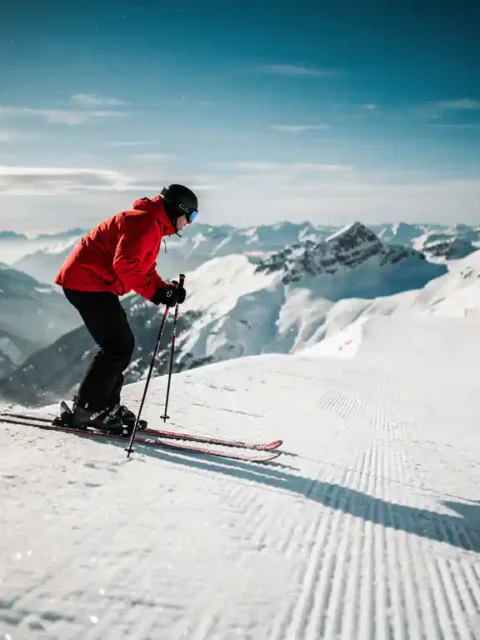
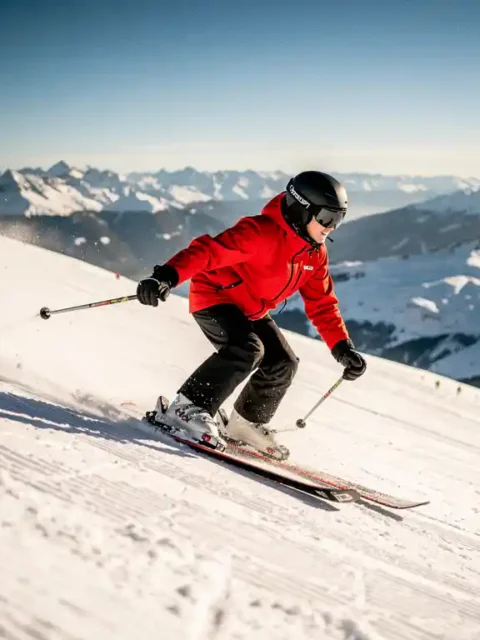
Good ski posture gives you more control, and more control means less fear. The basic stance for beginners is: knees slightly bent, weight forward over the tips of your boots, back straight but relaxed, and arms slightly forward. In this position you work with your skis rather than against them, which immediately makes skiing feel calmer.
Many beginners make the mistake of leaning back when they’re scared. It feels safer, but the effect is the opposite: the skis actually go faster and become harder to steer. By consciously shifting your weight forward, you engage the edges of your skis and gain grip on the snow. Grip feels safe, and safe feels relaxed.
Pay attention to your shoulders and hands as well. Tense shoulders raised up, arms stiff at your sides — these are signs that your body is in defensive mode. Shake out your arms, let your shoulders drop, and hold your poles lightly. Those small adjustments send a signal to your brain that everything is under control.
Do private lessons or group lessons help beginners relax faster?
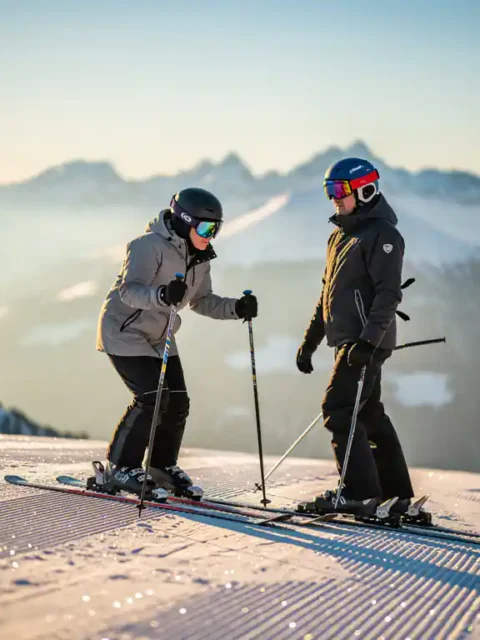
Private lessons help most beginners relax faster than group lessons, because the instructor gives you their full attention and adjusts the pace to your comfort level. There’s no group pressure, no waiting for others, and the instructor can immediately see when your tension is building and adapt their approach accordingly.
In a group lesson you learn in a social setting, which can actually be relaxing for some beginners. You see that others are struggling too, you laugh together about a tumble, and the group dynamic can lower the threshold. Group lessons are also less expensive, which is a practical advantage for many people.
The choice depends on your personality and learning style. If you’re someone who gets intimidated easily or struggles with a fear of heights while skiing, private lessons generally provide more calm and confidence. If you prefer learning in the company of others, a small group lesson can work just as well. Both options are available through our platform, where you can easily filter by lesson type, location, and price range.
When is a beginner ready for a more difficult slope?
A beginner is ready for a more difficult slope when they can descend their current slope comfortably and in control — without tension and without needing to seek out the edges. It’s not about speed or technical perfection, but about the feeling of control and relaxation at your current level.
Concrete signs that you’re ready to move up:
- You can set your own pace and brake deliberately whenever you want
- You make turns without having to think about them
- You breathe normally and your shoulders are relaxed during the descent
- You don’t feel relieved when you reach the bottom — just comfortable
- Your ski instructor indicates that you are technically ready for the next step
Never force the step out of impatience. Tackling a more difficult slope while you’re still tense on your current one is counterproductive. It increases the risk of falling, reinforces fear, and sets your learning progress back. Trust your instructor’s judgment and enjoy the feeling of mastery on the slope you already know.
What mental tips do ski instructors use for nervous beginners?
Experienced ski instructors use a combination of focus techniques, positive reframing, and goal-setting to help nervous beginners relax. The core principle is always the same: shift attention away from fear and onto something concrete and manageable, such as a point further down the slope or a specific movement.
Focus on a point ahead
Don’t look at your skis, and don’t try to take in the entire bottom of the slope at once. Pick a point about ten meters ahead and ski toward it. Then choose the next point. This technique reduces the mental burden of “having to get all the way down the mountain” into small, achievable segments. It’s a classic technique used by ski instructors worldwide with beginners who experience a fear of heights while skiing.
Reframe the thought
Instead of “I’m going to fall,” practice thinking “I’m going to make a turn.” Instead of “this is too steep,” tell yourself “I choose my own pace.” That small shift in language has a measurable effect on how your body responds. Fear lives largely in the stories we tell ourselves, and you can consciously rewrite those stories.
How Ski-Pro helps you learn to ski with confidence
Learning to ski in a relaxed way starts with the right instructor on the right slope. We understand that as a beginner, choosing from hundreds of ski schools can feel overwhelming — especially if you also struggle with a fear of heights while skiing. That’s why we offer a platform where you can quickly and easily find the perfect lesson to suit you.
Here’s what you can expect from us:
- Compare more than 250 certified ski schools and instructors in the Alps
- Filter by lesson type: private or group lessons, depending on what helps you relax fastest
- Transparent pricing, so there are no surprises on your winter sports holiday
- Lessons for all levels, from absolute beginners to advanced skiers
- Destinations in Austria, Switzerland, France, and Germany
Whether you’re dreaming of your first day on the slopes in Tyrol or a gentle introduction in Winterberg, you’ve come to the right place. Compare and book your ski lesson and take the first step toward a relaxed and unforgettable winter sports experience.
Frequently Asked Questions
What should I do if I freeze halfway down the slope due to panic?
Stop in a safe spot at the edge of the slope and use the diaphragmatic breathing technique: inhale through your nose, let your belly expand, and slowly exhale through your mouth. Do this three to five times deliberately before continuing. Then pick one point ten meters ahead and ski calmly toward it, rather than thinking about the full descent. If the panic happens repeatedly, it’s a good idea to book a private lesson so an instructor can personally guide you through these moments.
Does it help to practice relaxation techniques at home before my ski trip?
Yes, absolutely. Diaphragmatic breathing and mental visualization can easily be practiced at home: imagine yourself skiing down a slope, breathe rhythmically, and repeat positive phrases such as ‘I set my own pace.’ This trains your brain to stay in a relaxed state when you’re actually on the slope. The more familiar the techniques feel before you leave, the easier it is to apply them when tension really starts to build.
Does it matter which ski resort I choose as a nervous beginner?
Absolutely. Choose a resort with wide, quiet blue runs and low crowds, so you have the space to practice at your own pace without feeling rushed. Destinations like Winterberg or certain quieter areas in Tyrol are ideal for beginners who want to learn to ski in a relaxed setting. Through Ski-Pro you can easily filter by destination and lesson type, so you can find an environment that suits your comfort level.
How quickly is it normal to lose the tension as a beginner?
Most beginners notice a clear difference in relaxation after just one or two lessons, especially when they actively work on breathing and posture. Feeling fully relaxed on the slopes is a process that varies from person to person and also depends on factors such as a fear of heights and previous experience with sports. Be patient with yourself and use your instructor’s assessment as your benchmark — not the pace of those around you.