
How do you overcome a mental block while skiing?
You can overcome a mental block while skiing by acknowledging your fear, controlling your breathing, and gradually pushing your comfort zone. Fear of skiing is a normal response from your body to an unfamiliar environment and changes in elevation. With the right techniques and guidance, you’ll learn to ski down the slopes in a relaxed way faster than you think.
Whether you’re dealing with a fear of heights while skiing or simply feeling nervous on your first day on the slopes — you are definitely not alone. Below, we answer the most frequently asked questions about ski anxiety and mental blocks, so you can hit the mountain with confidence.
What causes fear and mental blocks on the ski slope?
Fear and mental blocks on the ski slope arise from a combination of unfamiliarity, elevation change, and a lack of control. Your brain registers the steep incline, the speed, and the slippery surface as potential danger and automatically switches into a fight-or-flight response. This is an ancient survival mechanism — not a sign of weakness.
For many beginners, a fear of heights while skiing plays a major role. Even if you’re not normally afraid of heights in everyday life, the perspective of a ski slope — with a sharp drop right in front of you — can be an entirely different experience. You’re standing on narrow skis, the snow is slippery, and you don’t yet know how to stop. Objectively speaking, that’s a challenging situation.
Other common causes include:
- A previous fall or accident that has damaged your confidence
- Social pressure from friends or family who are more advanced
- A lack of basic technical skills, leaving you feeling out of control
- Negative stories about ski accidents you’ve heard beforehand
- Fatigue or cold, which reduce your mental resilience
The good news is that all of these causes can be addressed. Fear on the slopes is rarely irrational, but almost always surmountable.
How do you know if you have a mental block while skiing?
You have a mental block while skiing when your body freezes the moment you want to head down the slope, even though you technically know how to do it. It’s the difference between “I can’t do it” and “I don’t dare to do it.” Your muscles tense up, your breathing quickens, and your thoughts jump to the worst-case scenario.
Recognizable signs of a mental block include:
- You’re standing at the top of the slope and can’t take a single step, even though you ski just fine on gentler inclines
- You unconsciously stiffen your body, which actually makes it harder to steer
- You’re constantly thinking about falling instead of focusing on technique
- You avoid certain slopes or situations, even when your instructor says you’re ready for them
- You feel a wave of panic when getting on the ski lift
The distinction from a technical problem is important. If you ski smoothly on a calm blue run but freeze completely on a red slope, the block is most likely mental in nature. Your body already knows what to do — your mind just won’t give it permission.
Which breathing and relaxation techniques help on the slope?
Controlled breathing is the fastest way to break through a mental block on the slope. By consciously breathing more slowly and deeply, you send a signal to your nervous system that it’s safe. This lowers your heart rate, relaxes your muscles, and gives your mind the space to think clearly.
Belly breathing for acute tension
Stand still on a flat section and breathe in through your nose for four counts, hold for two counts, and breathe out slowly through your mouth for six counts. Repeat this three to five times. You’ll notice your shoulders dropping and your grip on your ski poles loosening. That’s exactly the relaxation you need before tackling a difficult slope.
Visualization as mental preparation
Visualization is a technique used by many winter sports athletes: imagine yourself gliding down the slope smoothly and confidently before you actually go. Close your eyes, breathe calmly, and picture yourself making elegant turns. This might sound a little abstract, but it works because your brain can barely distinguish between a vivid mental image and reality. You’re literally training your confidence from a standstill.
Other useful relaxation techniques on the slope include:
- Consciously bending your knees slightly to release tension in your legs
- Actively dropping your shoulders when you notice you’re hunching them up
- Repeating a calm word or phrase, such as “smooth and easy,” to direct your focus
- Setting small goals, such as “I’ll ski to that tree and stop there for a moment”
How does a ski instructor help you overcome ski anxiety?
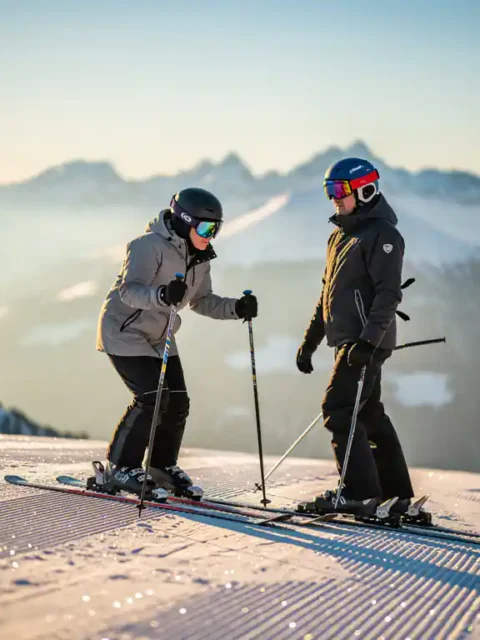
An experienced ski instructor helps with ski anxiety by not only teaching technique, but also building your confidence step by step. A good instructor recognizes mental blocks, adjusts the pace to your needs, and creates a safe environment where you feel free to experiment without judgment.
Private lessons are often more effective than group lessons when it comes to ski anxiety. In a group, social pressure can reinforce your block, whereas a private instructor is entirely focused on you. They can tailor the slope, pace, and exercises to exactly the moment when you’re ready for the next step.
What a good ski instructor does in practice when dealing with a fear of heights or ski anxiety:
- Starts on slopes that are well within your comfort zone, even if they’re technically easier than your skill level
- Explains why certain movements are safe, so your brain can be reassured
- Uses positive reinforcement rather than criticism
- Builds up successful experiences so your confidence grows before you even realize it
- Adjusts the lesson plan depending on how much or how little tension you feel on any given day
Which slope or exercise is the best starting point for nervous beginners?
The best starting point for nervous beginners is a flat or gently sloping practice area, also known as a magic carpet zone or beginner’s area. Here you learn the basic movements without speed or elevation posing any threat. You build confidence from the bottom up — not the other way around.
Start with these exercises in order:
- Feel how skis glide: Stand on a nearly flat section and let yourself slowly glide forward without doing anything. Get familiar with the feeling of movement without fear.
- Learn the snowplow: Point the tips of your skis slightly toward each other and slow yourself down. This gives you a sense of control, which directly reduces anxiety.
- Small turns on a blue run: Once you can brake, practice calm, wide turns on the easiest slope in the ski area.
- Repeat the stopping exercise: Deliberately practice stopping in different spots so you always feel like you’re in control of your speed.
Resist the temptation to move to a harder slope too quickly, even if others encourage you to do so. Every successful experience on an easy slope lays a foundation of confidence that you can draw on later when tackling steeper terrain.
When is ski anxiety normal, and when does it call for extra help?
Ski anxiety is completely normal when you’re new to the slopes or facing a challenging situation. Almost every beginner feels nervous on their first day. When the anxiety is so intense that you freeze completely, can no longer enjoy yourself, or experience physical symptoms such as hyperventilation or panic attacks, professional support becomes worthwhile.
Normal ski anxiety is characterized by:
- Nerves before a new slope that fade once you get going
- Caution that protects you rather than holds you back
- Fear that decreases as you gain more experience
Extra help is a good idea if:
- Your anxiety doesn’t improve — or even worsens — after several days of lessons
- You experience panic attacks on the slope or in the ski lift
- You have trouble sleeping or feel extreme tension in the days leading up to a ski day
- A previous fall or accident has had a traumatic impact on you
In that case, it may help to speak with a sports psychologist or coach who specializes in performance anxiety, in addition to taking ski lessons. Ski anxiety rooted in a traumatic experience calls for a different approach than ordinary beginner nerves.
How Ski-Pro helps you overcome ski anxiety
We understand better than anyone how overwhelming those first steps on skis can feel — especially when a fear of heights is part of the picture. That’s why we do everything we can to match you with the instructor who fits your situation perfectly. Through our platform, you can quickly find the right guidance, whether you’re looking for a calm private lesson or a small group of people in the same boat.
Here’s what we take care of for you:
- Compare more than 250 certified ski schools in the Alps by location, price, and availability
- Filter by private lessons — ideal when you need extra attention for ski anxiety
- Read reviews from other winter sports enthusiasts about instructors and their teaching style
- Book easily online, without any hassle, so you can focus on enjoying the slopes
Ready to take that first step? Compare and book your ski lesson and head up the mountain fully prepared. Because once you’re at the bottom — wind in your hair and a smile from ear to ear — you’ll know: it was absolutely worth it.
Frequently Asked Questions
Can I overcome ski anxiety without professional help?
In many cases, mild ski anxiety and beginner nerves can be overcome on your own with the right techniques, such as controlled breathing, visualization, and gradually pushing your comfort zone. That said, guidance from an experienced ski instructor is strongly recommended, as they can recognize your blocks and tailor the pace precisely to you. For more severe anxiety — such as panic attacks or fear stemming from trauma — a sports psychologist is the better choice.
How long does it take to get over ski anxiety?
It varies from person to person and depends on the cause and severity of the anxiety. Many beginners notice a clear improvement after just one or two private lessons, as successful experiences quickly build confidence. If the anxiety has a deeper root cause — such as a previous fall or a fear of heights — it may take several ski days or even multiple seasons before you truly feel relaxed on the slopes.
What type of ski lesson is best suited for someone with ski anxiety?
A private lesson is by far the most effective option for ski anxiety, as you won’t experience social pressure from other students and the instructor can give you their full attention. Through platforms like Ski-Pro, you can easily filter by private lessons and compare instructors based on their approach and reviews. That way, you can choose the guidance that best matches your situation and pace.
What should I do if I completely freeze with fear halfway down the slope?
Stop in a safe spot at the side of the slope, stand up straight, and immediately do a few rounds of belly breathing: inhale for four counts, hold for two counts, and exhale for six counts. Then set a small, achievable goal — such as skiing to the next flat section — rather than looking at the entire slope at once. If the anxiety persists, don’t hesitate to call your ski instructor or leave the slope via an alternative route.