
What are the different piste colors?
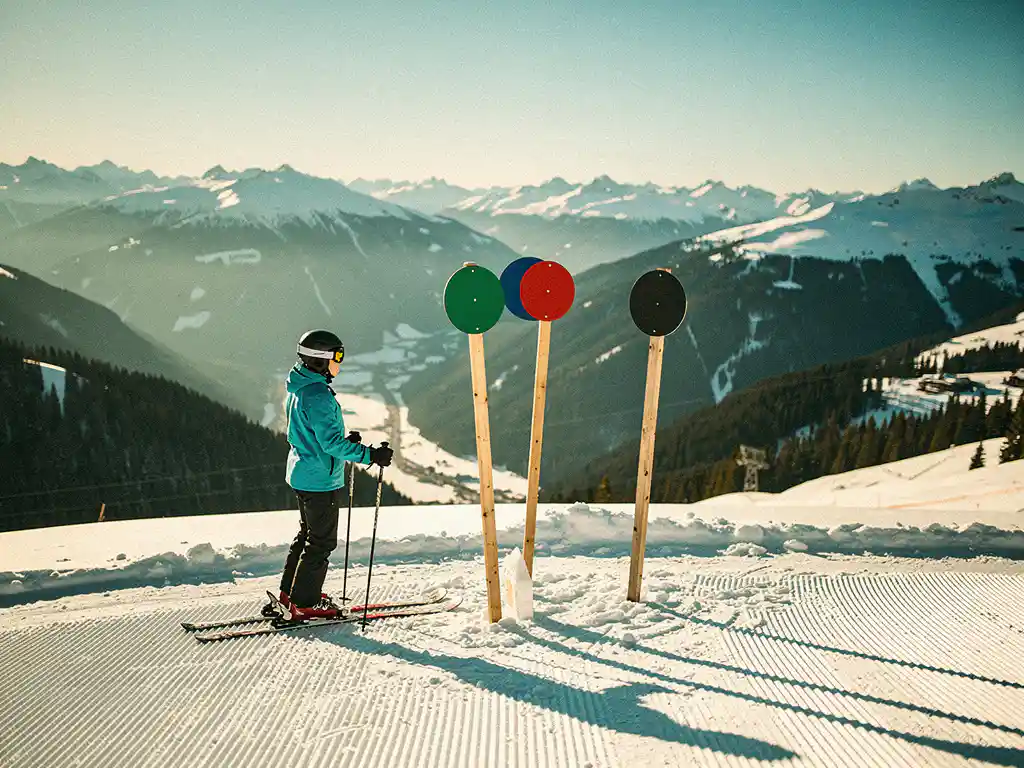
In the Alps, there are four official piste colors: green, blue, red, and black. Each color indicates the difficulty level of a run, ranging from the easiest slopes for absolute beginners to the steep challenges for advanced skiers. Not every ski resort uses all four colors, but the system is virtually the same throughout the Alps. In this article, we answer the most frequently asked questions about piste colors, so you’ll know exactly where to start and when you’re ready for the next step.
How many piste colors are there in the Alps?
In the Alps, four piste colors are used to indicate difficulty level: green, blue, red, and black. Green is the easiest category, followed by blue, red, and black as the most challenging. This color system helps skiers and snowboarders quickly determine which runs match their ability level.
The system has not been officially standardized by a single European authority, but it is applied in virtually the same way across most Alpine countries. Whether you’re skiing in Austria, Switzerland, France, or Italy, you can rely on the piste color as a dependable indication of what to expect. This makes navigating the mountain far less stressful, especially when you’re skiing in a new resort for the first time.
Some ski resorts add a fifth category: the orange or yellow run, used for freeride or ungroomed areas. However, this is not an official part of the standard system and is only seen occasionally.
What is the difference between a blue and a red run?
The biggest difference between a blue and a red run is the steepness and technical challenge. Blue runs are wide, relatively flat, and have an average gradient of around 25 percent. Red runs are steeper, sometimes narrower, and require greater control over speed and technique. They are intended for skiers with a solid foundation of basic skills.
On a blue run, you can practice your turns at a comfortable pace without the slope catching you off guard. Speed remains manageable and you have plenty of room to make and correct mistakes. That makes blue the ideal level for progressing from beginner to confident intermediate.
A red run demands more from you. The slope is steeper, meaning you accelerate faster and need to execute your turns with proper technique to stay in control. The terrain also varies more: you may encounter narrower sections, moguls, or uneven snow. Many skiers find the transition from blue to red to be the biggest step in their development.
Which run is suitable for absolute beginners?
For absolute beginners, green runs are the best choice. These runs have a minimal gradient, are wide, and are well maintained. They are specifically designed for people who are on skis or a snowboard for the first time and still need to learn how to brake, steer, and keep their balance.
Not every ski resort has green runs. In that case, the easiest blue runs are the starting point for beginners. Look at the trail map for blue routes that are close to the valley floor or labeled as “easy.” If in doubt, ask your ski instructor which route best suits your level.
Your first day on skis is exciting, but also challenging. A good ski lesson makes an enormous difference: you not only learn the correct technique, but also how to safely interact with other skiers and how to read the piste colors. This way, you’ll build enough confidence to move from the green to the blue run in no time.
When are you ready for a black run?
You are ready for a black run when you can descend red runs comfortably and in control, even at higher speeds and in varying snow conditions. Black runs are steep, technically demanding, and require a solid parallel technique with active speed management.
There are a few concrete skills you need to have mastered before tackling a black run:
- You make smooth parallel turns without snowplowing
- You can consciously control your speed, even on steep sections
- You feel comfortable on different types of snow, such as hard or uneven snow
- You can adjust your line for narrow sections or other skiers
- You don’t panic at a steep entry
Black runs vary greatly in difficulty. A black run in a small ski resort can be easier than a red in a large, steep resort. So don’t rely on the color alone — also consider the gradient and the terrain. If in doubt, take a look at the top of the run before committing to it.
Are piste colors the same in every ski resort?
Piste colors are not officially standardized and can vary slightly in interpretation from resort to resort. A red run in one ski area may feel like a blue in another. The system is a guideline, not an exact science, and every resort applies it based on its own terrain.
In North America, a different system is used: green (easy), blue (intermediate), black (difficult), and double black (expert). There is no red in the American system, which can sometimes be confusing for European skiers skiing in the US or Canada for the first time.
Within Europe, the colors are fairly consistent, but the difficulty level for each color can vary considerably. A large, technical resort like Verbier or Val-d’Isère has black runs that are far more challenging than the black runs at a smaller German ski area like Winterberg. Always use the piste colors as a starting point, but combine that with the trail map, local advice, and your own feel on the slopes.
How Ski-Pro helps you find the right run
Knowing what the piste colors mean is one thing, but finding the right ski lesson that matches your level is another matter entirely. That’s where we come in. Through our platform, you can easily compare more than 250 certified ski schools and instructors in the Alps, so you can get started with confidence — whether you’re stepping onto a green run for the first time or ready to take on your first black run.
Here’s what we take care of for you:
- Compare ski schools by location, price, level, and availability
- Private or group lessons: we help you make the best choice for your situation
- Lessons for every level, from absolute beginners on green runs to advanced skiers looking to conquer the black
- Transparent pricing with no surprises afterward
- Easy online booking in just a few clicks
Ready to hit the slopes? Compare and book your ski lesson and start your winter sports adventure fully prepared.
Frequently Asked Questions
Can I ski a blue run as a complete beginner if there are no green runs?
Yes, you can, but it is strongly recommended to do so under the guidance of a ski instructor. Not every ski resort has green runs, and the easiest blue runs are the alternative in that case. A certified instructor will help you pick up the basics quickly, so you can get down the slope safely and confidently — even if it’s a little steeper than a green run.
How long does it typically take to progress from a blue to a red run?
It varies from person to person, but most recreational skiers are ready for a red run after two to five ski weeks. Factors such as taking lessons, the frequency of your ski holidays, and your athletic background all play a significant role. With targeted private lessons, you can accelerate this progression considerably.
What should I do if I accidentally end up on a run that's too difficult?
Don’t panic and don’t force it. Ski slowly and in control, making wide, gentle turns toward the side of the run, away from the busy center. If the slope is truly too steep to descend safely, you can sideslip down or, as a last resort, leave the run via a lift connection or seek assistance from the ski patrol. Prevention is better: always check the trail map and ask for local advice before heading down a new run.
Do the piste colors in Europe also apply to snowboarders?
Yes, the piste color system applies to both skiers and snowboarders. The difficulty level based on gradient and terrain is the same for both sports. However, the transition between levels may feel different for snowboarders — many snowboarders find flat sections on green runs more difficult than skiers do, while steep red or black runs can actually be very manageable with the right technique.