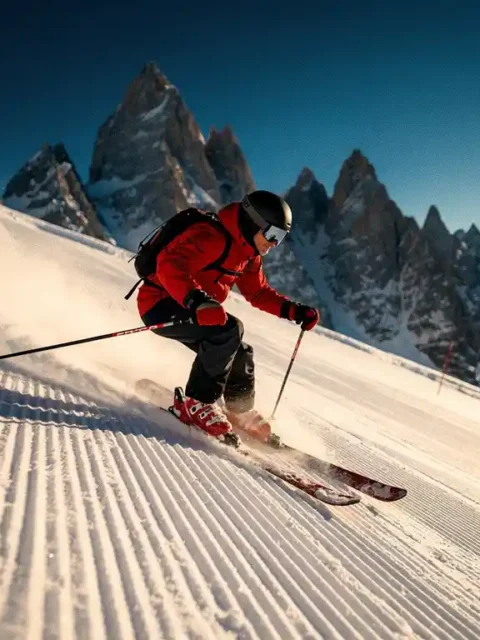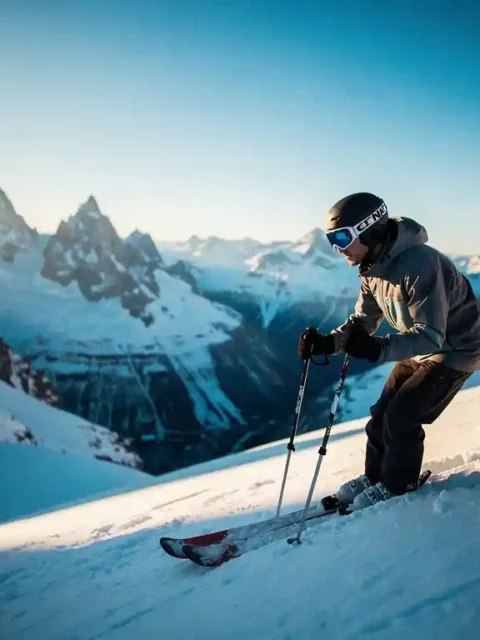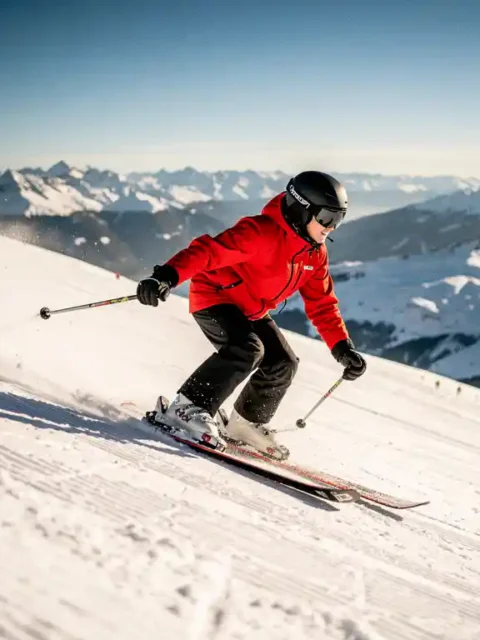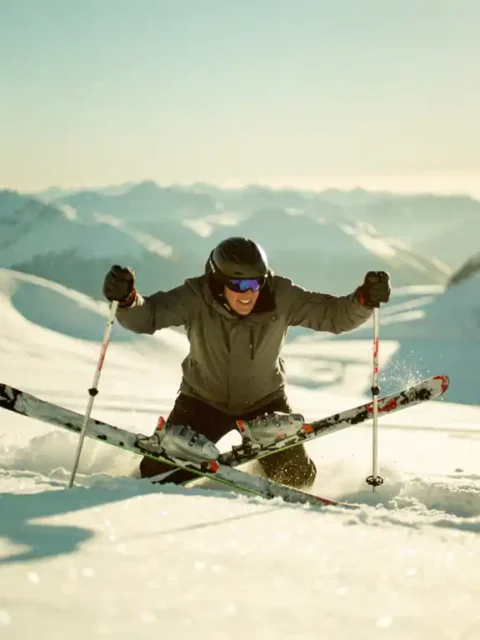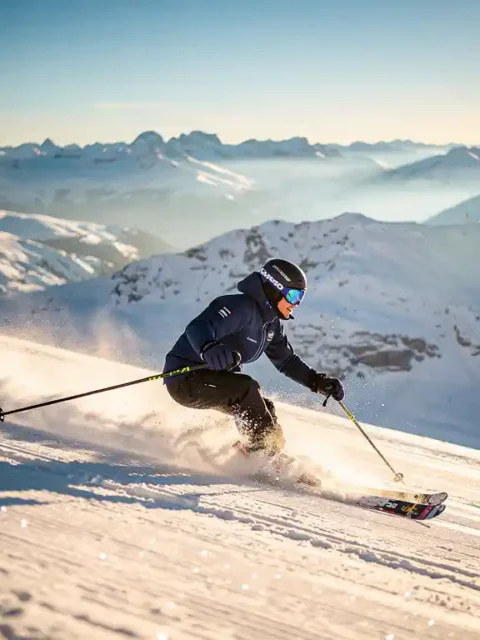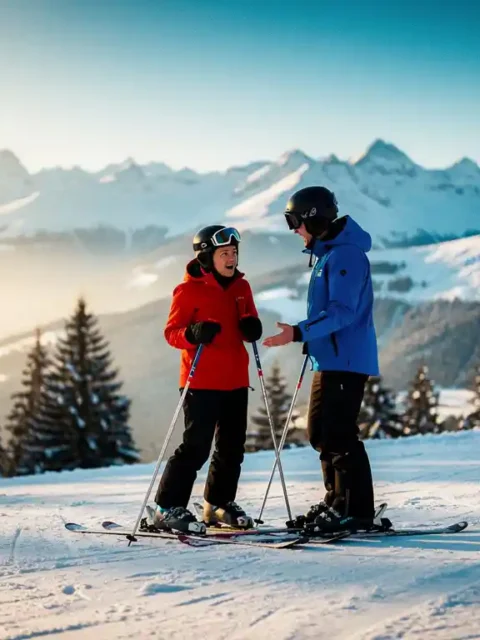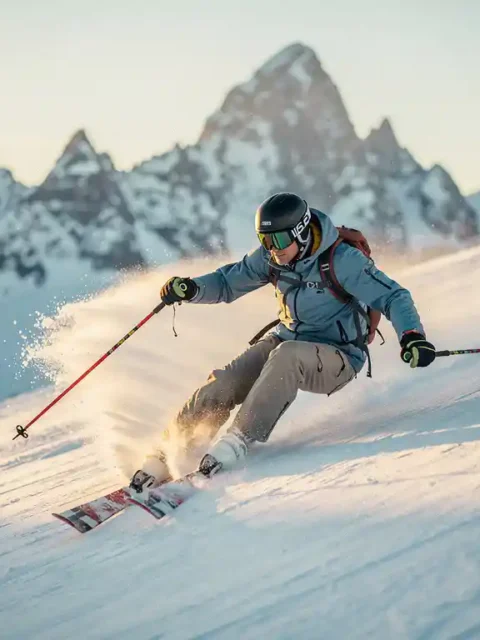

Why is relaxation so important when you’re taking your first turns on skis?
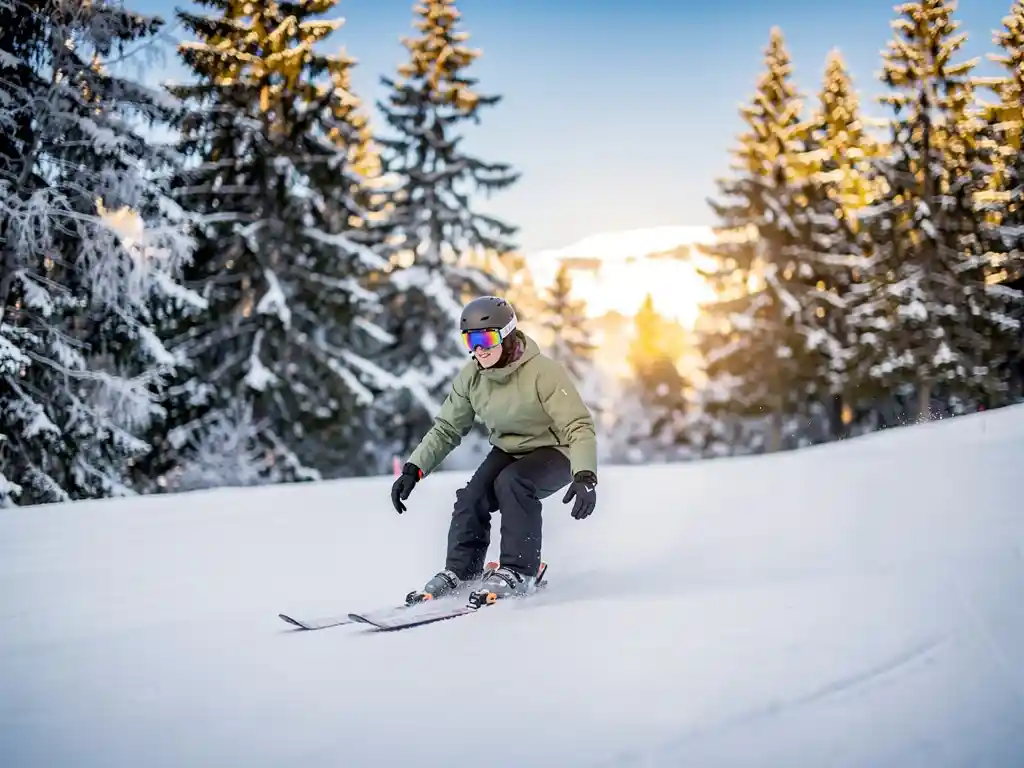
Relaxation is crucial during your first ski turns because a tense body reacts to the slope in a stiff and uncontrollable way, which leads to falls and frustration. Skiers who are relaxed can balance better, react faster, and feel the movements of their skis. Below, we answer the most frequently asked questions about tension, relaxation, and how beginners can start enjoying the snow more quickly.
What happens to your body when you ski while tense?
When you ski while tense, your muscles seize up and you lose the fine motor control you need for smooth, controlled turns. Your joints become stiff, your center of gravity shifts backward, and your skis respond more slowly to your steering input. The result: you lose your balance more easily and the risk of falling increases.
Tension is actually a survival response from your body. When you find something exciting or threatening, your nervous system switches into a kind of alarm mode. Muscles contract, breathing becomes shallower, and your focus narrows. On skis, this shows up as raised shoulders, bent knees positioned too far forward or backward, and arms hanging stiffly at your sides instead of swinging loosely out in front of you.
What many beginners don’t realize is that stiffness also disrupts the communication between your feet and your skis. Skis are designed to respond to subtle weight shifts. A tense body blocks those signals. You end up skiing against your own equipment, which makes learning your first turns unnecessarily difficult.
Why do beginners learn faster when they’re relaxed?
Relaxed beginners learn to ski faster because their bodies are open to new movement patterns. When you’re relaxed, you can consciously feel how your weight shifts, how the ski tilts, and how the snow feels beneath the sole of your boot. That sensory feedback is the foundation of all good ski instruction.
Motor learning — the process by which your brain acquires and automates new movements — works considerably better in a relaxed state. Tension activates the amygdala, the part of your brain that responds to danger, and that actually suppresses the brain regions responsible for learning new skills. Simply put: an anxious brain learns less effectively than a calm one.
On top of that, relaxed skiers are more willing to experiment. They try making a turn a little wider, lean slightly further forward, or let their skis glide a little more. Those small experiments are exactly what’s needed to refine your first ski turns and make them progressively smoother.
How can you relax on the slope as a beginner?
You can relax on the slope by breathing consciously, setting small achievable goals, and focusing your attention on what you feel rather than what you fear. Practical techniques help break the vicious cycle of tension and stiffness, so you can actually enjoy your first turns.
Try these concrete approaches:
- Belly breathing: Breathe in deliberately through your nose and out through your mouth. Shallow chest breathing amplifies tension; deep breathing calms your nervous system immediately.
- Set small goals: Don’t focus on the entire slope — just the section of piste right in front of you. One turn at a time is enough.
- Consciously drop your shoulders: Raised shoulders are a classic sign of tension. Deliberately let them drop before you head down the slope.
- Keep your knees soft: Think of springy, slightly bent knees rather than stiff, straight legs. This automatically gives you more control.
- Laugh and keep a sense of humor: It sounds simple, but laughing literally relaxes the muscles in your face and shoulders. Start on an easy slope and celebrate every small success.
- Choose a calm environment: Start on a wide, uncrowded slope. A busy red run as a beginner is a guaranteed recipe for extra stress.
Good preparation at home helps too. Stretch before skiing, get plenty of sleep, and eat enough. An exhausted or stiff body tenses up far more quickly than a well-rested and supple one.
Does a private ski lesson help reduce tension?
Yes, a private ski lesson demonstrably helps beginners reduce tension. You work at your own pace, without the pressure of a group, and the instructor tailors the lessons entirely to your needs and comfort level. That personal attention builds confidence and makes learning your first ski turns a much more enjoyable experience.
In a group lesson, the average pace of the group dictates the progress. If you need a little more time to practice a turn, that’s hard to accommodate in a group setting. A private instructor can see exactly where you’re getting stuck — whether that’s technical or purely mental — and adjusts their explanations and exercises on the spot.
Many beginners also experience social anxiety in group lessons: the fear of holding the group back or looking less capable than others. That social pressure disappears entirely in a private lesson. You can ask questions at your own pace, repeat the same exercise as many times as you need, and discover in a safe environment what works for you.
Private lessons are also ideal if you’ve had a bad experience on skis before, or if you simply need a little more time to build confidence. The investment pays off through faster progress and — perhaps more importantly — a much more enjoyable time on the slopes.
What role does the right equipment play in relaxed skiing?
The right equipment plays a major role in relaxed skiing, because poorly fitting or outdated gear directly contributes to insecurity and discomfort. Ski boots that pinch, skis that are too long or too stiff, or a helmet that doesn’t fit properly create distracting sensations that increase tension rather than reduce it.
Ski boots are the most important piece of equipment. They form the connection between your body and your skis. Boots that are too tight cause pain and cramping. Boots that are too loose provide no control. Always ask for proper advice when renting or buying, and take the time to have them properly fitted.
Skis for beginners are shorter and more flexible than advanced models. This is by design: shorter skis respond faster and are more forgiving of mistakes. On skis that are too long or too stiff, beginners have to exert far more effort to make a turn, which directly leads to more physical strain and more tension.
Also consider:
- A well-fitting helmet: Feeling safe directly contributes to mental calm on the slope.
- Warm, dry clothing: Cold and dampness are distracting and make your body stiffer.
- Ski goggles or sunglasses: Intense snow glare causes eye fatigue and added stress. A good pair of goggles eliminates that.
- Wrist guards or mittens: The sense of protection builds confidence, especially when you know that falling is part of the process as a beginner.
In short: invest in equipment that matches your level. That’s not a luxury — it’s a smart choice that speeds up your learning and makes your first ski turns a lot more fun.
How Ski-Pro helps you start on the slope in a relaxed way
Getting off to a good start in skiing is all about the right guidance at the right moment. We understand better than anyone that choosing from hundreds of ski schools can feel overwhelming — and that uncertainty starts before you’ve even put on a single ski. That’s why we’ve brought everything together in one place, so you can focus on the best part: the snow.
Through our platform, you can:
- Compare more than 250 certified ski schools and instructors in the Alps by level, price, and availability
- Choose between private lessons and group lessons, matched to your learning style and comfort zone
- View transparent prices and reviews, so you book without any surprises
- Reserve quickly and easily online, including for popular destinations in Austria, Switzerland, and France
Whether you’re stepping onto skis for the very first time in Winterberg or dreaming of your first week in Tyrol, we make sure you start your adventure well prepared and stress-free. Compare and book your ski lesson and take the first step toward relaxed, confident skiing.
Frequently Asked Questions
How long does it take before I can ski in a relaxed way as a beginner?
Most beginners notice that their tension starts to ease after just one or two days on the slope, especially if they start on a calm, easy run and set small goals. It helps enormously to celebrate your progress — no matter how small — and to avoid comparing yourself to others. With the right guidance, such as a private lesson or a group lesson at your level, this process goes considerably faster.
Is it normal to feel tired and tense after just a few turns?
Absolutely — this is one of the most common experiences among beginners. Tension consumes far more energy than relaxed movement, because your muscles are constantly contracting unnecessarily. Take regular short breaks, breathe in and out consciously, and let your shoulders drop before heading back up the slope. Fewer sessions of better quality are far more effective than hours of pushing through in a tense state.
What if I struggle with a fear of heights or a fear of speed on the slope?
Fear of heights and fear of speed are common challenges for beginners and don’t have to ruin your ski vacation. Always start on the flattest, shortest slope available and build your confidence step by step. A private instructor is especially valuable in this situation, as they can fully adapt the lessons to your anxiety level and teach you how to control your own speed — which directly reduces fear.
Which ski school or instructor is the best fit for me as an anxious beginner?
Look for a certified instructor with demonstrable experience teaching complete beginners or anxious skiers. Read reviews from other beginners and pay particular attention to comments about patience, clear explanations, and a safe learning environment. Through a comparison platform like Ski-Pro, you can easily filter by level, reviews, and availability to find an instructor who truly fits your needs.