
How can you relax while skiing?
Relaxed skiing comes from breathing consciously, keeping your body loose, and not letting fear or tension take over. Beginners in particular tend to tense up — both literally and figuratively — but with the right technique and mindset, that feeling passes quickly. In this article, we answer the most frequently asked questions about staying relaxed on the slopes, from breathing and posture to choosing the right run.
Why do beginners tense up so often when skiing?
Beginners tense up when skiing because the combination of speed, altitude, unfamiliar terrain, and strange equipment puts the brain into a mild state of alertness. This is a completely natural response: your body is protecting itself. But that very protective reaction makes skiing harder, not easier.
When you’re on skis for the first or second time, almost everything is new. The planks on your feet feel awkward, the slope looks steeper than it is, and you have no automatic movements to fall back on. Your brain interprets this as a risky situation and sends a signal to your muscles: tense up. The result? Stiff legs, raised shoulders, and a posture that actually makes you less stable.
On top of that, many beginners compare themselves to experienced skiers who glide down the slope smoothly and effortlessly. That comparison backfires. Skiing is a skill that takes time and repetition, and the tension you feel at the start isn’t a sign of inability — it’s simply part of the learning process.
What happens to your body when you ski while tense?
When you ski while tense, your muscles stiffen, you lose flexibility in your knees and ankles, and your reaction time slows down. Your body goes into a defensive mode that does the exact opposite of what you need on the slopes: fluidity, balance, and smooth movement.
In practice, this shows up in a number of typical beginner patterns:
- Leaning back on the skis instead of slightly forward
- A hunched upper body with pulled-in shoulders
- Stiff knees that can’t absorb bumps
- Holding your breath, which increases tension further
- Gripping the ski poles too tightly
All of these patterns reinforce each other. Stiff knees lead to less control, less control leads to more fear, and more fear leads to even stiffer knees. It’s a cycle you need to consciously break. The good news: you absolutely can, with the right approach.
How should you breathe to stay relaxed on the slopes?
Breathing correctly while skiing means breathing regularly, deeply, and consciously — ideally from the belly. Many beginners unconsciously hold their breath on the way down, which immediately increases muscle tension. By actively breathing, you send your body the signal that there’s no danger.
A simple technique that works well on the slopes:
- Inhale through your nose as you begin a turn
- Exhale slowly through your mouth as you complete the turn
- Repeat this rhythm with every turn
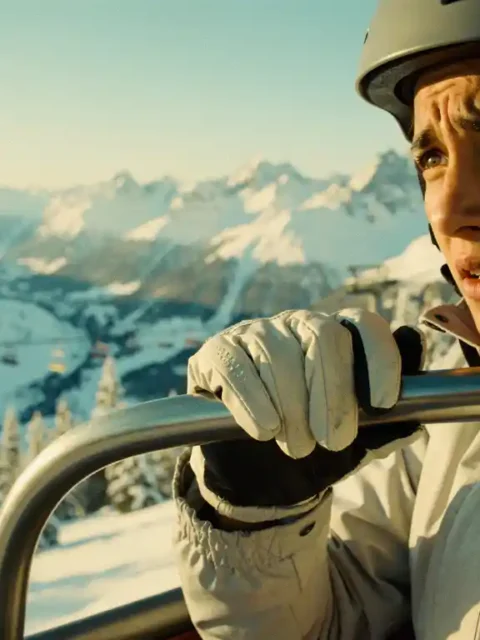
This sounds almost too simple, but the effect is surprisingly powerful. By linking your breathing to your movements, you create a rhythm — and rhythm is exactly what makes skiing feel so fluid. You can also practice this on the chairlift: take a few deep breaths in and out, consciously relax your shoulders, and head into the next run with a calmer mind.
Many experienced instructors teach beginners to count out loud or even hum while skiing. It sounds strange, but it works: if you’re making noise, you physically cannot hold your breath.
What body position helps you ski in a relaxed way?
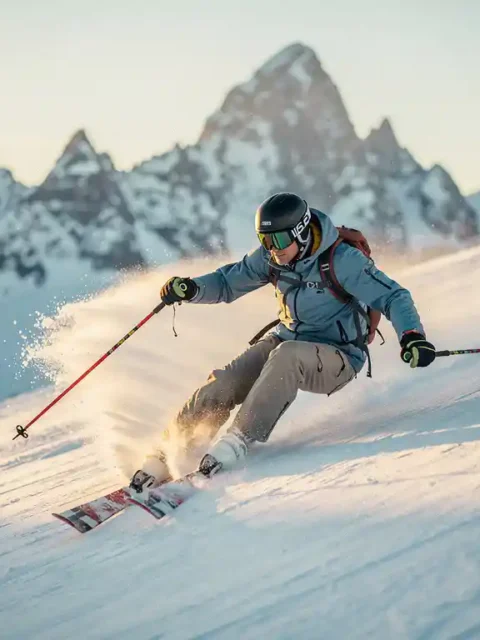
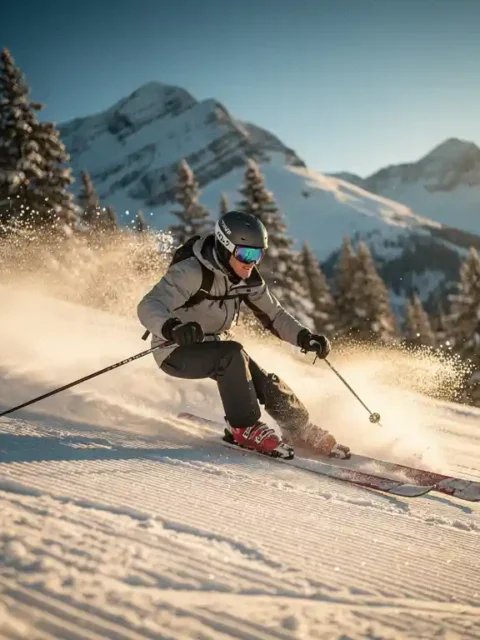
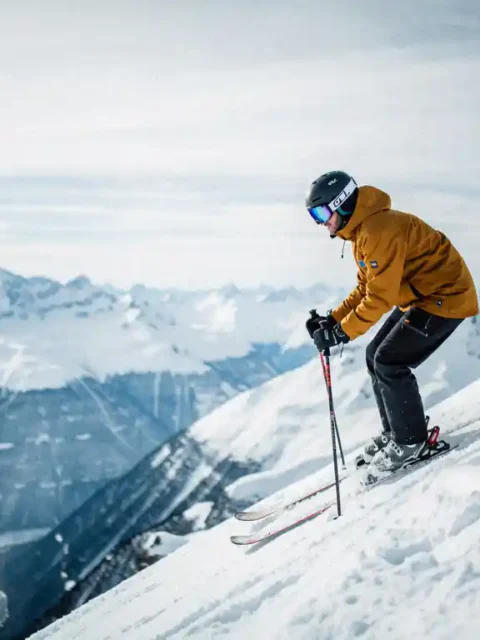
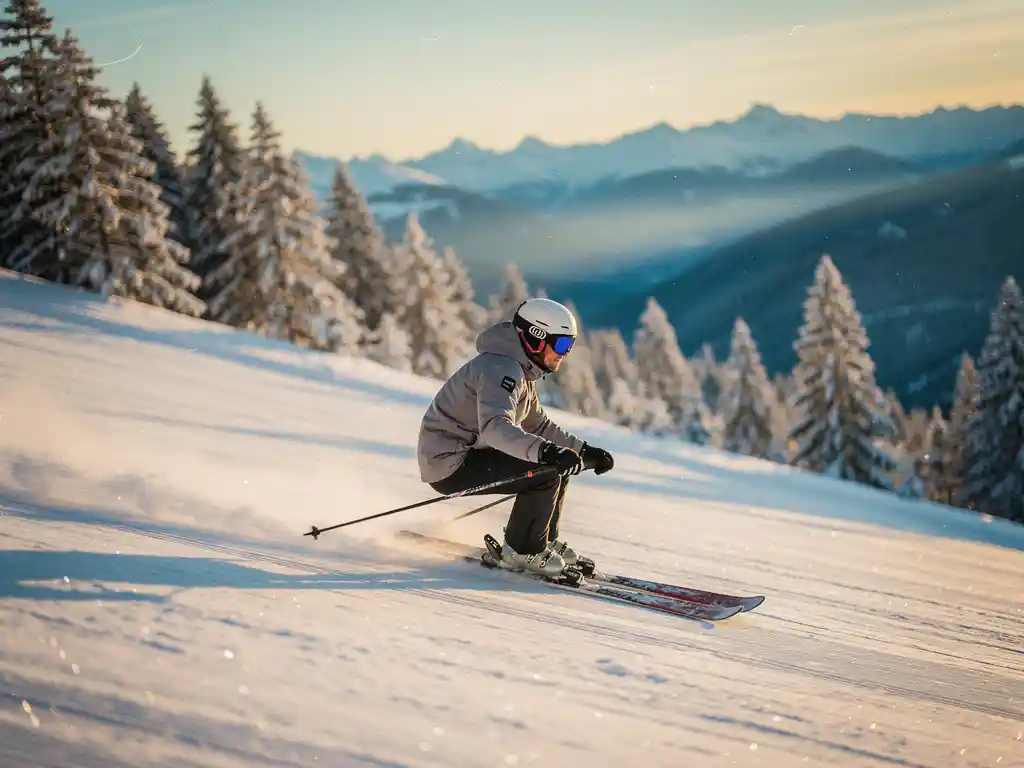
A relaxed skiing stance is characterized by slightly bent knees, a relaxed upper body leaning gently forward, and arms hanging loosely at your sides. This position gives you maximum control without requiring any unnecessary tension.
Think of the posture of someone walking calmly down a flight of stairs: fluid, slightly forward, knees bending with each step. On skis, it’s no different. A few concrete things to focus on:
- Knees: Always slightly bent, never locked straight. They are your shock absorbers.
- Upper body: Relaxed and gently tilted forward, not rigidly upright.
- Hands: Hold your ski poles loosely, as if you’re holding an egg you don’t want to crack.
- Gaze: Look ahead, not down at your skis. Where you look is where you go.
- Shoulders: Consciously let them drop. Raised shoulders are the first sign of tension.
A good exercise is to pause at the top of the slope, close your eyes, and scan your body from top to bottom. Are your shoulders raised? Let them drop. Are your hands clenched? Open them for a moment. Are your knees straight? Bend them slightly. Those ten seconds of preparation make a world of difference for the run ahead.
Does taking a ski lesson help you learn to ski in a relaxed way?
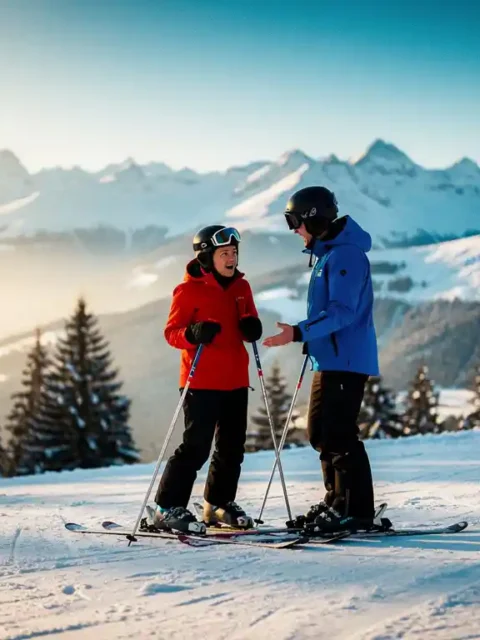
Yes, taking a ski lesson makes an enormous difference when it comes to learning to ski in a relaxed way. A good instructor doesn’t just teach you technique — they also help you recognize and overcome mental blocks. Guidance builds confidence, and confidence is the key to relaxation on the slopes.
In a ski lesson, you get direct feedback on your posture, breathing, and movement. An instructor immediately notices when you’re tensing up and can correct you in real time. That’s something you can never fully replicate with YouTube videos or tips from friends.
A lesson also provides structure. You know what you’ll be practicing, at what level, and at what pace. That predictability removes a large part of the uncertainty that causes tension in the first place. Group lessons give you the reassuring sense that you’re not the only one struggling with something, while private lessons give you the space to work entirely at your own pace.
Which slopes are best suited for relaxed practice?
Blue runs are the most suitable for relaxed practice. They have a gentle gradient, are wide enough to make turns at a comfortable pace, and offer plenty of room to stop without panic. For absolute beginners, practice areas or children’s slopes are an even better starting point.
It can be tempting to move on to harder slopes quickly, especially if your friends or family are already skiing red or black runs. But you can only learn to relax on terrain where you feel comfortable. Spending a few hours on a blue run and really getting to know it well will do more for your progress than one stressful descent on a slope that’s too difficult.
Popular beginner destinations such as Sölden, Ischgl, and Les Gets have excellent blue runs specifically designed for skiers who are still learning. Timing matters too: head out early in the morning when the slopes are still quiet. Less crowding means fewer distractions, less pressure, and more room to experiment.
When is it normal for skiing to still feel stressful?
It is completely normal for skiing to still feel stressful during the first two to three days, even when you’re applying the right technique. Your body and brain need time to store new movement patterns. Tension at the beginning isn’t a failure — it’s a sign that you’re learning.
Every skier has a turning point: the moment when it all clicks. That moment is different for everyone. Some experience it as early as the second day; others not until after a week on the slopes. What does help is letting go of that expectation and treating every run as practice, not as a performance that can succeed or fail.
If skiing still feels overwhelming after several days, that’s a clear signal to return to an easier slope or book an extra lesson. Pushing on through terrain that’s too difficult only amplifies the tension. Take a step back, rebuild from a solid foundation, and you’ll find that confidence grows on its own.
How Ski-Pro helps you learn to ski in a relaxed way
Relaxed skiing starts with the right guidance — and finding that guidance is easier when you don’t have to spend hours searching for the best instructor or ski school. That’s exactly where we come in. Through Ski-Pro, you can easily compare more than 250 certified ski schools and instructors across the Alps, all in one place.
Whether you’re looking for a relaxed group lesson on a blue run in Tyrol, or a private lesson where an instructor personally guides you on your posture and breathing, we make it easy to find the perfect match. Here’s what we offer:
- Comparison of lessons by level, location, and price
- Access to more than 250 ski schools and instructors
- Transparent pricing with no surprises
- Easy online booking, including last-minute
- Options for all levels, from complete beginner to advanced
Ready to take your first — or next — run with confidence and ease? Find your perfect ski lesson and start your adventure on the slopes, stress-free.
Frequently Asked Questions
How long does it take before you can ski in a truly relaxed way?
Most beginners notice a clear improvement after three to five days of active skiing, provided they are practicing at the right level. The exact moment varies from person to person and depends on factors such as prior sports experience, the difficulty of the slopes, and the quality of instruction. Those who start with a ski lesson and consciously work on their breathing and posture generally reach that relaxed feeling faster than someone who tries to figure it all out on their own.
What is the most common mistake that makes tension worse for beginners?
The most common mistake is moving on to more difficult slopes too quickly, before you feel comfortable on easier terrain. This creates a buildup of stress and reinforces exactly the wrong habits, such as leaning back and keeping your knees stiff. Stay on a slope that is slightly below your maximum level until your movements feel automatic and relaxed — then take the next step.
Can I practice the relaxation techniques at home before hitting the slopes?
Yes, absolutely. The breathing technique — inhaling as you begin a turn and slowly exhaling through the turn — can be rehearsed at home so that it becomes automatic on the slopes. You can also practice the body position in front of a mirror: slightly bent knees, relaxed shoulders, and a gentle forward lean. The more familiar these elements are before you get on the slopes, the less mental energy they’ll take up while you’re actually skiing.
Is a private lesson or a group lesson better if I want to learn to ski in a relaxed way quickly?
It depends on what causes you the most tension. If you tend to compare yourself to others or feel self-conscious about making mistakes, a private lesson offers more comfort and personalized attention for your specific tension and technique. If you find it reassuring to see that others are also struggling, and group energy motivates you, then a group lesson can be just as effective. Through Ski-Pro, you can easily compare both options by location, level, and price.