
Why do beginners struggle with making turns?
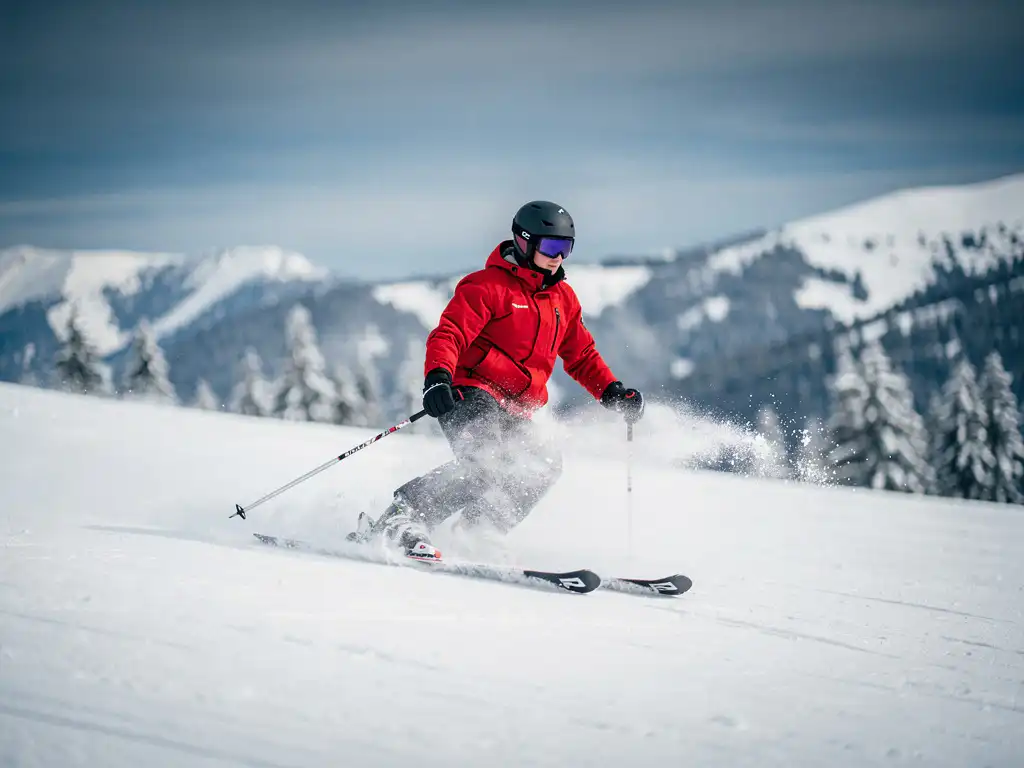
As a beginner, making turns on skis feels impossible because your body instinctively leans back when it senses speed building up, when in fact you need to lean forward and into the turn. This is a classic beginner problem that almost everyone recognizes. In this article, we answer the most frequently asked questions about making turns on skis, from the technique behind the pizza wedge to the moment when a ski lesson truly makes a difference.
What goes wrong when a beginner tries to make a turn?
As a beginner, something almost always goes wrong at exactly the same point when attempting a turn: you lean back out of fear of the speed, your weight is poorly distributed, and as a result your skis don’t respond the way you want. The outcome is that you keep going straight, fall, or panic your way down the slope without any control.
The most common mistakes are:
- Leaning back: Your body seeks stability by shifting backward, but this causes you to lose control over the tips of your skis.
- Standing rigid: Tense knees and a stiff upper body make it impossible to steer smoothly.
- Skis too far apart: Without the correct stance, you lose grip and can’t control both skis as a unit.
- Staring at your feet: Your gaze should be directed down the slope, not at your own skis.
These are not signs that you’re bad at skiing. They are simply the natural reactions of a body experiencing something new and exciting. With the right technique and a little practice, these mistakes will disappear on their own.
How does making a turn on skis work technically?
A turn on skis works through weight transfer and edging. You shift your weight onto the outside ski, tilt both skis onto their inside edges, and steer with your knees in the direction of the turn. Skis are designed so that, when edged correctly, they naturally follow an arc.
Technically speaking, three elements work together to produce a correct turn:
- Weight transfer: At the start of a left turn, you shift your weight onto your right (outside) ski. That ski carries most of the weight and controls the direction.
- Edging: By pressing your knees toward the inside of the turn, you tilt your skis onto their inside edges. This is called carving and is the foundation of every turn.
- Upper body rotation: Your shoulders and hips rotate slightly in the direction of the turn, supporting the movement and maintaining your balance.
As a beginner, you start out using what’s known as the pizza wedge or snowplow stance to simplify this process. In that position, the tips of your skis point toward each other, which automatically combines braking and steering. As soon as you shift your weight to one side, the ski on that side begins to steer and you complete a turn. Simple in theory, but it takes practice for your body to truly feel it.
Why is fear the biggest obstacle to making turns?
Fear is the biggest obstacle to learning turns because it literally locks up your body. The moment you feel unsafe, your entire body tenses up, you lean back, and you lose exactly the fluidity and weight sensitivity you need to make a turn. Fear and good ski technique are fundamentally at odds.
This is a physiological phenomenon: your fight-or-flight response causes your muscles to stiffen and your instincts to override your technique. On skis, that is devastating — stiffness means less control, not more.
What helps break through fear:
- Start on a quiet, wide slope with minimal vertical drop.
- Practice braking and stopping before attempting turns.
- Go slowly and deliberately, repeating movements until they feel familiar.
- Don’t let other skiers on the slope rush you.
Many beginners forget that it’s completely normal to feel afraid. The slope feels steep, the speed is unfamiliar, and you’re standing on two slippery planks. Give yourself the space to adjust. Confidence grows with every turn you make, even if it isn’t perfect yet.
What is the difference between a snowplow turn and a parallel turn?
The difference between a snowplow turn and a parallel turn lies in the position of the skis. In a snowplow turn — also known as pizza wedge skiing — the tips of the skis point toward each other in a V-shape. In a parallel turn, both skis are side by side in a parallel position and the turn is made purely through edging and weight transfer.
The snowplow turn: the foundation for every beginner
The snowplow turn is the first turn you learn as a beginner. The V-position creates friction and automatically slows you down. You steer by putting more weight on one ski: weight on the left ski produces a turn to the right, weight on the right ski produces a turn to the left. It is a reliable, safe technique that gives you immediate control over your speed.
The parallel turn: the next step
In a parallel turn, the skis run alongside each other. You make the turn entirely by edging the skis and shifting your weight. This requires more feel, better balance, and greater confidence in your skis. The parallel turn is faster, more elegant, and more efficient, but it takes practice and often guidance to learn properly. Most beginners make this transition after a few days on the slopes, often with the help of an instructor.
What exercises help beginners learn turns more quickly?
The exercises that help beginners learn turns most quickly are those that train weight transfer and balance without requiring you to make full turns right away. Building up step by step works far better than trying to nail the perfect turn from the start.
Try these exercises on a quiet, flat to gently sloping run:
- Lifting one ski: Stand in the snowplow position and alternately lift the inside edge of one ski. This trains weight transfer and lets you feel how the other ski steers.
- Star turns: Stand still on your skis and walk in a circle by taking small steps, moving each ski to the side in turn. This builds a feel for the skis and the position of your feet.
- Turns with arms outstretched: Hold your arms horizontally while making turns. This helps keep your upper body upright and prevents you from rotating too much.
- Looking where you want to go: Focus your gaze on a point further down the slope in the direction of the turn. Your body will naturally follow your eyes.
- Traversing diagonally: Ski across the slope at an angle rather than heading straight down. This reduces speed and gives you more time to practice steering.
Repetition is the key. Every time you make a turn, your body learns a little more. Patience and consistency are your best friends on the slopes.
When is it a good idea to take a ski lesson if you can’t make turns?
It’s a good idea to take a ski lesson as soon as you notice that you keep repeating the same mistakes after multiple attempts, or when fear is holding you back from progressing. An instructor can see in an instant what’s going wrong and can move you further in a few hours than you would get on your own in a week.
Practicing on your own is valuable, but without proper feedback there’s a real risk of reinforcing bad habits. Many beginners think they’ll figure it out themselves, only to come home after a week of skiing with the same technical problems they started with. A good instructor immediately recognizes whether your weight is off, your knees are too stiff, or you’re not using the pizza wedge correctly.
Definitely take a ski lesson if:
- After two or three days you still can’t make turns.
- You’re afraid to go down the slope and can’t overcome that fear on your own.
- You want to learn to carve or move on to parallel turns.
- You’re bringing children along and want to give them a solid foundation.
- It’s your first time skiing and you want to enjoy the slopes as quickly as possible.
Taking a ski lesson isn’t admitting defeat. It’s the smartest investment you can make in your enjoyment on the slopes.
How Ski-Pro helps you find the right ski lesson
We understand that finding the right ski lesson can feel overwhelming as a beginner. Which ski school? Private lesson or group lesson? Which resort suits my level? We make that choice a whole lot easier.
Through our platform you can:
- Compare more than 250 certified ski schools and instructors across the Alps.
- Filter by location, budget, language, and lesson type (private or group).
- Book directly online, with no hassle or hidden pricing.
- Find lessons for all levels, from complete beginner to advanced skier.
Whether you’re learning the pizza wedge for the first time on the slopes of Tyrol or you’re ready for your first parallel turns in the Swiss Alps, we’ll help you find the perfect match. Compare and book your ski lesson and hit the slopes fully prepared.
Frequently Asked Questions
How long does it take on average for a beginner to make turns independently?
Most beginners start to grasp the basics of the snowplow turn after one to two days of practice, but making turns independently and in a controlled manner takes an average of two to four days on the slopes. This varies from person to person and depends heavily on how often you practice and whether you have guidance. With a ski lesson, this process goes considerably faster because you receive immediate, accurate feedback and don’t develop bad habits.
Does it matter which slope I practice on as a beginner?
Yes, absolutely. Always start on a green or blue run with a gentle, wide slope and few other skiers. A slope that is too steep or too busy increases anxiety and makes it nearly impossible to practice calmly. Ask the ski school or resort which slopes are most suitable for beginners, as this varies by ski area.
What is the biggest difference between a private lesson and a group lesson for beginners?
In a private lesson you receive one-on-one attention and the lesson is fully tailored to your pace, mistakes, and learning style, which significantly speeds up the learning process. A group lesson is less expensive and can be motivating because you practice alongside others at the same level, but the instructor has less time per person. For beginners who want to learn quickly or who feel extra anxious, a private lesson is often the best investment.
Can I still learn to ski well as an adult, or is it too late?
It is absolutely not too late to learn to ski as an adult. Adults often learn technique faster than children because they understand instructions better and can practice more deliberately. The only drawback is that adults sometimes find it harder to let go of fear, but with the right guidance and a gradual build-up, this is very manageable. Many people take up skiing later in life and enjoy it for years to come.