
How to get up when skiing?
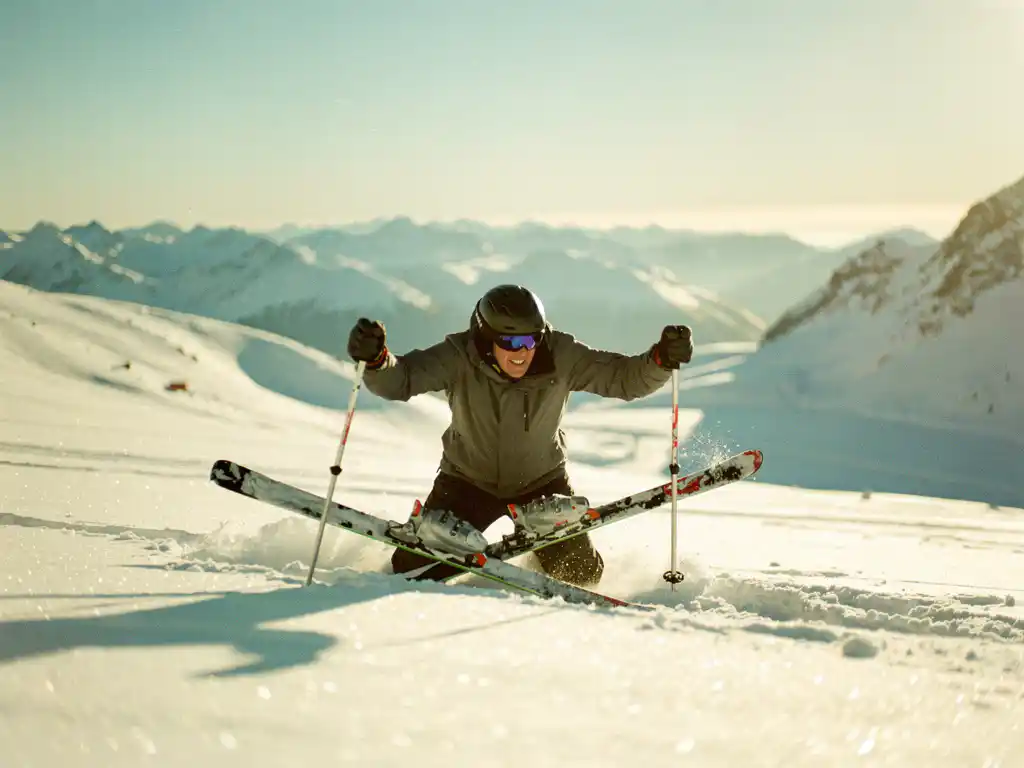
Getting up after a fall on skis means placing your skis parallel to each other, perpendicular to the slope, bringing your body toward your knees, and pushing yourself up with your hands or ski poles. It sounds simple, but for beginners, on a slippery, sloping surface it can quickly feel like an impossible puzzle. In this article, we answer the most common questions about getting up, falling safely, and exercises that will get you back on your feet faster.
Why falling and getting up while skiing is so difficult for beginners
Falling and getting up while skiing is difficult for beginners because skis are long, attached to your feet, and sitting on a sloped, slippery surface. Your body isn’t used to this combination, which means your reflexes let you down and every attempt to stand up feels like you’re about to fall again.
On flat ground, you simply stand up. But on a ski slope, everything changes. The incline pulls you downhill, the snow offers little grip, and your skis are positioned at an angle that significantly limits your range of motion. On top of that, as a beginner you’re not yet used to the weight of ski boots or the length of the skis. Your muscles don’t quite know what to do, and that makes every fall a small challenge in itself.
Add to that the fact that many beginners panic after a fall. They try to get up immediately without first checking their position, causing them to slide away or fall again. The good news? Getting up is a skill you can learn, just like making turns while skiing. With the right technique, it happens much faster than you’d expect.
How to get up step by step after a fall on skis
After a fall on skis, you get up by first positioning your skis, then gathering your weight and pushing yourself upward. The key is the sequence: position, balance, strength. Do it in the wrong order and you’ll reward yourself with a second fall.
Follow these steps for a smooth return to your skis:
- Stay down for a moment and breathe. First check whether you’ve injured anything. No rush — the slope isn’t going anywhere.
- Rotate your body so your skis are across the slope. Your skis must be perpendicular to the hill, not pointing up or down. This prevents you from shooting off the moment you stand up.
- Pull your knees toward your chest. Bring your skis as close to your body as possible. This gives you a more stable starting position.
- Place your hands or ski poles in the snow beside your hip. Use the poles for support, not as a lever. Push them firmly into the snow so they don’t slide away.
- Push yourself up using your legs. Use your leg muscles as the engine, not your arms. Lean slightly forward as you rise so your weight stays over your skis.
- Stand upright and find your balance. Once standing, keep your knees slightly bent and your weight evenly distributed over both skis.
A common mistake is trying to stand up while your skis are still pointing downhill. They’ll slide away before you’re fully upright. So always check the position of your skis first before applying any force.
What to do when you can’t get up on skis
If you can’t get up on your skis, release your ski bindings, stand up without your skis, and then put them back on. This isn’t failure — it’s a smart solution that even experienced skiers use on steep or icy sections.
There are situations where the standard technique simply doesn’t work. Think of a very steep slope, an icy surface, or a position where your skis are stuck in the snow. In that case:
- Release your bindings by pressing down on the heel of your ski boot or opening the binding manually.
- Get onto your knees and then stand up without the skis on your feet.
- Put your skis back on on a flat spot beside you. Keep them perpendicular to the slope so they don’t slide away.
- Ask for help if you really can’t manage. Every slope has ski patrol and fellow skiers who are happy to lend a hand. There’s no shame in it.
Children and people with less upper body strength sometimes have extra difficulty getting up. For them, releasing the bindings is often the quickest and safest solution. Practice this at home so you know how your bindings work before you get on the slope.
How to fall safely to reduce injuries while skiing
Falling safely while skiing means relaxing your body, keeping your arms close to your sides, and trying to land on your side or backside. A tense body breaks more easily than a relaxed one, so the counterintuitive golden rule is: let go.
Many beginner injuries don’t result from the fall itself, but from the attempt to stop it. Reaching out with your arms, staying rigid, or trying to get up while you’re still falling — those are the real culprits. Here’s what helps you fall more safely:
- Relax your muscles. A stiff body absorbs impact poorly. Let yourself go.
- Keep your arms close to your body. Don’t stretch them out to catch yourself. Your wrists are vulnerable and not built to absorb your full body weight.
- Try to land on your side or backside. These are the most resilient parts of your body for absorbing a fall.
- Don’t fall straight backward. If you’re falling backward, try to tuck slightly forward so you don’t land hard on your head or back.
- Wear a helmet and wrist guards. Good protective gear significantly reduces the impact of a fall.
Beginners fall more often on average than advanced skiers, and that’s perfectly fine. Every fall is a lesson. The more you ski, the better your body learns to anticipate, and the less severe the falls become.
Which exercises help beginners get up on skis faster
Beginners learn to get up on skis faster by doing targeted exercises at home and on the slope that build strength, balance, and body awareness. You don’t need to be an elite athlete — a few focused movements make a big difference.
Exercises at home before ski season
Before you’ve seen a single snowflake, you can start preparing:
- Squats and lunges: These strengthen the leg muscles you use when getting up and making turns on skis.
- Plank exercises: Core strength is essential for balance on skis. A strong core helps you stay stable after a fall.
- Single-leg balance exercises: Stand on one leg for a minute, then switch. This trains the stabilizing muscles you’ll rely on heavily on the slope.
Exercises directly on the slope
On the slope, you can also actively practice getting up:
- Deliberately sitting down and getting up on a flat section. Find a flat, quiet part of the slope and practice getting up without the pressure of an incline. Repeat this a few times until it feels automatic.
- Practicing with ski poles. Consciously use your poles as support when getting up. Many beginners forget they have them.
- Skiing slowly and falling in a controlled way. Practice falling at low speed on a soft, flat surface. This takes away the fear and teaches your body what to do.
A good ski instructor will have you practice these techniques in your very first lesson. That’s exactly what makes a ski lesson so valuable for beginners: you don’t just learn to ski, you also learn to handle falls and getting up safely.
How Ski-Pro helps you take your first steps on skis
The fastest way to learn how to get up after a fall is with the right guidance. A certified ski instructor will show you in your first lesson how to fall safely, how to get up, and how to make your first turns. This builds not only technical confidence but also self-assurance on the slope.
We help you find the perfect instructor or ski school. Through our platform, you can easily compare more than 250 certified ski schools and instructors in the Alps. Whether you choose a group lesson or a private lesson, we make sure you find the right match quickly and effortlessly. Here’s what we offer:
- Compare lessons from 250+ ski schools by location, price, and level
- Book easily online, without any hassle
- Options for all levels, from complete beginner to advanced skier
- Transparent pricing with no hidden costs
- Lessons at top destinations in Austria, Switzerland, France, and more
Ready to hit the slopes? Compare and book your ski lesson through Ski-Pro and start your winter sports adventure well prepared and with a big smile.
Frequently Asked Questions
How long does it take a beginner to master getting up after a fall?
Most beginners develop a reasonable feel for the technique of getting up after just a few hours on the slope. With focused practice on a flat section at the start of your first ski lesson, it quickly starts to feel automatic. A private lesson or group lesson with a certified instructor speeds up this process considerably, since you receive direct feedback on your technique.
Are ski poles required as a beginner, or can I get up without them?
Ski poles are not required, but they make getting up after a fall much easier by providing extra support. Many beginner courses actually start without poles so you can focus on balance and leg work first, but once you use them, they’re a valuable tool for getting up. Just make sure you use the poles as a support point and not as a lever, to avoid shoulder injuries.
What should I do if my skis release automatically when I fall? Do I need to adjust them?
If your bindings release with every minor fall, they are probably set too loose. The DIN value of your binding determines how easily it releases and must be adjusted based on your weight, height, boot size, and skiing level. Always have this checked and set by a professional at a ski rental shop or sports store, so the bindings release during a real fall but not with every movement.
Can I practice getting up even if I've never skied before?
Yes, absolutely. At home you can already build strength and balance with squats, lunges, and single-leg balance exercises, so your muscles are prepared for the movements needed when getting up. On the slope, it’s best to practice getting up on a flat, quiet section before heading onto real hills, ideally under the guidance of a ski instructor who will teach you the correct technique step by step.