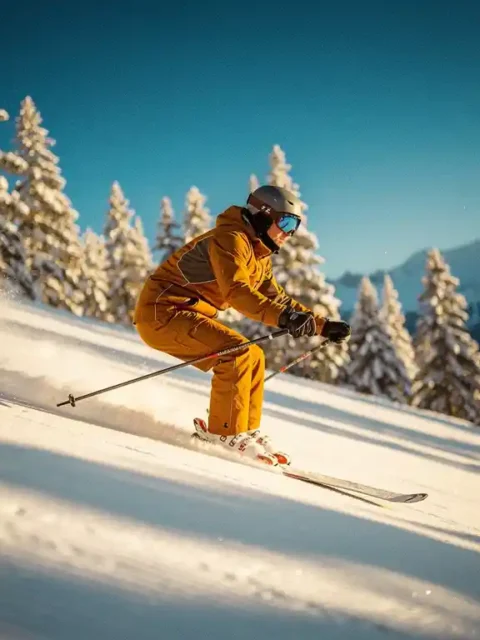

How do you overcome your fear of ski lifts?
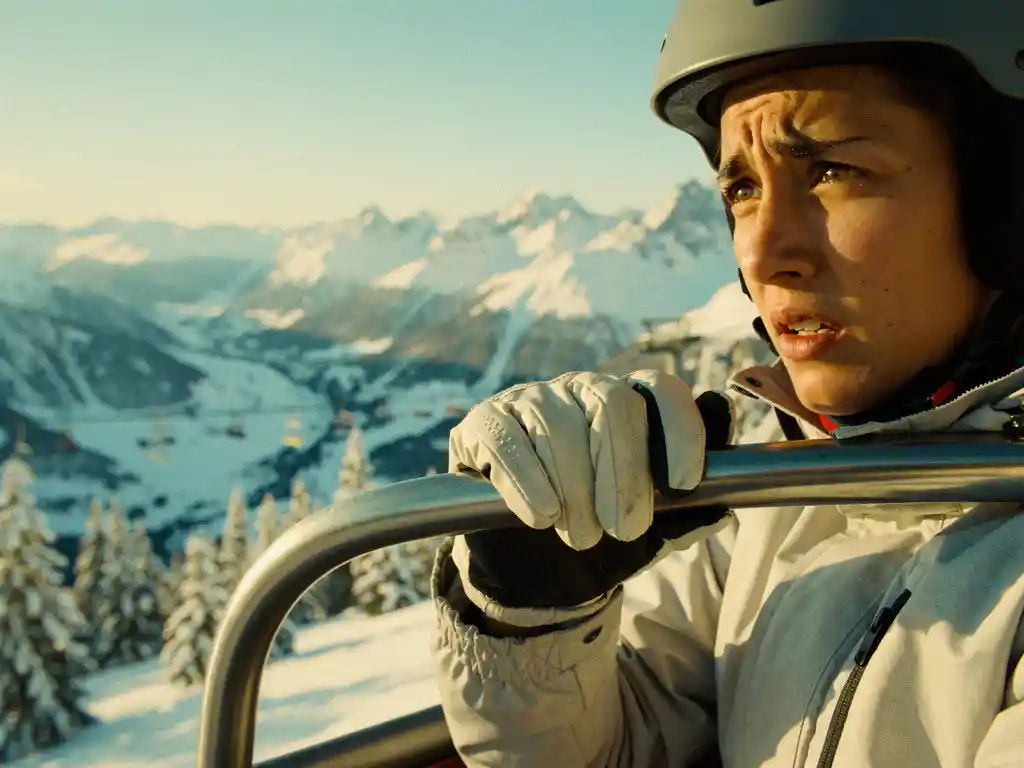
You can overcome your fear of ski lifts by gradually exposing yourself to the lift, starting with and practicing on the least intimidating lift types, and applying breathing techniques when panic sets in. For most beginners, the worst lift anxiety fades after just a few rides. Below, we answer the most frequently asked questions about fear of heights while skiing, so you can head up the mountain with confidence.
What makes a ski lift so scary for beginners?
A ski lift feels scary for beginners because you have no control over the movement, you are suspended high above the ground, and you don’t know how to get on or off. That combination of fear of heights, unfamiliarity, and wearing awkward equipment makes the lift more daunting for many first-year skiers than the slope itself.
Fear of heights while skiing is actually a very logical reaction. You’re standing on two slippery planks, your legs are locked into stiff ski boots, and before you know it you’re floating several meters above the snow in a seat that gently sways back and forth. Your brain registers danger, even though the lift is technically very safe.
What makes the fear worse for beginners:
- Lack of experience: you don’t know what to expect when getting on and off
- Height: chairlifts can hang dozens of meters above the ground
- Movement: the lift doesn’t stop for you and won’t wait until you’re ready
- Equipment: skis on your feet feel awkward and unstable when you’re sitting still
- Social pressure: the fear of holding others up or making mistakes in front of a queue of people
The good news is that this feeling is completely normal and fades for almost everyone once you understand how the lift works and know what to expect.
Which types of ski lifts are least scary for beginners?
The drag lift — also known as a button lift or T-bar lift — is the least scary for beginners because you keep both feet on the ground. You are simply pulled up over the snow. Next come the gondola and cable car, where you are fully enclosed. Chairlifts are the most challenging for people with a fear of heights while skiing.
As a beginner, it’s wise to deliberately choose lift types that match your comfort level. Here is a handy overview from least to most challenging:
- Button lift or T-bar lift: you stay on the ground and are pulled up by a pole with a disc or bar. No height, no fuss.
- Magic carpet or conveyor belt: a moving belt along the ground, perfect for the gentlest slopes. Absolutely no height involved.
- Gondola or cable car: you sit in an enclosed cabin, which feels safer to many people than an open chair.
- Chairlift with safety bar: an open chair at height, but with a safety bar that you pull down in front of you.
- Chairlift without safety bar: the most challenging option for anyone with a fear of heights while skiing.
On your first ski vacation, deliberately start with lifts where you can feel the ground beneath your feet. As your confidence grows, you can gradually move on to higher lift types.
How do you safely get on and off a chairlift?
To safely board a chairlift, wait calmly in the loading zone, stand on the marked spots, look over your shoulder as the chair approaches, and then sit down smoothly while the lift keeps moving. To get off, raise the safety bar in time, place your skis flat on the snow, and glide away as soon as you reach the unloading area.
Getting on: step by step
- Wait calmly in the queue and move forward into the loading zone
- Stand on the markings on the ground, together with your companions
- Look over your shoulder at the approaching chair
- As soon as the chair touches the back of your knees, simply let yourself sit down
- Pull the safety bar down once you are seated
- Tuck your ski poles under your arm or hold them loosely
Getting off: step by step
- Raise the safety bar well before the unloading zone, as soon as the sign indicates
- Slide forward to the edge of your seat
- Place your skis flat on the snow as soon as they touch the slope
- Stand up and glide calmly to the side, away from the lift area
- Don’t stop in the unloading zone — the next chair is right behind you
Tip: ask the lift operator to slow the lift down. At most ski resorts, this is perfectly possible for beginners or people with lift anxiety. Don’t be embarrassed to ask.
What can you do if you panic on the lift?
If you panic on a chairlift, the first and most important step is to breathe. Focus on exhaling slowly, look toward the horizon rather than down, and talk to your companion. Panicking on the lift is dangerous if you react by moving around or trying to get off. Stay seated and wait calmly for the next unloading area.
Practical techniques that help in the moment:
- Belly breathing: breathe in for four counts, hold for four counts, breathe out for six counts. Repeat three times.
- Fix your gaze: look at the mountaintops or the tree line, not at the ground below you
- Talk out loud: describe what you see to distract your brain from the fear
- Hold the handlebar: it gives you something to grip and a sense of control
- Music: earbuds playing a familiar song can work wonders
What you should absolutely not do: try to climb out of the lift or move around wildly. The lift is safe — your sense of danger is real, but the situation itself is not. Actively remind yourself of this.
Does a ski lesson help with overcoming lift anxiety?
Yes, a ski lesson helps enormously with overcoming lift anxiety. A good ski instructor guides you not only on the slope, but also through getting on and off the lift, explains what to expect, and helps you build confidence in a safe environment. That structured support process is far more effective for beginners with a fear of heights while skiing than figuring it out alone.
A ski instructor knows the lifts at the resort inside and out. They know which lifts are quieter, when it’s less busy, and how to help a beginner board as calmly as possible. The presence of a trusted guide also makes you feel less alone in an unfamiliar situation.
Group lessons have the added benefit of letting you see how other beginners tackle the same challenge — which helps normalize the fear. Private lessons, on the other hand, allow the instructor to adjust their pace entirely to your comfort level, without any pressure to rush or any social anxiety.
Looking for a ski instructor who is the right fit for you? Through Ski-Pro, you can easily compare more than 250 certified ski schools and instructors in the Alps, so you can find someone with experience working with beginners who understands lift anxiety.
How long does it take for lift anxiety to go away?
For most beginners, lift anxiety decreases noticeably after two to five rides. After a full day of skiing, many people already feel much more comfortable on the chairlift. For those with more severe fear of heights, it may take longer — but the same principle applies: repetition and proper guidance are the key.
Lift anxiety is fundamentally a fear of the unknown. Your brain isn’t used to the situation and triggers an alarm. The more often you take the lift, the more evidence you give your brain that it’s safe — and the sooner the alarm stops going off.
A few factors that determine how quickly the fear fades:
- How severe your fear of heights is: mild height anxiety fades faster than a deep-seated phobia
- Whether you have guidance: with an instructor, progress is generally faster than going it alone
- Whether you choose the right lift types: starting with a drag lift speeds up the process
- Whether you ride the lift regularly: avoiding it makes the fear grow, repetition makes it shrink
Give yourself the space to set your own pace. Nobody expects you to take the longest chairlift on your first ski vacation. Start small, celebrate every little victory, and enjoy the feeling of standing at the top of the mountain with the whole slope ahead of you. Because that feeling makes it more than worth it.
Frequently Asked Questions
Can I refuse to take a chairlift if I'm too scared?
Yes, you can always ask the lift operator whether an alternative route or a different lift type is available. At most ski resorts, there are multiple ways to get up the mountain. Don’t be embarrassed about this — lift operators are used to beginners and people with a fear of heights and are happy to help.
What if I'm skiing alone and have no one to help me at the lift?
Ask the lift operator for help or to slow the lift down slightly — this is a standard request they are used to. You can also join a group or ask another skier if you can board together, as most skiers are happy to help. You might also consider booking a (private) ski lesson through a platform like Ski-Pro, so you have a certified instructor by your side to guide you through the entire process.
Does watching videos of how a chairlift works help beforehand?
Absolutely — mental preparation is a proven technique for reducing anxiety. By watching videos of the boarding and unloading process in advance, you know exactly what to expect and significantly lower the barrier. Combine this with the breathing techniques in this article so you are both mentally and physically prepared for your first ride.
Should I tell the ski school or instructor about my lift anxiety?
Yes, definitely let your ski instructor know in advance. A good instructor will then fully tailor their approach to your needs, deliberately choose quieter lifts, and take extra time to talk through each lift ride before and after. The more honest you are about your fear, the better the guidance you will receive.