
How to Quickly Improve Your Ski Technique?

Want to improve your skiing skills faster? You can! Whether you regularly go on winter sports holidays or are just starting out, improving your ski technique doesn’t have to take years. With the right approach, you can make enormous progress within a single ski vacation. In this article, we share the most effective ways to quickly improve your ski technique without endless practice. We discuss common mistakes that hinder your progress, show how the right posture immediately improves your control, and explain why personal coaching can make a big difference. You’ll also get practical exercises you can do at home to hit the slopes stronger. Ready to take your skiing skills to the next level? Read on!
Common Mistakes Made by Beginning Skiers
When you’re just starting to ski, you’re likely making several classic mistakes that almost everyone makes. These mistakes are completely normal, but they can significantly slow your progress if you don’t address them.
One of the most common mistakes is incorrect body posture. Many beginners lean too far back on their skis. We do this instinctively because we’re afraid of falling, but it results in less control and faster leg fatigue. By leaning backward, too much pressure is placed on your heels, and you lose contact with the front of your skis – precisely the part you use to steer!
Another common mistake is incorrect weight distribution. Beginners often put too much weight on their inside ski during a turn, when it should be the opposite. By putting more pressure on your outside ski, you get much more grip and stability in your turns.
We also often see beginners rotating their upper body too much in turns. Your skis steer better when you keep your upper body relatively quiet and let the movement come primarily from your legs and hips. Excessive shoulder rotation makes you less stable and disturbs your balance.
Fear of speed is perhaps the biggest brake on your progression. When you’re afraid to pick up speed, you automatically adopt the ‘braking position’: skis wide apart, weight shifted backward, and constantly skiing in the snowplow (pizza) position. This limits your freedom of movement and prevents you from experiencing the flow of skiing. A bit of healthy speed actually helps you ski more smoothly!
Finally, many beginning skiers forget to look ahead. They stare at their skis or the snow directly in front of them, giving themselves no time to react to changes in the terrain. By looking further ahead, you give yourself more time to make decisions and improve your spatial awareness on the slope.
The Correct Posture on the Slopes
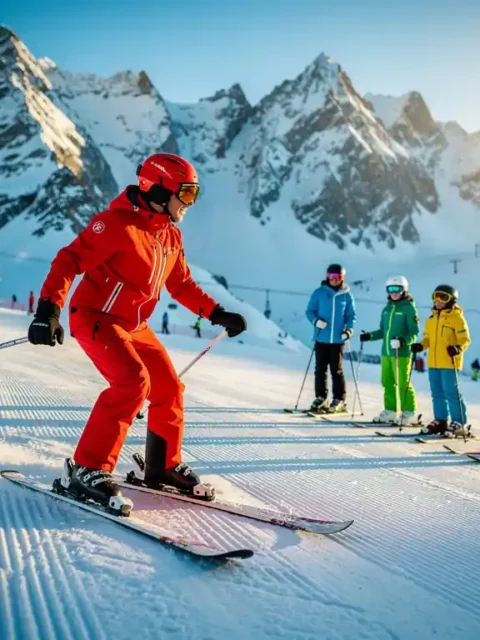
The foundation of good skiing begins with the right posture. With a good position on your skis, you immediately improve your balance, control, and endurance. Let’s look at the key elements of an effective skiing posture.
Your knees are crucial in skiing. Keep them slightly bent – not too much, but certainly not straight. This flexible position works as a natural shock absorber and allows you to quickly respond to irregularities in the snow. Think of your knees as springs that can constantly adapt to the terrain.
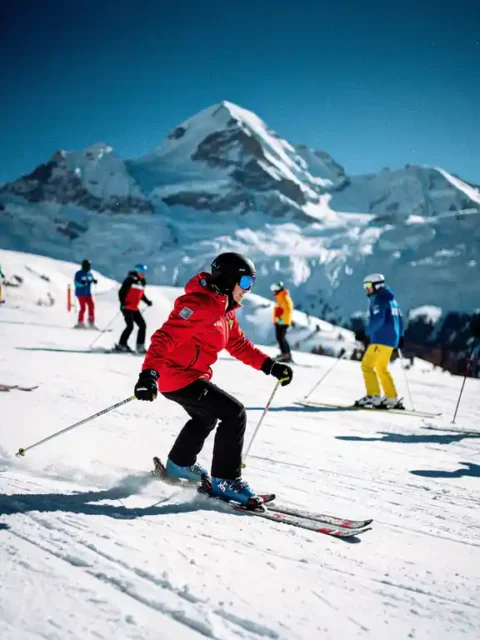
Your upper body should be upright and slightly forward-facing. A common mistake is leaning backward, but that greatly reduces your control. Try to imagine that your chest is always slightly ahead of your feet. This ensures that your weight is properly distributed across your entire ski and gives you more control over the front of your skis – the part you use to steer.
Your arms play a supporting role in your balance. Keep them relaxed and extended forward, approximately at navel height. Your poles should rest lightly in your hands, ready to plant when you initiate a turn. Avoid lifting your arms high or letting your hands hang by your hips – both disrupt your balance.
The position of your hips is also important. They should remain above your feet, not too far back or forward. Your hips are like the pivot point between your upper and lower body. From your hips, you can initiate the movement to make turns, while your upper body remains relatively stable.
Finally, your gaze is an underestimated element of good skiing posture. Always look 10 to 15 meters ahead, in the direction you want to go. Your body automatically follows where your eyes are looking. By looking far ahead, you better plan your route and respond in time to changes in the terrain.
This posture might feel unnatural at first, but quickly becomes comfortable if you keep practicing it. The great thing is that a small improvement in your posture immediately has major effects on your skiing ability and enjoyment on the slopes.
Why Personal Ski Lessons Make the Difference
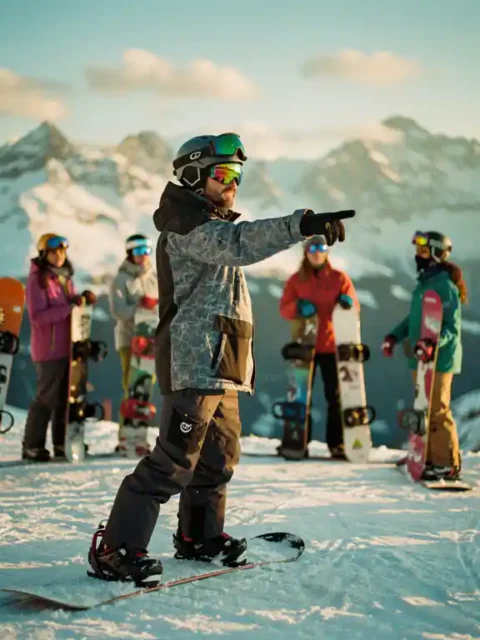
If you really want to make quick progress in skiing, there’s really nothing that can replace good personal ski instruction. While self-study and tips from friends are certainly valuable, professional instruction offers benefits you can’t get any other way.
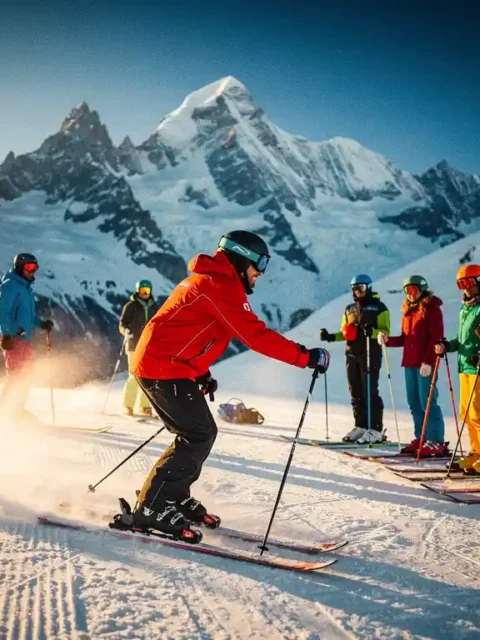
The biggest advantage of personal ski lessons is direct feedback. A ski instructor can see what you’re doing in real time and correct you immediately. Many skiers think they’re executing a certain movement correctly, while in reality they’re using a technique that impedes their progress. An instructor sees this right away and can make adjustments before bad habits become ingrained.
A good ski instructor also completely tailors the lessons to your level. They analyze what you specifically struggle with and design exercises that target exactly those areas. In a group lesson, you get more general instructions, but in a private lesson, you work on your personal challenges.
Moreover, an instructor helps you not only with technique but also with overcoming mental blocks. Many skiers are limited by fear – fear of falling, fear of steep slopes, or fear of speed. An experienced instructor knows exactly how to gradually take you outside your comfort zone, in a way that feels safe and builds your confidence.
Another advantage is that an instructor helps you move through the different learning phases more quickly. Without guidance, you might stay stuck in certain techniques for weeks or even seasons, whereas with the right instructions, you might be ready to learn new skills after just a few hours.
Even if you’ve been skiing for years, a refresher course or an advanced lesson can help you correct persistent mistakes or refine your technique. Many experienced skiers are surprised by how much better they can become with just a few hours of professional instruction.
Daily Exercises for Rapid Progression
You don’t need to be on the slopes to improve your ski technique. With targeted dry exercises at home, you can prepare your muscles, improve your balance, and ingrain movement patterns that you can directly apply once you’re on skis.
One of the most effective exercises for skiers is the squat. Perform this by placing your feet shoulder-width apart, keeping your back straight, and slowly bending your knees as if you’re sitting down on a chair. Keep your weight on your heels and make sure your knees don’t extend past your toes. Squats strengthen exactly those leg muscles that you use most during skiing.
For better balance, try standing on one leg while doing daily activities, such as brushing your teeth or washing dishes. Try to maintain this for at least 30 seconds per leg and then switch. If this becomes easy, close your eyes to increase the challenge. This exercise improves your proprioception – your body’s ability to sense its position in space – which is essential for good skiing.
The “alpine skier” position is also excellent for home practice. Stand with your back against a wall and bend your knees until your thighs are parallel to the floor (as if sitting on an invisible chair). Hold this position for 30-60 seconds. This isometric exercise builds endurance in exactly the muscles you use when in the proper skiing position.
For coordination and agility, you can do lateral jumps – jumping sideways from one leg to the other. Start slowly and focus on a soft landing and good balance. This helps your body get used to transferring weight from one ski to the other while making turns.
Don’t forget your core – a strong core is fundamental for good balance while skiing. Plank exercises are ideal for this. Start with 30 seconds and gradually build up as you get stronger.
Do these exercises at least three times a week in the months leading up to your ski vacation. You’ll be amazed at the difference it makes when you’re back on the slopes. Your muscles are stronger, your balance is better, and your body already knows the movement patterns, allowing your ski technique to improve much faster.
In addition to physical exercises, you can also practice mentally. Visualize yourself making perfect turns or gliding smoothly down the slope. Studies show that this mental training can be almost as effective as actual practice!
Once you’re on the slopes, start each day with a few simple exercises to warm up. Make some short turns on a quiet blue run, focus on your posture, and feel how your weight shifts during each turn. This conscious warm-up ensures that your muscles and your brain are ready for a day full of progress.
By combining these targeted exercises at home with conscious training on the slopes, you can significantly accelerate your ski technique. And who knows, by the end of your next ski vacation, you might be confidently tackling slopes you previously didn’t dare to try!
If you really want to make quick progress, consider booking a professional ski instructor who can guide you personally. At Ski-Pro, we’re happy to help you find the perfect ski lesson that matches your level and learning goals. Whether you’re a complete beginner or want to refine your technique, the right instruction makes a world of difference in how quickly you improve your ski technique.
Frequently Asked Questions
Hoe lang duurt het voordat ik van beginnersniveau naar gevorderd niveau kan gaan?
De progressie verschilt per persoon, maar met de juiste aanpak kun je binnen 2-3 intensieve skivakanties van complete beginner naar comfortabel gevorderde skiër gaan. Consistente training is hierbij cruciaal – dagelijks een paar uur oefenen met gerichte aandacht voor techniek levert veel meer resultaat op dan sporadisch lange dagen maken. Een combinatie van persoonlijke lessen, doelgerichte oefeningen en regelmatige feedback versnelt dit proces aanzienlijk.
Wat kan ik doen als ik bang blijf op steile pistes, ondanks goede techniek?
Angst voor steile hellingen is heel normaal en kun je stap voor stap overwinnen. Begin met het skiën van korte stukjes steile piste, waarbij je tussendoor pauzeert en jezelf complimenteert met elke succesvolle afdaling. Focus op je ademhaling en techniek, niet op de steilte of snelheid. Het kan ook enorm helpen om één privéles te nemen specifiek gericht op het skiën van steile pistes – een instructeur kan je laten zien hoe je je gewicht moet verdelen en welke bochtentechniek het meest effectief is op steiler terrein.
Welke specifieke oefeningen kan ik doen om mijn bochtentechniek te verbeteren?
Voor betere bochten zijn ‘korte zwaaien’ een uitstekende oefening – maak op een rustige blauwe piste zoveel mogelijk korte, ritmische bochten waarbij je bewust je gewicht verplaatst naar je buitenski. Een andere effectieve oefening is ‘skiën op één been’ – til tijdens een lange, rustige bocht je binnenste ski licht op om te voelen hoe je stuurt met je buitenski. Ook het oefenen van ‘carven’ helpt enorm: kantel je ski’s op hun kanten zonder te schuiven en voel hoe de ski’s zelf de bocht maken. Doe deze oefeningen dagelijks 15-20 minuten voor het beste resultaat.
Hoe kan ik mijn skitechniek verbeteren als ik maar één keer per jaar op wintersport ga?
Ook met slechts één skivakantie per jaar kun je aanzienlijke vooruitgang boeken door slim te trainen. Begin je vakantie met een of twee privélessen om snel roest van vorig jaar weg te halen en focus dan elke dag op één specifiek aspect van je techniek. Bereid je fysiek voor met de oefeningen uit het artikel, minimaal 8 weken voor je vertrek. Overweeg ook om buiten het seizoen droogtraining te volgen of indoor ski-faciliteiten te bezoeken voor een opfriscursus halverwege het jaar.
Welke uitrusting maakt het grootste verschil voor het verbeteren van mijn techniek?
Goed passende skischoenen zijn verreweg het belangrijkste uitrustingsstuk voor techniekverbetering – ze zorgen voor directe controle over je ski’s en goede krachtoverdracht. Investeer liever in kwaliteitsschoenen dan in high-end ski’s. Voor beginnende en intermediate skiërs zijn veelzijdige all-mountain ski’s ideaal, niet te stug en met een middelbrede taille (80-90mm). Laat je uitrusting altijd professioneel aanpassen aan je niveau, lengte en gewicht, omdat verkeerd afgestelde bindingen je techniek kunnen belemmeren.
Hoe weet ik wanneer ik klaar ben om van blauwe naar rode pistes over te stappen?
Je bent klaar voor rode pistes wanneer je comfortabel parallelle bochten kunt maken op blauwe pistes, ook als deze wat steiler worden of de sneeuwcondities minder ideaal zijn. Je zou in staat moeten zijn om je snelheid te controleren zonder constant te remmen en je kunt variëren tussen korte en lange bochten. Een goede test is of je een blauwe piste kunt afdalen terwijl je je gewicht bewust verplaatst van ski naar ski en daarbij je binnenste ski licht kunt optillen tijdens de bocht – dit toont aan dat je de basisvaardigheden beheerst die nodig zijn voor steilere terrein.
Wat zijn de meest voorkomende plateaus in ski-ontwikkeling en hoe doorbreek je die?
Het meest voorkomende plateau is de overgang van ploegbochten naar parallelle bochten, wat je kunt doorbreken door specifiek te oefenen met het geleidelijk optillen van je binnenste ski tijdens bochten. Een ander frequent plateau komt voor bij intermediates die moeite hebben met variërende sneeuwcondities – neem dan een les specifiek gericht op techniek voor verschillende sneeuwtypen. Voor gevorderden is het ‘carving-plateau’ gebruikelijk – dit doorbreek je door bewust te trainen op het kantelen van je ski’s zonder te schuiven en door je focus te verleggen van kracht naar precisie en timing.