
How do you make your first turn on skis, step by step?
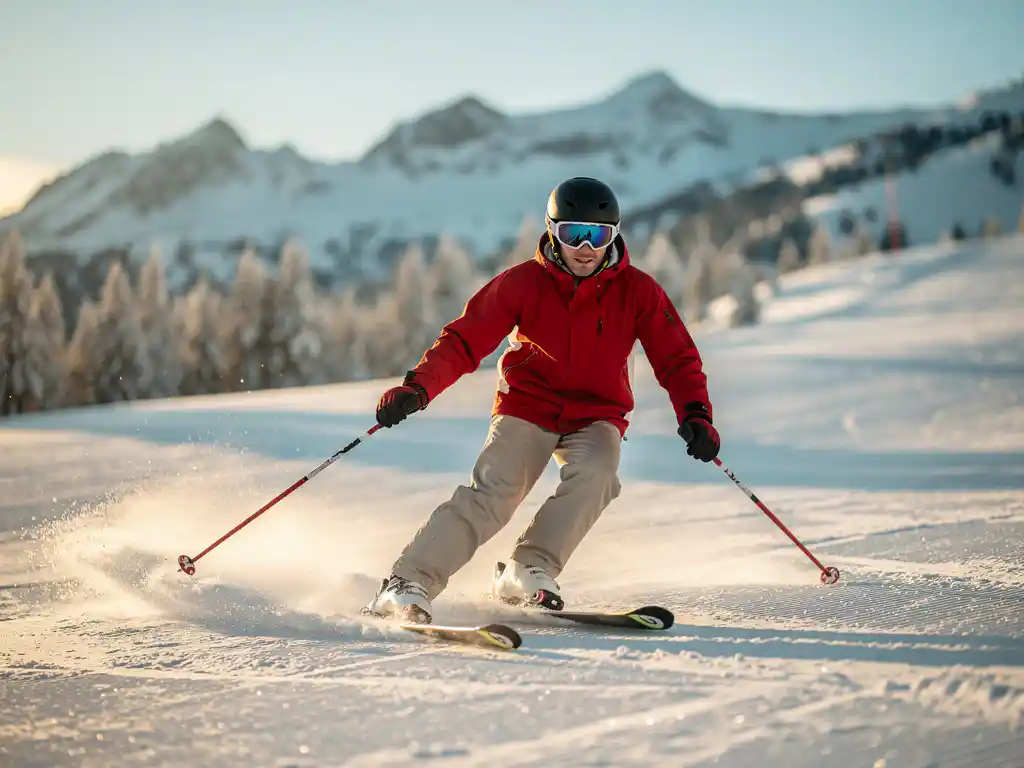
You make your first turn on skis by shifting your weight — from a stable snowplow stance — toward the ski on the inside of the turn, while keeping your knees slightly bent and your gaze directed forward. This sounds simpler than it feels on an actual slope, but with the right technique most beginners manage it during their first or second ski lesson. In this article, we answer all your questions about making your first turn on skis, step by step.
What stance do you need before making a turn?
Before you can make a turn, you need a stable basic position: feet hip-width apart, knees slightly bent, torso leaning slightly forward, and arms relaxed in front of your body. This basic stance gives you control over your skis and allows you to react quickly to the slope. Without this foundation, making a turn becomes far harder than it needs to be.
The most common mistake beginners make is standing too upright or leaning too far back. Standing too straight makes you rigid and gives you little grip. Leaning too far back causes the tails of your skis to press too hard into the snow, causing you to lose control. The ideal position feels a bit like sitting on an invisible bar stool: relaxed but engaged.
Pay attention to your ski boots as well. They are deliberately stiff and angled slightly forward. When you let your shins press lightly against the tongue of the boot, you automatically fall into the correct forward position. It feels awkward at first, but it is exactly the stance you need to make smooth turns later on.
How does weight transfer work when making a turn?
Weight transfer is the foundation of every turn on skis. By shifting your body weight onto the outside ski of the turn, you apply more pressure to that ski against the snow, which initiates and guides the turn. The more deliberately you shift your weight, the sharper and more controlled the turn becomes.
Imagine you want to turn left. You shift your weight onto your right ski, which is the outside ski in a left turn. Your right foot presses firmly into the footbed of your boot, your right knee bends a little more, and your hip tilts subtly to the right. Your left ski follows naturally.
This principle sounds logical, but in practice beginners do the opposite: they lean toward the mountain out of fear of falling, when in fact you need to dare to lean toward the valley. That mental step is the biggest stumbling block for many people. Learning to trust your skis and consciously shift your weight is therefore the first thing a good ski instructor will teach you.
What is the difference between a snowplow turn and a parallel turn?
A snowplow turn, also known as a pizza turn or wedge turn, is a beginner’s turn in which the tips of your skis point toward each other and the tails fan outward. A parallel turn is an advanced technique in which both skis remain parallel throughout the entire turn and you steer purely through weight transfer and edging.
The snowplow turn: control for beginners
Skiing in a pizza wedge position automatically creates resistance and braking force. The V-shape provides stability and gives you time to steer calmly. The snowplow turn is the ideal entry-level technique because it lets you actively brake and control your speed without needing to have perfect balance yet. Almost all beginners learn the pizza wedge first before moving on to anything else.
The parallel turn: the next step
In a parallel turn, your skis stay side by side and you turn by shifting your weight and edging your skis — that is, setting them at an angle into the snow. This requires more balance, timing, and body awareness. Most recreational skiers reach this level after several ski holidays or a solid course. It is not the goal of your first day on the slopes, but it is something to work toward.
How do you make your first snowplow turn, step by step?
You make your first snowplow turn by shifting your weight onto one ski from a stable pizza wedge stance, while lightly edging that ski and directing your gaze in the direction of the turn. The turn then follows almost on its own. The process is explained step by step below.
- Get into the pizza wedge stance: Push the tips of your skis toward each other to form a V-shape. Keep your knees bent and your weight evenly distributed.
- Choose your direction: Want to go right? Direct your gaze to the right and let your shoulders rotate slightly in that direction.
- Shift your weight: Press your left foot a little more firmly into your boot and subtly shift your hip to the left. The outside ski of the turn — in this case your left ski — now takes on more weight.
- Edge your ski slightly: Press the inside edge of your left foot gently downward. This tilts the ski and helps it carve into the turn.
- Let the turn run out: Hold your position steady until you have reached the desired direction. Then bring your weight back to the center before initiating the next turn.
- Repeat on the other side: Learning to make turns on skis is about rhythm. Alternate calmly from left to right and let the slope work for you.
Always start on a wide, gentle slope with few other skiers. A blue or even a green run is ideal for your first attempts. Try not to go too fast: skiing slowly gives you more time to feel what your skis are doing.
Why do beginners often struggle to make turns?
Beginners often struggle to make turns because they instinctively lean toward the mountain out of fear of falling, while the technique requires leaning toward the valley. In addition, many beginners look down at their skis instead of looking ahead, which disrupts their balance and blocks the turn.
Other common causes include:
- Standing too stiff: Tense muscles react more slowly and give you less feel for the surface. Skiing in a relaxed way means learning faster.
- Not transferring weight: Beginners hope the skis will turn on their own, but without active weight transfer very little happens.
- Going too fast: Speed feels scary, causing beginners to lean back and lose control. Starting slowly on a gentle slope makes an enormous difference.
- Poor equipment: Skis that are not properly tuned or boots that do not fit well make the technical challenge harder than it needs to be.
- No proper instruction: Many people try to figure it out on their own by watching others. This takes far longer than a focused lesson.
The good news: almost all of these obstacles can be overcome quickly once you know what to pay attention to. A little awareness and the right guidance make a world of difference.
Does a ski lesson really help when learning to make your first turn?
Yes, a ski lesson makes a huge difference when learning to make your first turn. A certified ski instructor immediately spots the mistakes you are making and corrects them before they become habits. What you learn in half an hour of instruction can otherwise cost you an entire holiday of frustration and painful falls.
A good instructor tailors their explanations to your level, gives you exercises that work specifically for you, and ensures you learn to handle the slope safely. Group lessons are a great and affordable way to learn the basics alongside other beginners, while private lessons help you progress faster if that is what you want.
How Ski-Pro helps you with your first turns on the slope
Whether you are dreaming of your first pizza wedge turn in Tirol or want to start out gently on the slopes of Winterberg, the right ski lesson makes all the difference. Through Ski-Pro, you can easily find and compare ski schools and instructors that perfectly match your level, location, and budget. Here is how we do it:
- Access to more than 250 certified ski schools and instructors in the Alps
- Transparent comparison of group lessons and private lessons by price and quality
- Easy online booking, including last minute
- Suitable for all levels, from absolute beginner to advanced skier
- Personal service from real winter sports enthusiasts who know exactly what you need
Your first turn on skis is a moment you will never forget. Make sure you start well prepared and book your ski lesson today through our platform. You hit the slopes — we take care of the rest!
Frequently Asked Questions
How long does it take before I can make turns on the slope on my own?
Most beginners make their first snowplow turn during the first or second ski lesson. To make turns independently and in a controlled way on a blue run, you need an average of two to three days of practice, ideally with guidance from an instructor. How consistently you train and how good your basic stance is largely determines how quickly you progress.
Which slope is best for practicing my first turns?
Always start on a green or blue run: wide, quiet, and with a gentle gradient. A slope that is too steep generates too much speed, causing you to instinctively lean back and lose control. Many ski resorts have dedicated practice areas or beginner zones that are ideal for your first turns.
What do I do if I keep picking up too much speed during a turn and don't know how to brake?
If you are building up too much speed, widen your pizza wedge stance by pushing the tails of your skis further apart. This increases resistance and slows you down automatically. Also make wider, sweeping turns across the full width of the slope instead of heading straight down, so the gradient generates less speed.
Is it better to take a private lesson or a group lesson as a complete beginner?
Both options work well, but with a private lesson you learn faster because the instructor focuses entirely on you and tailors the exercises to your specific mistakes and pace. Group lessons are considerably more affordable and also offer social motivation, which many beginners find genuinely encouraging. Through Ski-Pro you can easily compare both options by price and availability, so you can make the choice that suits you best.