
What is the correct posture for ski poles?
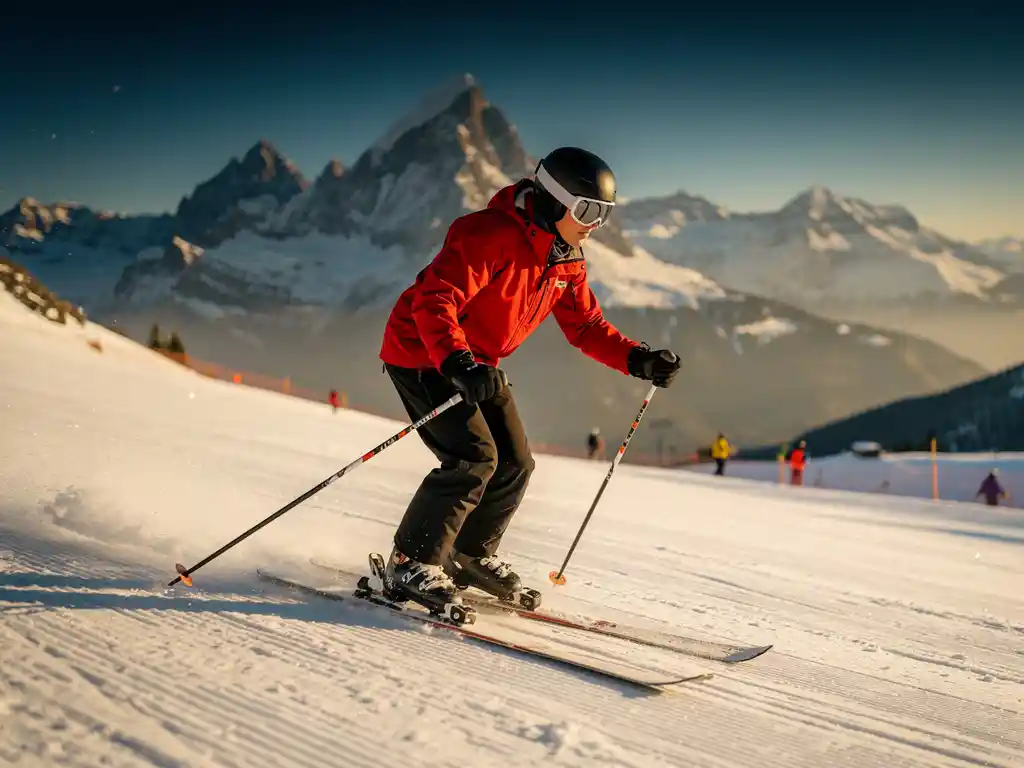
The correct posture for ski poles starts with a relaxed grip, a slightly bent elbow, and a natural swing from the wrist. You hold the poles angled backward, with the tip pointing toward the snow behind you — not straight down or out in front. This basic posture applies to all skill levels, but for beginners in particular, it forms the foundation of good ski technique.
Using ski poles correctly has more of an impact on your balance and rhythm than most beginners expect. In this article, we answer the most frequently asked questions about ski poles — from how to hold them to when you should actually use them as a beginner.
How do you hold ski poles correctly?
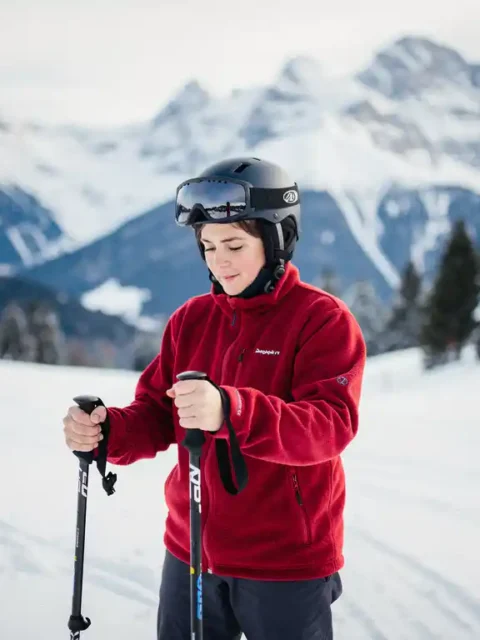
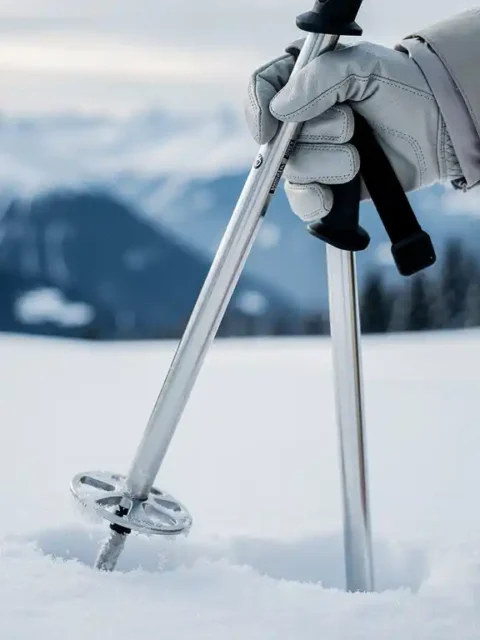
You hold ski poles correctly by inserting your hand upward through the strap and then draping the strap over your hand. You then grip the handle so that the strap presses against your palm. Your fingers hold the pole lightly — not in a tense, clenched grip. Your elbows are slightly bent and your arms hang relaxed at your sides.
This may sound like a minor detail, but the way you use the strap makes a big difference. By wearing the strap correctly, you don’t need to grip the pole tightly. The strap carries the weight of the pole, keeping your wrist and forearm relaxed. This gives you greater control and prevents fatigue in your hands and forearms after a long day on the slopes.
Many skiers simply push their hand down through the strap from above, which renders it useless. The result is a stiff, tense grip that limits your freedom of movement and prevents the pole from releasing during a fall. That last point is actually dangerous: when you fall, the pole needs to be able to come free to prevent injuries.
What is the correct length for ski poles?
You determine the correct length for ski poles by holding the pole upside down, with the tip pointing up. Grip the pole just below the basket. If your elbow forms an angle of roughly 90 degrees, the length is correct. For a beginner on an average slope, this is the ideal starting position for good balance.
Another rule of thumb: pole length in centimeters is roughly equal to your height in centimeters multiplied by 0.68. If you are 175 cm tall, you should look for a pole of around 120 cm. This is an approximation, but a good starting point if you don’t have a pole on hand to test.
Poles that are too long push your body backward, shifting your weight onto your heels. In skiing, that is exactly the opposite of what you want. Poles that are too short force you to lean too far forward, putting strain on your back and knees. For beginners, the correct length is therefore not a luxury — it is a genuine basic requirement for comfortable and safe skiing.
Where should you plant your ski poles while skiing?
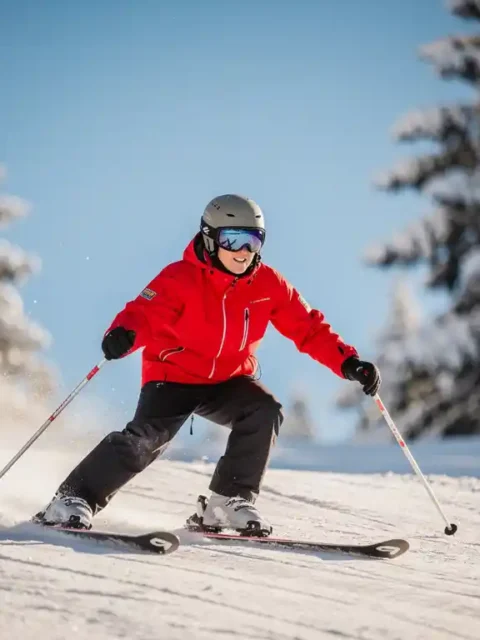
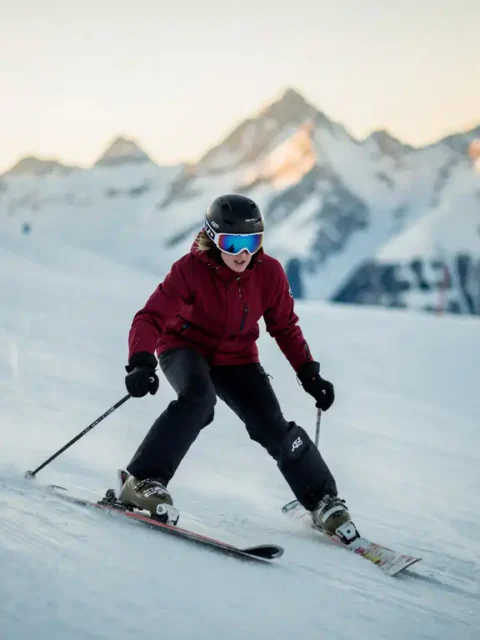
While skiing, you plant your pole at an angle in front of you, on the inside of the turn you are about to make. The pole briefly touches the snow, provides a light impulse, and helps you maintain the rhythm of your turns. The plant is always in front of your body — never to the side or behind you.
The pole plant, as this moment is called, is more than a technical trick. It is a signal to your body that the next turn is beginning. Your arm moves from the wrist, not from the shoulder. Think of a small, quick wrist movement where the pole touches the snow and you immediately continue skiing. The pole does not get stuck in the snow — it only briefly makes contact with the ground.
As a beginner, you don’t need to have the pole plant perfectly mastered yet, but consciously placing your poles helps you develop a good rhythm early on. Skiers who do this well move more fluidly from turn to turn and lose less speed and balance in the transition.
Why do many beginners hold their ski poles incorrectly?
Many beginners hold their ski poles incorrectly because they instinctively use them as support, similar to hiking poles. They carry the poles horizontally in front of them, plant them straight down, or grip them tensely out of uncertainty. This pattern develops from a combination of nerves, unfamiliarity, and a lack of clear instruction.
On the slope, everything feels overwhelming at first. You are focused on your skis, your speed, other skiers, and the gradient. The poles are the last thing you consciously think about. As a result, you fall back on what feels familiar — and for most people, that is the posture of a hiker or someone holding on for support.
On top of that, many beginners learn to ski without explicit instruction on pole technique. Beginner ski lessons rightly focus first on balance, snowplowing, and braking. Poles are sometimes introduced later, but in the meantime, beginners already have them in hand and have no idea what to do with them. A good ski instructor addresses this early on, so you don’t develop bad habits that you’ll have to unlearn later.
When should you use ski poles as a beginner?
As a beginner, you should only use ski poles once your basic balance is stable and you can already brake and steer independently. In the very first lessons, it is better to leave the poles behind or simply let them hang at your sides. Once you start making turns and developing a basic rhythm, poles help improve your timing and coordination.
Some ski schools have complete beginners ski the entire first day without poles. This is not a punishment — it is a deliberate choice. Without poles, you are forced to find your balance entirely through your body, which accelerates the development of fundamental ski technique. Poles can be distracting in the beginning and may even create a false sense of security.
Once you do start using the poles, be intentional about it. Hold them in a relaxed grip, let them swing naturally with your movement, and practice the simple wrist motion of the pole plant on quiet, wide runs. This way, you build up correct technique step by step, without having to correct bad habits later.
How Ski-Pro helps you take your first steps on the slopes
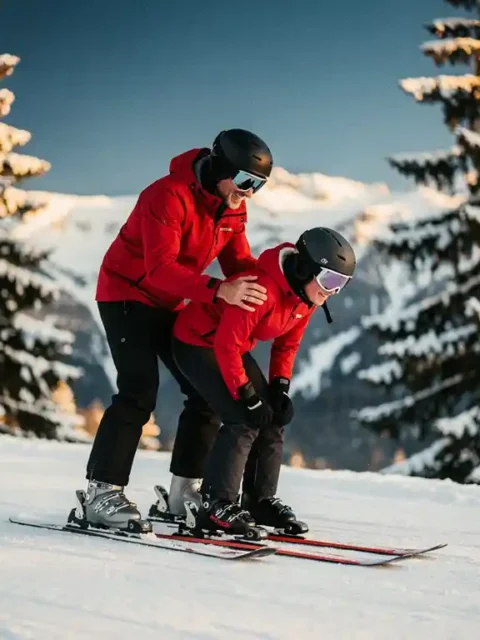
The fastest way to learn ski pole technique is with the right guidance. An experienced ski instructor can see at a glance how you are holding your poles, corrects your posture on the spot, and gives you exercises suited to your level. Finding the perfect lesson doesn’t have to be complicated — and that is exactly what we are here for.
Through our platform, you can quickly and easily find the best ski lesson for you:
- More than 250 certified ski schools and instructors in the Alps, from Tyrol to the Swiss mountains
- Compare lessons by price, level, and location, so you know exactly what you are booking
- Private or group lessons, depending on what suits you best
- Transparent pricing, no surprises afterward
- Suitable for all beginners, from children to adults stepping onto skis for the first time
Whether you dream of making your first turns in Winterberg or an adventurous week in Austria, Ski-Pro is the right place for you. Compare, book, and hit the slopes with an instructor who will teach you to ski the right way — poles and all!
Frequently Asked Questions
Should I use ski poles right away as a complete beginner?
No, as a complete beginner it is actually wise to start your first lessons without ski poles. Without poles, you learn to find your balance purely through your body, which improves your basic posture and ski technique more quickly. Once you can brake and steer independently, you add the poles gradually.
What should I do if my ski poles seem too long or too short on the slope?
Turn the pole upside down and grip it just below the basket: if your elbow forms a 90-degree angle, the length is correct. If not, adjust the poles at your ski rental shop or ski school before continuing. The wrong length directly affects your balance and posture, so it is worth correcting right away.
How do I know if I am using my ski poles correctly while skiing?
A good sign is that your poles swing naturally with your movement and that your wrists are doing the work, not your shoulders. If you notice that you are holding your poles out horizontally in front of you, gripping them tensely, or using them as support on the slope, these are signs that your technique needs adjustment. A ski instructor can see this at a glance and correct it immediately.
Can I use ski poles to brake or stop?
No, ski poles are not meant for braking or stopping, and using them this way is actually dangerous. You always brake with your skis, using the snowplow position or parallel turns. Poles are used exclusively for rhythm, timing, and balance support when initiating turns.