
Which exercises improve your balance on skis?
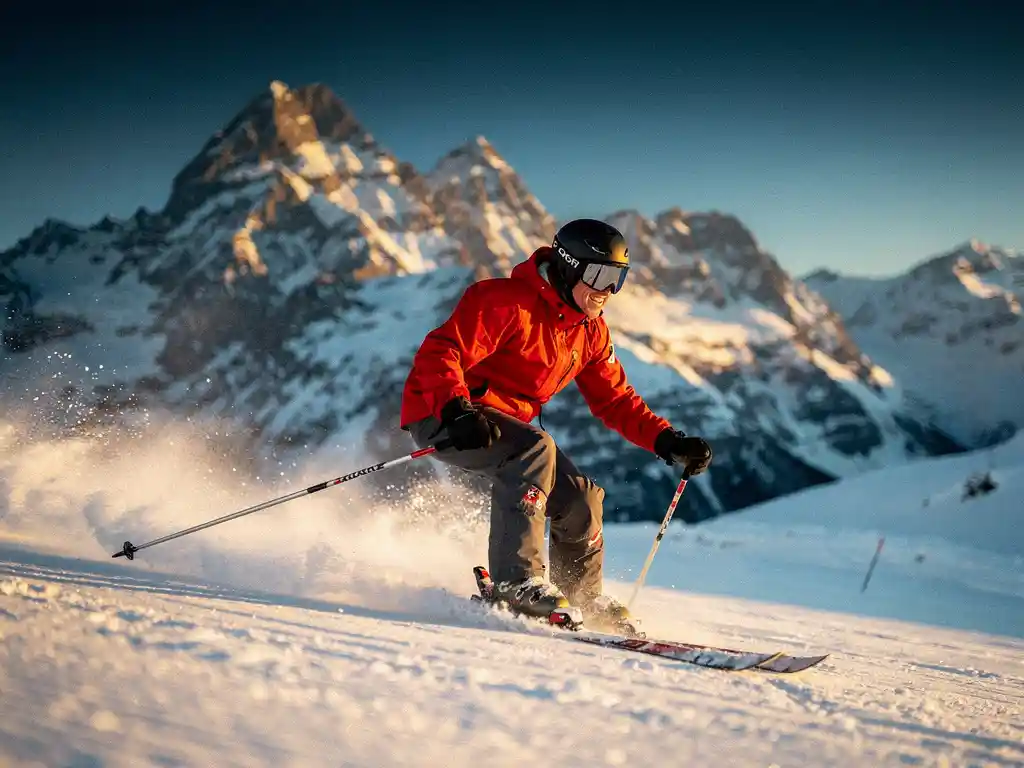
Balance exercises such as single-leg standing, squat variations, and hip hinges are the most effective ways to improve your balance on skis. Regular training strengthens the small stabilizing muscles in your ankles, knees, and hips that you need on the slopes to stay in control of your movements. In this article, we answer the most frequently asked questions about balance and skiing, from which muscles you train to how yoga helps you on the slopes.
Which muscles do you use for balance on skis?
For balance on skis, you primarily use the muscles in your legs, hips, and core. The quadriceps, hamstrings, calf muscles, and tibialis anterior (shin) work together to stabilize your position, while the deep core muscles and glutes keep your upper body upright through every turn or unexpected movement on the slope.
What many beginners don’t realize is that the small stabilizing muscles around the ankles and knees are at least as important as the large leg muscles. These so-called proprioceptive muscles respond incredibly quickly to changes in the snow surface and prevent you from falling when you hit a bump or an icy patch.
Good to know: your upper body plays a role too. The shoulder and back muscles help keep your arms balanced, which directly affects your center of gravity. Those who train their core stand more stably and tire less quickly on the slopes.
Which exercises at home improve your balance for skiing?
At home, you can improve your skiing balance with exercises such as single-leg standing, split squats, hip hinges, and planks. These exercises target the stabilizing muscles in your legs, hips, and core that you directly need when skiing. No gym is required, and they are suitable for all levels.
Here are the most effective exercises:
- Single-leg standing: Stand on one leg and hold your balance for as long as possible. Make it harder by closing your eyes or standing on a cushion.
- Split squat (Bulgarian split squat): Place one foot on a chair behind you and lower yourself deep on the standing leg. Ideal for the quadriceps and stability.
- Hip hinge: Lean forward from the hips with a straight back. Trains the hamstrings and glutes you need for ski turns.
- Lateral step with resistance band: Step sideways with a band around your knees. Strengthens the outer hip muscles that stabilize you in turns.
- Plank variations: Static and dynamic planks train your core stability, which directly contributes to a stable skiing posture.
- Balance board or BOSU ball: If you have one, it’s invaluable. You train the same proprioceptive reflexes as on the slope.
Start with two to three sets of thirty seconds or ten to fifteen repetitions per exercise. Build up gradually as you get stronger and more stable.
How do balance exercises on the slopes help you learn to ski faster?
Balance exercises speed up the learning process on the slopes because they prepare your body for the specific demands of skiing. Those who already have a solid base of balance need to spend less energy staying upright and can focus entirely on technique, turns, and speed. This makes learning to ski considerably easier and more enjoyable.
Skiing requires what athletes call proprioception: your body’s ability to sense its position in space and make rapid adjustments. The better you have trained this ability, the faster you pick up new movement patterns. A beginner who has been doing balance exercises for weeks will literally stand more steadily on their first day on the slopes.
In addition, good balance fitness reduces the risk of injury. Those who have strengthened their ankles and knees are better protected against the sudden forces that occur during skiing. Fewer injuries mean more time on the slopes and, therefore, faster progress.
What is the difference between static and dynamic balance exercises for skiers?
Static balance exercises train your ability to stand still and controlled in one position, such as single-leg standing or holding a plank. Dynamic balance exercises train your ability to maintain balance during movement, such as lateral steps or single-leg hops. Both types are valuable for skiers, but dynamic exercises most closely mirror the reality of the slopes.
Static exercises: the foundation
Static exercises build fundamental stability in your joints and muscles. They are ideal as a starting point, especially if you have little experience with balance or strength training. Think of single-leg standing, holding a low ski position, or holding a plank. These exercises teach your body to maintain a position without losing balance.
Dynamic exercises: ski-specific training
Dynamic exercises mimic the constant movement of skiing. Your body learns to maintain balance while changing position, just as it does with every turn on the slope. Examples include lateral jumps, skater lunges, and balance board exercises where you shift back and forth. For those looking to improve their ski technique, these are the exercises that make the biggest difference on the slopes.
How often should you do balance exercises before your ski vacation?
Ideally, train balance exercises three to four times per week, starting six to eight weeks before your ski vacation. This gives your body enough time to strengthen the stabilizing muscles and develop the proprioceptive reflexes you need on the slopes. Training for fewer than four weeks has little effect on your balance.
A smart training schedule looks like this:
- Weeks 1 and 2: Focus on static exercises. Build a stable foundation with single-leg standing, planks, and light squats.
- Weeks 3 and 4: Add dynamic exercises. Combine static and dynamic training for a more complete training effect.
- Weeks 5 and 6: Increase the intensity and add ski-specific imitation exercises, such as skater lunges and deeper squat positions.
- Weeks 7 and 8: Maintain your fitness without overtraining. Rest is just as important as training.
Even ten to fifteen minutes a day makes a noticeable difference. Consistency matters more here than the length of each session.
Can yoga and Pilates also help with balance on skis?
Yes, yoga and Pilates are excellent additions to your ski preparation. Both disciplines improve your core stability, body awareness, and flexibility, which directly contributes to better balance on skis. Yoga also strengthens your concentration and breathing, while Pilates specifically trains the deep stabilizing muscles that are so important in skiing.
In yoga, poses such as the warrior poses, tree pose, and chair pose are particularly useful. They train strength, balance, and concentration simultaneously, at a pace that is easy to follow even for beginners.
Pilates focuses on the so-called core: the deep abdominal and back muscles that stabilize your trunk. A strong core means your upper body stays calm while your legs do the work in a turn — exactly what good ski technique requires.
Combine yoga or Pilates with the more specific balance exercises in this article for the best preparation. Two yoga or Pilates sessions per week, supplemented by two targeted leg training sessions, is an ideal mix for the six to eight weeks leading up to your ski vacation.
How Ski-Pro helps you hit the slopes better prepared
Training at home is a great start, but the real leap in balance comes with guidance from an experienced ski instructor. A good instructor can immediately see where your posture needs improvement and give you exercises that are perfectly matched to your level and learning style. Whether you’re stepping onto skis for the first time or looking to refine your technique, professional guidance dramatically accelerates your progress.
We help you find that perfect match. Through our platform, you can easily compare more than 250 certified ski schools and instructors in the Alps, so you can book exactly the lesson that suits you. Here are our advantages at a glance:
- More than 250 ski schools and instructors in Austria, Switzerland, France, and more
- Easy comparison by price, level, and location
- Suitable for absolute beginners to advanced skiers
- Transparent pricing, no surprises
- Personal advice to help you make the best choice
Ready to hit the slopes well prepared and full of confidence? Compare and book your ski lesson through Ski-Pro and take that first step toward an amazing ski adventure!
Frequently Asked Questions
Can I start balance training if I've never skied before?
Absolutely — in fact, that’s when it’s most valuable. As a complete beginner, you benefit the most from starting a balance routine early, because your body has more time to develop the stabilizing muscles and proprioceptive reflexes. Start with simple static exercises such as single-leg standing and light squats, and build up gradually from there toward your ski vacation.
What if I only have a few weeks to train before my ski vacation?
Even two to three weeks of training makes a noticeable difference, though six to eight weeks is ideal. In that case, go straight to the most ski-specific exercises: split squats, lateral steps with a resistance band, and dynamic single-leg balance exercises. Train ten to fifteen minutes daily and, if possible, combine this with one or two yoga sessions for extra core stability.
How do I know if my balance is good enough for the slopes?
A good rule of thumb: if you can effortlessly stand on one leg for thirty seconds with your eyes closed and a stable core, you have a solid base of balance for skiing. If you can’t do this yet, that’s exactly the starting point to work on. A certified ski instructor can also assess on the very first lesson day where your balance and posture need improvement.
Are there specific mistakes beginners make when training balance for skiing?
The most common mistake is progressing too quickly to heavy or complex exercises without first building a stable foundation. As a result, many people end up training the wrong muscles or compensating with their large leg muscles instead of the small stabilizing ones. Always start with static exercises, focus on a straight back and controlled movements, and only add dynamic variations once the basic position feels stable.