
From what age should skiers start using ski poles?
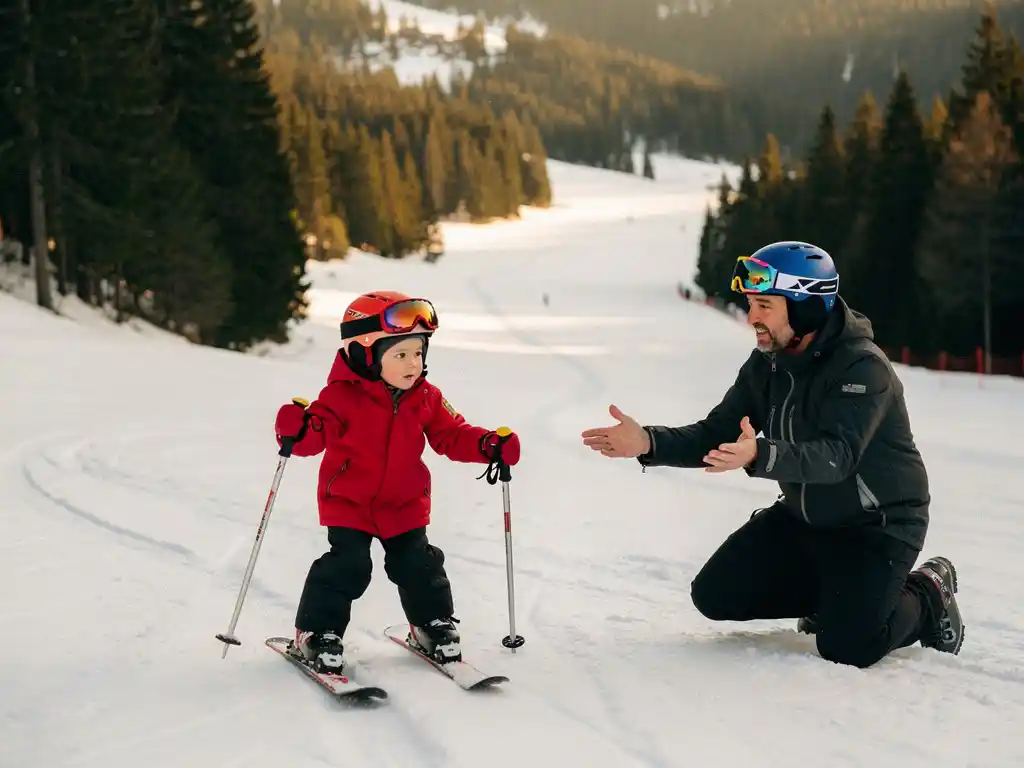
Beginners are best off starting with ski poles once they can stop smoothly, make turns, and feel confident on the slope — usually after two to three full days of skiing. Ski poles are not a tool for the very first lessons, but a complement for skiers who have already developed a basic sense of balance. In this article, we answer the most frequently asked questions about using ski poles as a beginner.
Why do beginners ski without poles in the first place?
Beginners ski without poles because, in the early stages, poles are more of a distraction than a help. When you are just learning to ski, you need all your concentration for your body posture, weight distribution, and leg movement. Ski poles often give beginners a false sense of support, causing them to lean rather than find their balance.
Without poles, you instinctively learn to use your arms for balance, keep your upper body upright, and distribute your weight correctly across your skis. These are precisely the fundamental skills you will need later to ski well and safely. Instructors in the Alps almost always start without poles, and that is no coincidence. It is the most effective way to build a solid foundation.
Furthermore, ski poles in the hands of a beginner can be dangerous. On busy beginner slopes, during exercises, or during a fall, poles can cause accidents — both for yourself and for the skiers around you.
What skills should you master before picking up ski poles?
Before introducing ski poles, you need to be able to perform a number of basic skills independently and fluently. Without this foundation, poles add little value and can even slow down your progress.
These are the skills you should master first:
- Stopping: You can brake in a controlled manner and come to a complete stop at any time, even on a slightly steeper slope.
- Making snowplow turns: You make smooth turns to the left and right without wobbling or falling.
- Weight distribution: You understand how to distribute your weight across your skis and actively apply this when steering.
- Confident riding on blue runs: You ski on easy slopes without significant fear or hesitation.
- Stopping and starting: You can stand still on a slope, sidestep, and set off again on your own.
Once all of these elements fall into place, the time has come to introduce ski poles. On average, that is after two to three full days of skiing, but it varies from person to person. Some people need a week, and that is perfectly normal.
How do you use ski poles correctly as a beginner?
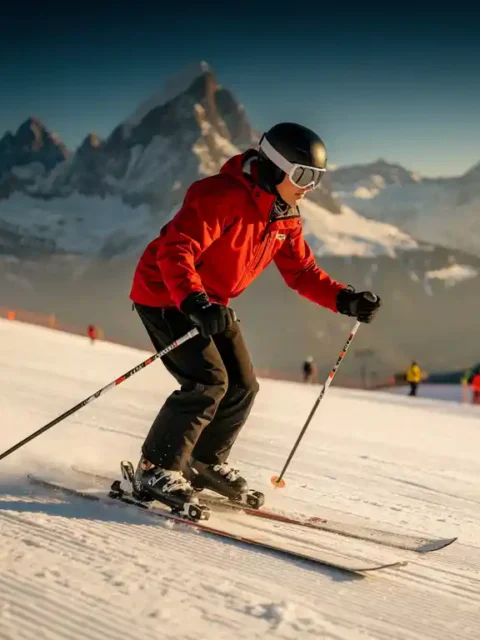
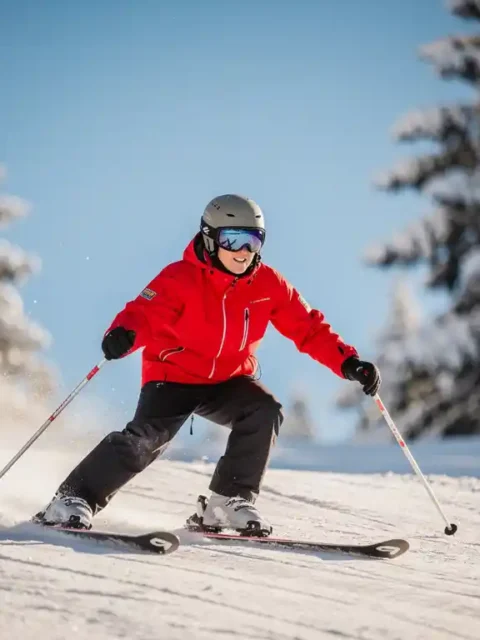
Correct use of ski poles as a beginner starts with the right technique: plant the pole briefly and lightly in the snow to the side of your ski, use it as a rhythm and balance aid when initiating a turn, and keep your wrists relaxed. The pole does not steer — it supports the timing of your movement.
Many beginners make the mistake of leaning too heavily on their poles, planting them too far out in front, or simply dragging them along without actively using them. This leads to poor posture and slows down your technical development.
The correct wrist movement
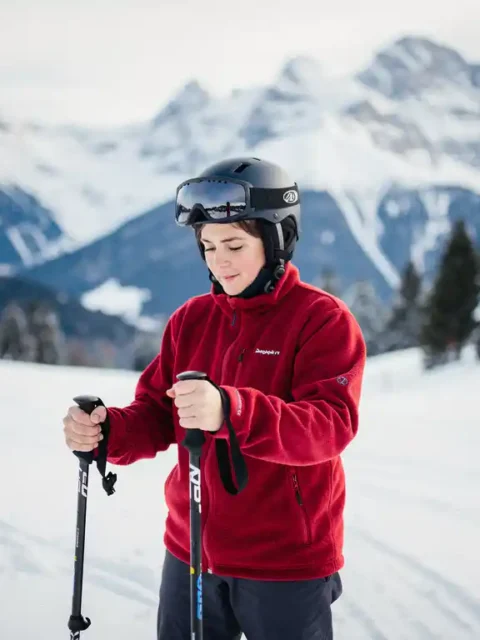
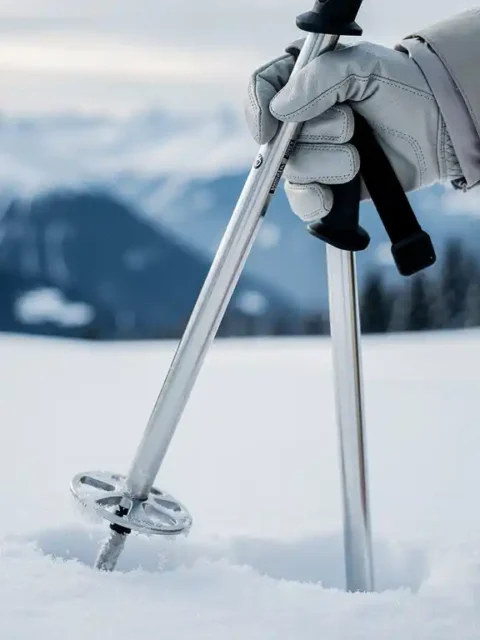
Thread your hand through the pole’s wrist strap and hold the pole with a relaxed grip. The strap carries the weight of the pole, so your hand does not need to grip tightly. Let your wrist lead the movement, not your entire arm.
The pole plant moment
Plant the pole at the start of each turn, just before you shift your weight onto the new outside ski. This gives you a clear rhythm and helps you make turns more smoothly and consistently. Practice this first on a quiet, wide slope where you have plenty of room.
What is the correct length for ski poles for beginners?
You determine the correct length for ski poles as a beginner by holding the pole upside down, just below the basket, while standing upright. Your elbow should then form an angle of approximately 90 degrees. This is the universal rule of thumb for determining the correct pole length.
In practice, this means that pole length depends on your height. A general guideline:
- 5’3″ to 5’5″ (1.60 m to 1.65 m): 105 cm pole
- 5’5″ to 5’9″ (1.65 m to 1.75 m): 110 cm pole
- 5’9″ to 6’1″ (1.75 m to 1.85 m): 115 cm pole
- Above 6’1″ (1.85 m): 120 cm pole or longer
As a beginner, your best option is to rent poles from your ski resort or ski school. That way, you do not need to invest right away and can take your time figuring out which length feels most comfortable for you. Adjustable poles are also a great option, especially for children who are still growing.
Should children also wait before using ski poles?
Yes, children should definitely wait before using ski poles — and in most cases, even longer than adults. Young children learn to ski best by moving their whole body freely, and ski poles restrict that freedom. Most ski instructors recommend waiting until children are around seven years old before introducing poles, and only if they are already skiing comfortably.
For toddlers and young children, ski poles are simply not suitable. They lack the coordination to handle poles safely, and on busy children’s slopes, poles pose a risk to other young skiers. Many children’s ski schools deliberately work without poles, even with slightly more advanced children, because it benefits both balance and the enjoyment of skiing.
Wait to introduce poles until your child:
- Can make turns independently on blue runs
- Can stop safely without assistance
- Is old enough to follow instructions on how to use poles
Can ski poles also be detrimental for advanced beginners?
Yes, ski poles can also be detrimental for advanced beginners if they are introduced too early or used incorrectly. The most common problem is that skiers use their poles as a crutch, causing them to lean back and develop poor posture that is difficult to correct later on.
Another risk is that advanced beginners focus too much on planting the pole and therefore pay less attention to their leg work and weight distribution — which are actually the core of good ski technique. In such cases, poles can create a false sense of control.
Do you recognize yourself in this? Consider deliberately skiing a few runs without poles during a lesson. Many instructors use this as an exercise, even with more advanced skiers, to refine basic posture and develop greater awareness of their own balance.
How Ski-Pro helps you with your first skiing experiences
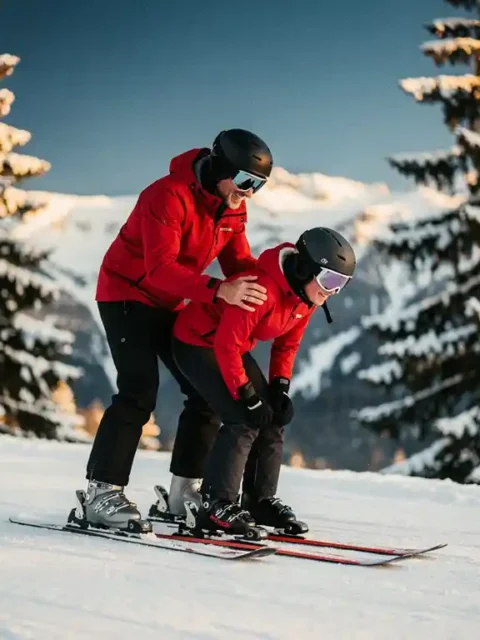
Whether you are just starting out on skis or have already had a few days on the slopes, a good ski lesson makes the difference between frustration and pure snow-filled fun. With an experienced instructor, you will learn exactly when the right moment is to introduce ski poles, how to use them correctly, and what technical steps to take next.
Through Ski-Pro, you can easily find and compare ski and snowboard lessons with more than 250 certified ski schools and instructors in the Alps. Whether you are looking for a private lesson just for yourself, a fun group lesson, or a child-friendly program for the little adventurers in your family, we help you find the perfect match. That way, you step onto the slope with confidence — with or without poles.
- Compare hundreds of ski schools by location, price, and level
- Book easily online, without any hassle
- Choose from private lessons, group lessons, and children’s programs
- Trust certified instructors who know exactly when you are ready for the next step
Ready for your first or next adventure in the snow? Find your perfect ski lesson and start the best week of the year without a worry.
Frequently Asked Questions
Can I rent ski poles as a beginner, or do I need to buy them?
As a beginner, it is wise to rent ski poles rather than buy them straight away. Most ski resorts and ski schools offer rental poles for a small fee, so you can take your time finding out which length and type suits you best. Only once you notice that you ski regularly and are sure of your preferences is it worth investing in your own pair of poles.
What should I do if I notice I am leaning too much on my ski poles while skiing?
If you notice that you are leaning on your poles, the best solution is to deliberately ski a few runs without them. This forces you to rediscover and correct your balance and weight distribution. Many certified ski instructors also use this exercise with more advanced skiers to break bad habits and refine basic technique.
How quickly will I get the hang of using ski poles correctly?
Most beginners pick up the basic principles of pole use within one to two days of skiing, provided they already have a solid foundation in stopping and making turns. The real feel for timing and rhythm — where the pole plant flows seamlessly into your turns — develops gradually with more practice on the slope. A private lesson with a certified instructor can significantly speed up this learning process.
Are there specific situations on the slope where I am better off not using my ski poles?
Yes, on busy beginner slopes, on the ski lift, or in narrow passages, it is wise to keep your poles close to you or temporarily avoid using them actively so you do not hit other skiers. In the event of a fall, it is also important to let go of your poles to prevent injuries to your wrists or shoulders. Good wrist straps help with this, but also practice consciously letting go when you fall.