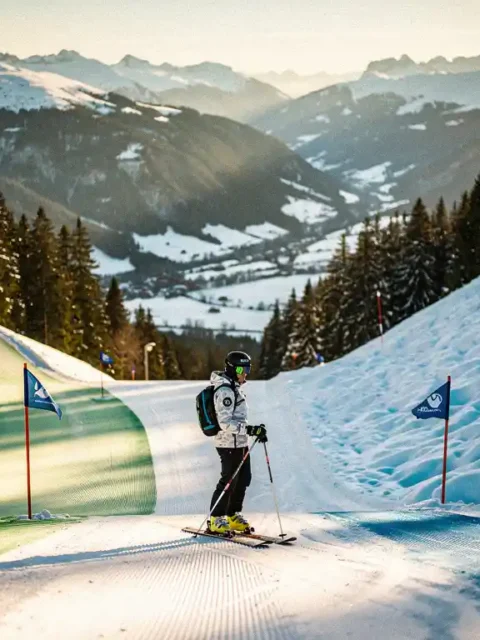

How do you keep your upper body stable while skiing?
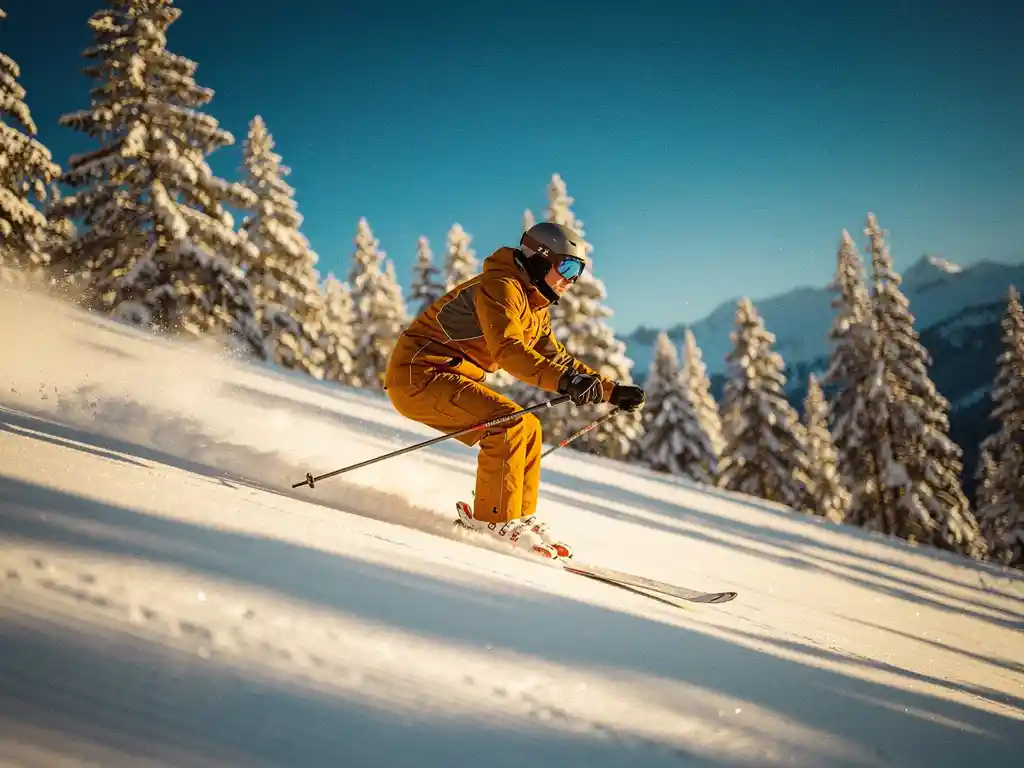
Keeping your upper body stable while skiing means actively engaging your core, keeping your shoulders facing downhill, and positioning your arms calmly in front of your body. This sounds simple, but for many skiers it is precisely the upper body that unnecessarily moves with every turn, directly undermining balance and control. In this article, we answer the most frequently asked questions about proper ski posture for a stable upper body, so you can fly down the slopes with confidence.
Why does your upper body move too much while skiing?
Excessive upper body movement while skiing usually occurs because your core is not active enough and your shoulders “follow” the turns instead of staying stable. Beginners instinctively use their upper body as a counterbalance, when the movement should actually come from the hips and legs. This is one of the most common mistakes in ski posture.
When you stand on skis, your body feels every change in speed and terrain. Your brain responds by using the upper body as a balancing organ, much like you extend your arms when you are about to slip on icy ground. On skis, however, this works against you: the moment your shoulders rotate or your torso tilts, you lose connection with your skis and steering becomes considerably harder.
Another common cause is tension. Skiers who feel nervous on the slopes unconsciously raise their shoulders and stiffen their torso, causing every bump or unexpected movement to travel through the entire body. Relaxed skiing starts with a conscious, active posture in which your core forms the bridge between your stable upper body and your dynamic legs.
What is the correct posture for a stable upper body on skis?
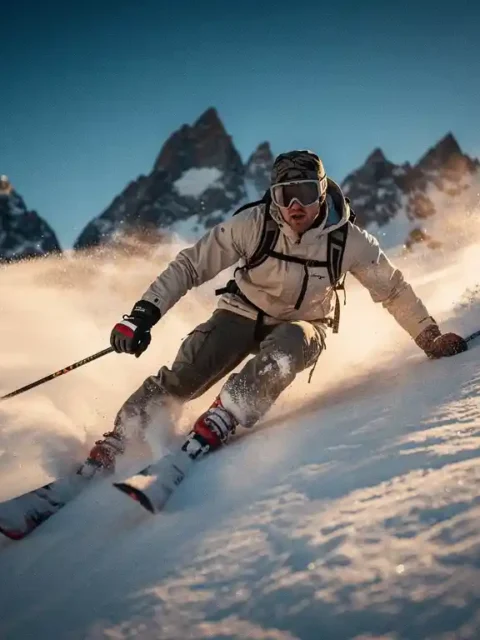
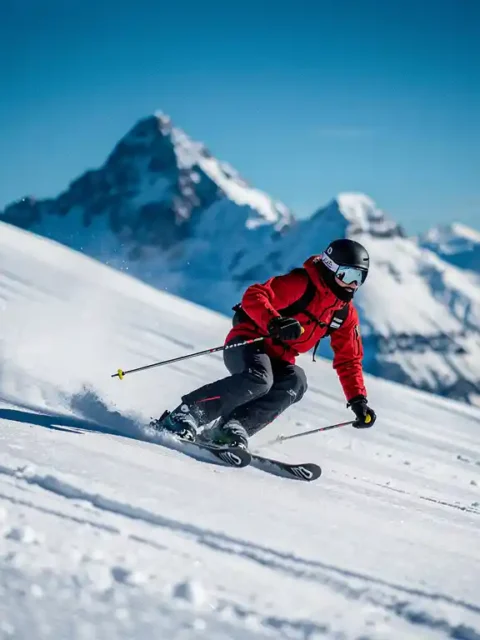
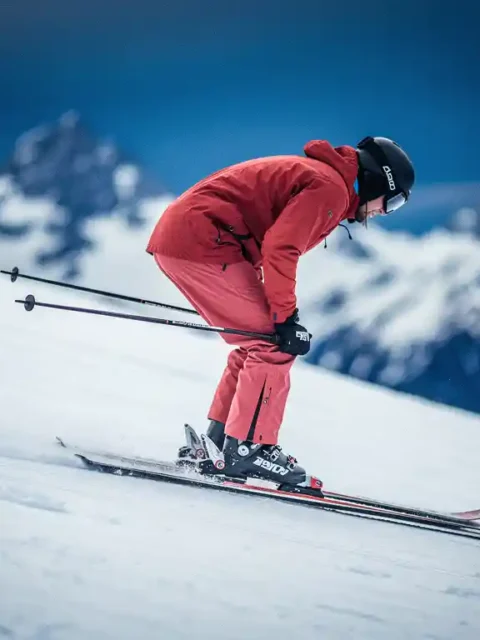
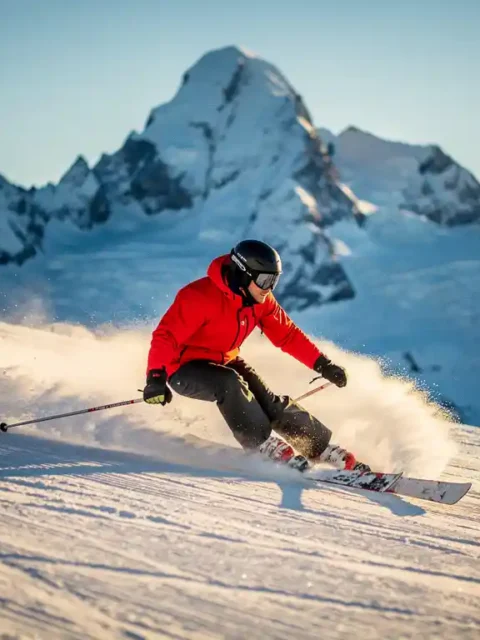
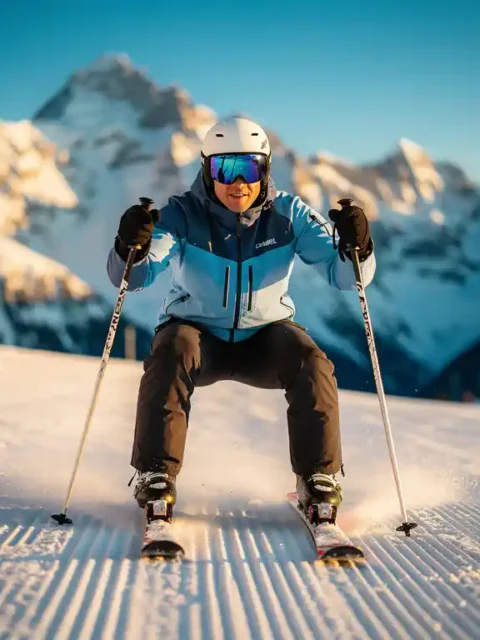
The correct ski posture for a stable upper body means: shoulders relaxed but low, torso slightly tilted forward, arms in front of the body with poles pointing slightly outward, and eyes focused on the slope ahead. Your upper body acts as a calm platform while your legs do all the active work.
In concrete terms, the ideal posture looks like this:
- Head and eyes: look ahead, not at your skis. Where your eyes go, your body follows.
- Shoulders: relaxed, slightly down, and facing the valley — even in turns.
- Arms: bent in front of your body, symmetrical and low. Think of carrying a serving tray.
- Torso: slightly tilted forward from the ankles, not bent from the waist.
- Hips: open and facing forward, acting as the pivot point between your stable upper body and your active lower body.
A useful trick: imagine you are carrying a glass of water on your chest that you do not want to spill. That mental image automatically helps your upper body stay calm, regardless of what your legs are doing.
Which muscles do you use for upper body stability?
Upper body stability while skiing relies primarily on the core muscles: the abdominals, the spinal extensors, the obliques, and the deep stabilizers surrounding the spine. Together, they form the foundation that allows your shoulders and arms to remain calm while your legs actively steer.
The deep abdominal muscles, also known as the transversus abdominis, are the most critical. They keep your spine in a neutral position and prevent every external force — such as a bump or a sharp turn — from traveling through your entire torso. Many skiers train their abdominals but neglect the deep stabilizers that you rarely consciously engage in everyday life.
The muscles around the shoulder blades also play an important role. When these muscles are active, your shoulder blades stay in place and your upper body does not rotate with every movement of your arms or hips. This is precisely why skiers with good posture look so effortless: their upper body seems almost to float while their legs work hard.
How do you keep your hips and shoulders aligned during turns?
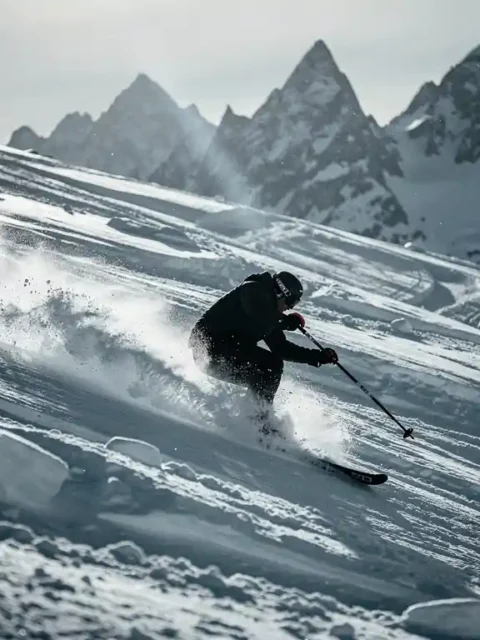
Keeping your hips and shoulders aligned during turns means consciously keeping your upper body facing the valley while your hips initiate the turn. This is called “anticipation” or “looking ahead”: your shoulders are already pointing toward the next turn while your legs are still finishing the current one.
This principle is one of the cornerstones of proper ski posture and is also referred to as the separation between the upper and lower body. Your hips and legs actively rotate into the turn, while your shoulders remain relatively stable and continue to face downhill. That separation gives your skis grip and makes smooth, controlled turns possible.
In practice, it helps to consciously move your outside arm slightly forward as you initiate a turn. That small gesture keeps your shoulder open toward the valley and prevents your upper body from rotating with the turn. Combine this with an active core and you will quickly notice how much more control you have, even on steeper slopes.
Which exercises help make your upper body more stable on skis?
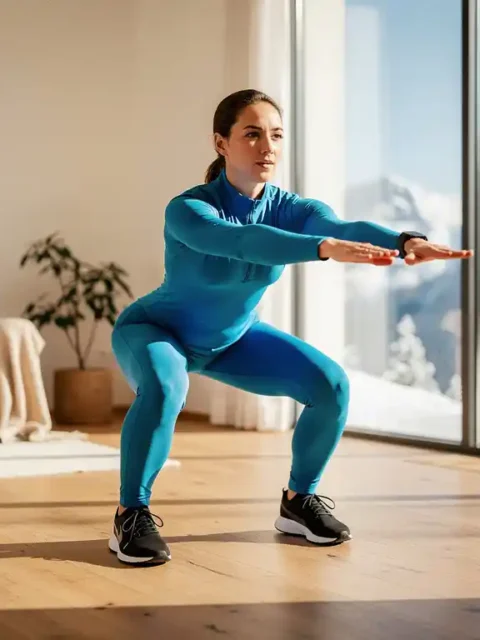
The best exercises for a more stable upper body on skis are core-strengthening exercises such as planks, dead bugs, and Pallof presses, supplemented with balance and coordination exercises such as standing on a balance board or BOSU ball. These exercises train exactly the muscle groups you need for a stable ski posture.
Core exercises for the slopes
- Plank variations: the classic plank, side plank, and plank with arm lift train your deep stabilizers without loading your back.
- Dead bug: lie on your back, arms extended upward, legs in tabletop position. Alternately extend one arm and the opposite leg. Perfect for deep core activation.
- Pallof press: using a resistance band or cable, hold a load in front of your chest and press it forward without rotating. This trains rotational stability — exactly what you need in turns.
Balance and coordination exercises
- BOSU ball squats: squats on an unstable surface force your core and shoulders to stay stable automatically.
- Single-leg stand with arm movement: stand on one leg and move your arms in different directions. Your body learns to decouple the upper body from movement in your legs.
- Shoulder blade retractions: consciously squeeze your shoulder blades together and release. Simple but effective for better posture on skis.
Ideally, start these exercises a few weeks before your ski vacation. That way you step onto the slopes with a body that is ready for the challenge.
When is a ski lesson the fastest way to improve your posture?
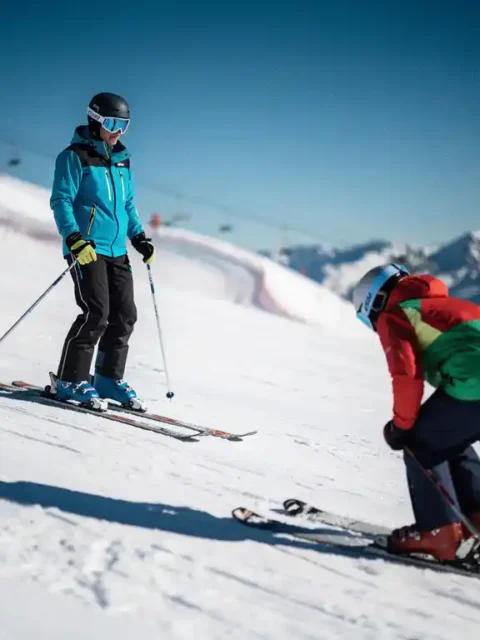
A ski lesson is the fastest way to improve your posture once you notice that you keep repeating the same mistake despite practicing on your own. A certified ski instructor can see in minutes what you cannot see yourself, provides immediate feedback, and corrects your ski posture right where it matters most: on the slope itself.
Practicing independently certainly has value, but posture is something that is difficult to assess while you are doing it. Video recordings help, but an instructor standing beside you and guiding you in real time dramatically accelerates your learning process. Especially for beginners who have no frame of reference for what a stable upper body feels like, personal guidance is indispensable.
Private lessons are the most effective option: the instructor focuses entirely on your specific mistakes and adjusts the pace to your level. Group lessons are a great alternative if you also want to enjoy the social side of skiing, but for targeted posture improvement, the rule is simple: the more personal the attention, the faster the progress.
How Ski-Pro helps you with proper ski posture
A stable upper body on skis starts with the right instructor — and you can find one faster than you think. Through Ski-Pro, you can easily compare and book lessons with more than 250 certified ski schools and instructors across the Alps. Whether you are stepping onto skis for the first time in Winterberg or are ready for your first full week in Tyrol, we help you find the perfect match.
- Compare quickly: browse offerings, prices, and availability from hundreds of ski schools in one place.
- Choose your lesson type: private lessons for targeted posture correction or group lessons for a social snow experience.
- All levels welcome: from complete beginner to advanced skier looking to refine their technique.
- Transparent pricing: no surprises — just honest comparisons and stress-free booking.
All you have to do is choose. We take care of the rest, so you can focus on the slopes on what really matters: enjoying the snow and making every turn better than the last.
Frequently Asked Questions
How quickly will I notice an improvement in my upper body stability when I start the recommended exercises?
Most skiers notice a clear difference after just two to three weeks of consistent training, especially if you perform core exercises such as planks and dead bugs three times a week. Keep in mind that on the slopes it takes a little time before the improved muscle strength automatically shows up in your posture. Give yourself at least one full day of skiing to ‘feel’ the new stability before you evaluate yourself.
What should I do if I notice on the slopes that my shoulders are rotating into the turns again?
Stop on a quiet section of the slope and consciously reset your basic posture: arms in front of your body, shoulders low and facing the valley, and gently engage your core. A useful reset technique is to make two slow, wide turns on an easy slope and focus entirely on keeping your upper body still. By repeating this regularly, you train the awareness that eventually becomes automatic.
Is a stable upper body important on easier blue runs, or only on steep slopes?
Good upper body posture matters at every level and on every slope, including blue runs. Easy slopes are actually the ideal moment to build the right habits, so they become automatic once you move to more challenging terrain. Skiers who develop bad habits on easy slopes find that those mistakes are greatly amplified on steeper runs.
Can I improve my upper body stability without going to the gym?
Absolutely — most of the effective exercises such as planks, dead bugs, and single-leg stands with arm movement can be done at home without any equipment. Add an inexpensive resistance band for the Pallof press and you have a complete preparation workout at home. Consistency matters more than location here: ten minutes a day is more effective than one long session per week.