
Why do you need to lean forward when skiing?

Leaning forward when skiing is essential because it shifts your weight over the front of the ski, giving your skis grip on the snow and allowing you to control your direction and speed. Without this forward pressure, you lose steering and your skis slide out from under you. In this article, we answer the most frequently asked questions about proper ski posture for beginners.
What happens to your skis when you don’t lean forward?
If you don’t lean forward when skiing, you lose control of your skis. Your weight shifts to the back of the ski, causing the tips to rise and your skis to stop responding to steering. The result: you pick up speed with no way to brake, and falling is only a matter of time.
This is one of the most common mistakes beginners make. The natural reflex to lean back when you feel scared or are going too fast actually works against you on skis. The more you lean back, the less edge grip you have on the snow, and the less you can carve or brake. Your skis effectively shoot out from under you.
On top of that, leaning back puts enormous strain on your knees and thighs, because your muscles have to work hard to compensate for the poor position. Skiers who habitually sit too far back find their legs are completely exhausted by mid-morning. A good, forward-leaning posture is not only technically superior — it is also far less tiring.
How exactly does leaning forward work in skiing?
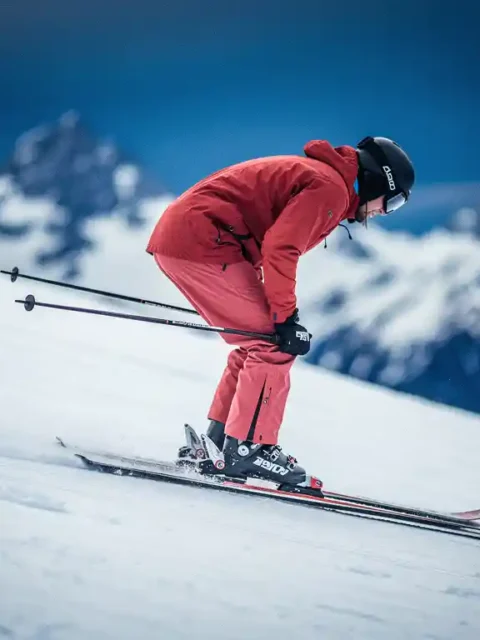
Leaning forward in skiing means actively pressing your shins against the front of your ski boots, so that your weight is distributed evenly along the full length of the ski. This engages the ski’s contact edge with the snow from tip to tail, providing grip, steering, and control.
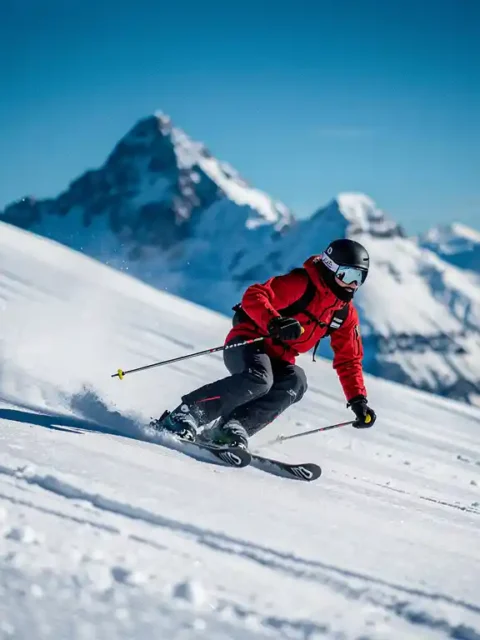
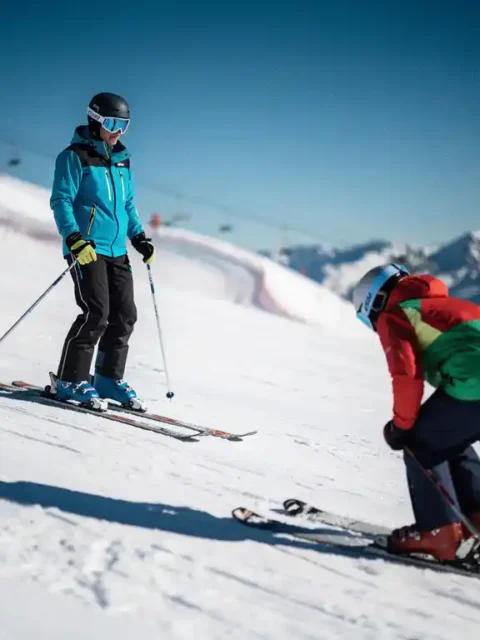
It is not about bending your upper body forward as if taking a bow. That is a common misconception. The movement starts from your ankles and shins. When you gently push your shin forward into the boot, your entire body tilts slightly forward in a straight line, from heel to head. Your knees bend slightly, your hips stay above your heels, and your upper body follows in a natural, relaxed position.
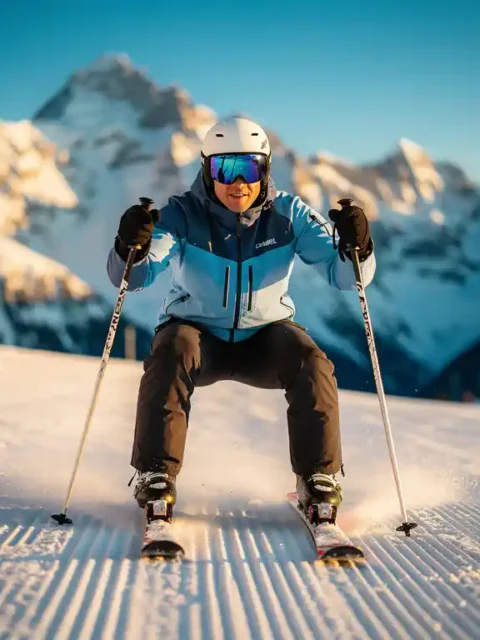
This principle is also known as the athletic stance: knees slightly bent, weight centered, arms relaxed in front of you. In this position, you can react quickly to the terrain, shift edges smoothly, and manage your speed. It is the foundation of proper ski posture on which all other techniques are built.
How far forward should a beginner lean?
As a beginner, you need to lean forward enough to keep your shin in constant contact with the front of your ski boot. A practical rule of thumb: if you take your ski boots off and your shins show no red pressure marks after a day of skiing, you are probably not leaning forward enough.
You do not need to hang dramatically far forward. A light, constant pressure of your shin against the boot is enough. Think of the stance of someone about to sprint: weight slightly forward, knees bent, ready to move. That is the feeling you are looking for on the slope.
Start on a flat, quiet slope and consciously experiment with your weight distribution. Lean slightly forward and feel how your skis respond. Lean slightly back and notice how control disappears. This deliberate play with your posture is the fastest way to learn what the right amount of forward pressure feels like for you.
Why is leaning forward so difficult for beginners?
Leaning forward feels unnatural and even dangerous to beginners, because your instinct tells you to lean back when you feel like you are about to fall or are going too fast. This survival instinct works exactly the wrong way on skis and is the biggest mental barrier for new skiers.
Beyond the fear response, ski boots also play a role. Ski boots are stiff and unfamiliar, especially for people wearing them for the first time. Many beginners walk and stand in ski boots as if they were regular shoes, with their weight on the heel. They carry that habit onto the slope, with all the consequences that follow.
There is also a perception problem: on a slope, the correct posture feels as though you are hanging far forward, when in reality you are simply standing upright relative to the incline. Your brain interprets the angled surface as dangerous and wants to compensate by leaning back. Breaking that pattern takes time and confidence, which is exactly why guidance from a good ski instructor is so valuable.
What exercises help you lean forward more effectively?
There are several targeted exercises that help you develop and internalize the correct forward posture. Most can be practiced at home or on the slope without having to head straight to a steep run.
- Shin pressure exercise: Stand in your ski boots and consciously press your shin forward against the boot. Hold for ten seconds. This trains your muscle memory for the correct pressure.
- Hands on knees: Ski down a gentle slope with your hands resting on your knees. This forces your upper body forward and gives you an immediate sense of the correct position.
- Poles held out in front: Hold your ski poles horizontally in front of your stomach while skiing. If you lean back, the poles will touch your thighs — instant feedback on your posture.
- Slow turns on a flat slope: Practice turns on the flattest slope you can find and focus exclusively on the contact between your shin and the boot. Speed is your enemy when learning technique.
- Squat position at home: Do squats at home and notice how your weight needs to shift forward to maintain balance. That same weight distribution is what you want on skis.
Consistency is key. Five minutes of deliberate practice on a quiet slope does more for you than an hour of mindlessly cruising down a red run. Ask your instructor for regular feedback on your posture — an incorrect position is far easier to spot from the outside than it is to feel from within.
Does the type of ski boot affect your forward lean?
Yes, the type of ski boot has a significant impact on how easily you can lean forward. The stiffness of a ski boot, expressed as the flex index, determines how much resistance the boot offers when you push your shin forward. A boot that is too stiff makes leaning forward literally harder work.
For beginners, boots with a lower flex rating (between 60 and 80) are ideal. These boots give more easily, making it simpler to build forward pressure without requiring a great deal of force. More advanced skiers use stiffer boots (100 and above) because they want greater precision and direct control at higher speeds.
Beyond stiffness, fit is crucial. A ski boot that is too large gives your foot too much room to move, causing you to lose control and feel for pressure. A well-fitting boot that holds your foot firmly in place makes it much easier to adopt and maintain the correct ski posture. Whether you are renting or buying ski boots, always get advice from a specialist at a ski equipment store.
How Ski-Pro helps you achieve the correct ski posture
You cannot learn proper ski posture from an article alone, no matter how well written it is. You need an instructor who can see your specific mistakes, correct them, and give you tailored exercises. That is exactly what Ski-Pro is for. Through our platform, you can easily compare and book lessons with more than 250 certified ski schools and instructors across the Alps. Whether you are stepping onto skis for the first time in Tyrol or looking to refine your technique in Switzerland, we help you find the perfect match. Here is what we offer:
- Compare lessons from 250+ certified ski schools in one place
- Choose between private lessons (fastest progress) or group lessons (fun and affordable)
- Filter by location, level, language, and price
- Transparent pricing, no hidden costs
- Perfect for absolute beginners exploring the Alps for the first time
Ready to finally feel that forward pressure the right way on the slope? Compare and book your ski lesson through Ski-Pro and head to the mountain fully prepared!
Frequently Asked Questions
How quickly can a beginner learn the correct forward-lean posture?
Most beginners start to feel the correct posture after just one or two focused lessons with an instructor. Internalizing the posture — so you no longer have to think about it consciously — takes an average of a full ski week of five to seven days. Consistent practice on gentle slopes combined with feedback from a certified instructor speeds up this process considerably.
Can I practice the correct ski posture at home before hitting the slopes?
Yes, absolutely. Exercises such as squats, single-leg balance, and consciously pressing your shin against the stiff edge of a boot help prepare your muscle memory in advance. You can also rehearse the athletic stance in front of a mirror: knees slightly bent, weight slightly forward, arms relaxed in front of you. The more familiar you are with the posture on dry ground, the faster you will pick it up on the slope.
What if I keep falling back into a rearward posture even after several lessons?
This is a common problem and usually has one of two causes: fear or poorly fitting ski boots. If fear is the culprit, it helps to deliberately practice on even flatter slopes until your confidence grows. If the boot does not fit well or the flex is too stiff, have it reassessed by a specialist. A certified instructor can quickly determine whether the issue is technical, mental, or equipment-related.
Does it matter what type of slope you practice the forward-lean posture on?
Absolutely. Always start on a blue or even a green slope with a gentle gradient and little traffic. On a quiet, flat slope you can focus entirely on your posture without being distracted by speed or other skiers. Once the posture feels automatic on easy terrain, gradually progress to steeper slopes, where correct forward pressure becomes even more important.