
Why is good skiing posture so important?
Good skiing posture matters because it directly affects your balance, control, and safety on the slopes. Leaning incorrectly or engaging the wrong muscle groups causes you to tire more quickly, fall more often, and increases your risk of injury. For beginners, proper ski posture is the foundation on which all other skills are built.
The good news: correct posture is not a matter of talent, but of technique. With the right guidance, you will pick it up faster than you think. In this article, we answer the most frequently asked questions about posture on skis, from common mistakes to the quickest way to get it right.
What happens to your body when your ski posture is wrong?
When your ski posture is wrong, the wrong muscle groups become overloaded and you lose control of your movements. Your body constantly compensates for the lack of balance, leading to faster fatigue, less grip on your skis, and an increased risk of falling or injuring your knees, ankles, and back.
In practice, this shows up in a few typical problems. Leaning too far back causes you to lose control of the ski tips and makes steering impossible. Leaning too far forward puts heavy strain on the knees and quickly wears your legs out. And keeping your legs too stiff means you absorb no shock at all, making every bump on the slope feel like an earthquake.
The danger also lies in cumulative strain. Poor posture over half a day of skiing means your muscles and joints are constantly overworked. This translates not only into pain on the day itself, but also into a greater risk of injury over the long term. Skiing well truly starts from within: with a body positioned correctly.
What does correct ski posture actually look like?
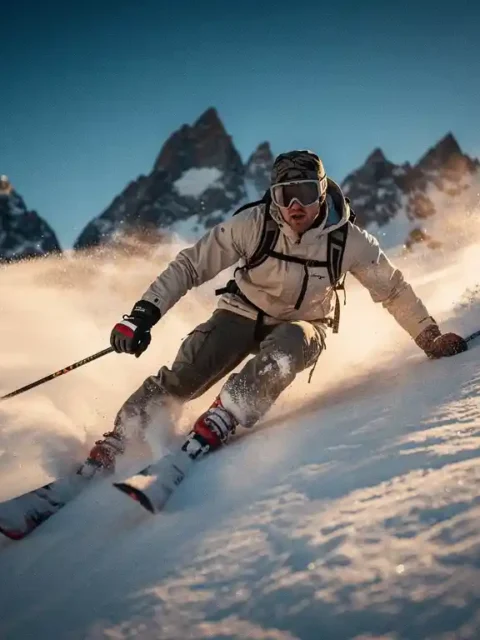
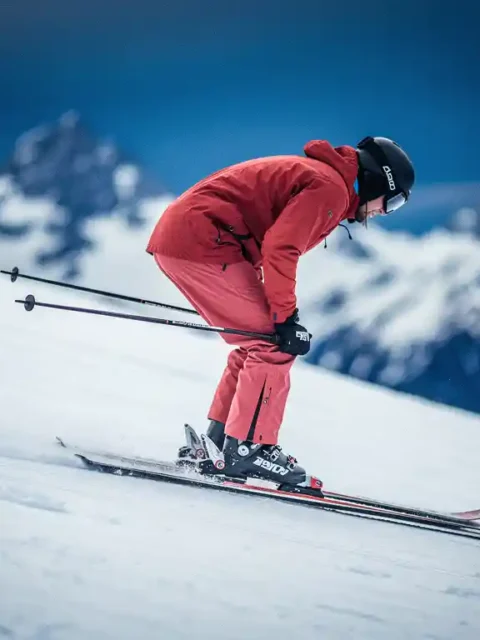
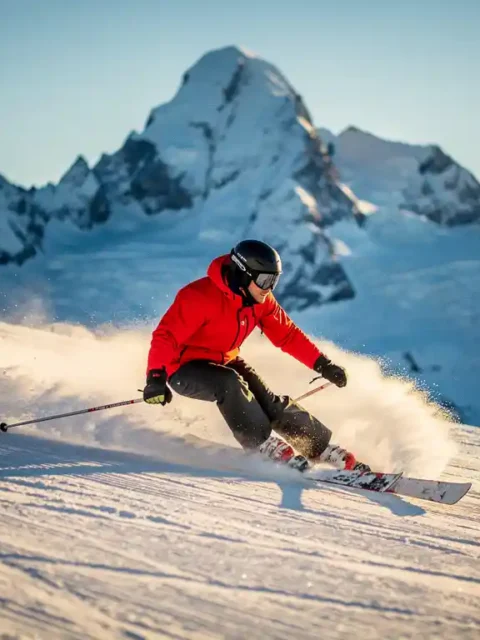
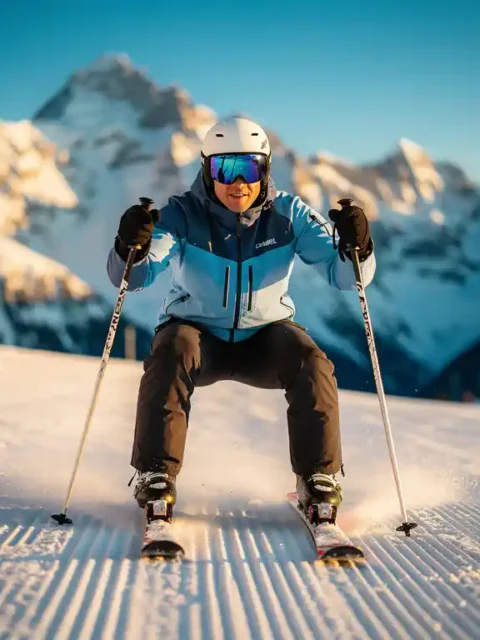
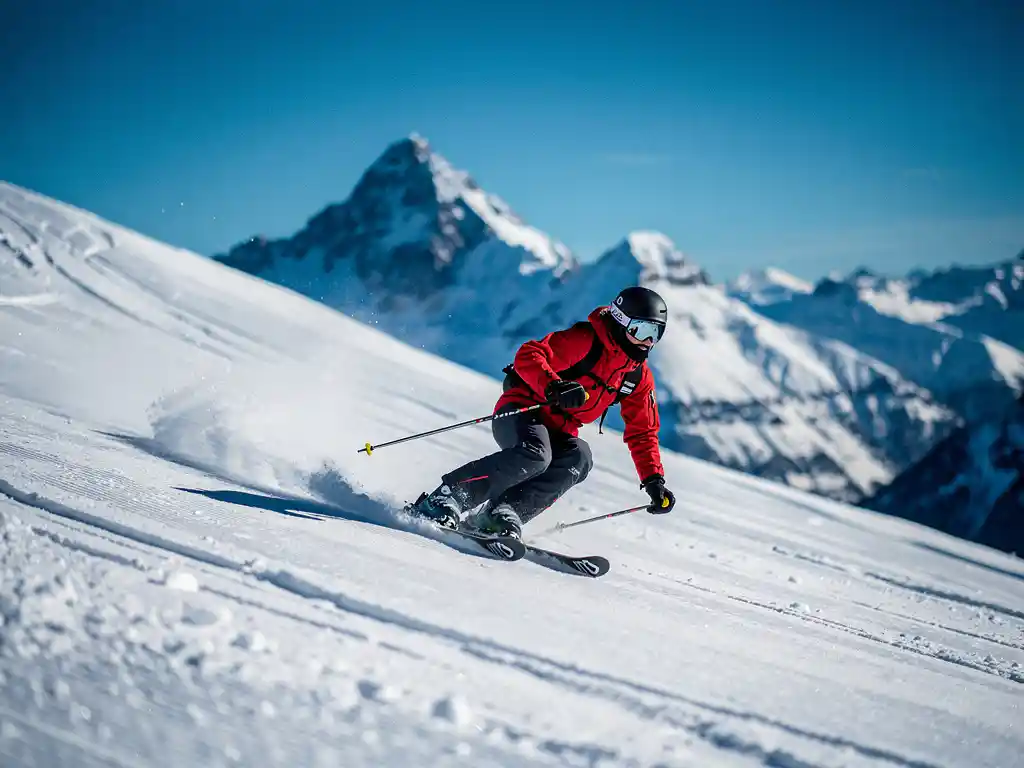
Correct ski posture is a slightly bent, athletic stance in which your weight is evenly distributed across your feet, your knees are flexed smoothly, and your upper body leans slightly forward. Your arms hang relaxed in front of your body, with the ski poles angled slightly backward.
To make it concrete, here are the key elements of proper ski posture:
- Knees slightly bent: not straight, but not excessively dropped either. Think of the position of someone who is just about to sit down.
- Weight across the whole foot: with a slight pressure on the ball of the foot, so you can actively steer the skis.
- Upper body slightly forward: your nose over your kneecaps, your kneecaps over your toes.
- Hips low and relaxed: not a stiff, upright stance, but a dynamic ready position.
- Arms in front of the body: do not let them hang at your sides — keep them slightly bent and out in front for balance.
- Eyes looking ahead: look down the slope, not at your skis. Your body follows your gaze.
This posture may feel unnatural at first, especially if you are used to standing upright. But it is precisely this slightly forward-leaning, athletic position that allows you to react quickly to the terrain and turn smoothly.
Why is good ski posture especially important for beginners?
For beginners, proper ski posture is especially important because they have not yet developed automatic movement patterns. A bad posture learned early becomes ingrained as a habit that is much harder to correct later on. The first lessons on skis literally lay the foundation for everything that follows.
Beginners also face a double challenge: they must simultaneously get used to the equipment, the terrain, the speed, and their own body position. That is a lot of information at once. If the basic posture is wrong, nothing else has a solid foundation either. It is like building a house on a crooked floor.
Confidence also plays a major role. Those who stand correctly have more control. Those who have more control dare to do more. And those who dare more learn faster. Correct ski posture is therefore not just a technical matter, but a psychological one too: it gives beginners the feeling that they can do it. That makes the experience on the slopes immediately much more enjoyable.
What common posture mistakes do ski instructors see in beginners?
The most common posture mistakes in beginners are leaning back, keeping the knees too stiff, and letting the arms hang at the sides. These mistakes almost always arise from a combination of fear, unfamiliarity with the equipment, and an instinctive reaction to speed or steep terrain.
Ski instructors see these mistakes time and time again:
- Leaning back (the “banana”): the most classic beginner mistake. Out of fear of the slope, the skier leans backward, causing complete loss of control over the skis.
- Straight knees: failing to bend the knees means there is no shock absorption and no ability to react smoothly to uneven snow.
- Arms at the sides: this disrupts balance and makes it harder to use the ski poles correctly.
- Looking at the skis: looking down causes you to lose your overview and react too late to what lies ahead.
- Tense shoulders and back: stiffness in the upper half of the body makes it impossible to move and turn fluidly.
What is striking is that these mistakes are almost never made consciously. They are an automatic response of the body to an unfamiliar situation. That is precisely why it is so valuable to have them corrected early by an experienced instructor, before they become deeply ingrained habits.
How can you learn good ski posture more quickly?
You learn good ski posture more quickly by practicing deliberately with targeted feedback, simple body exercises, and by visualizing the correct position. Repetition is the key — but repetition of the right movements, not of mistakes you keep reinforcing.
A few practical tips that really help:
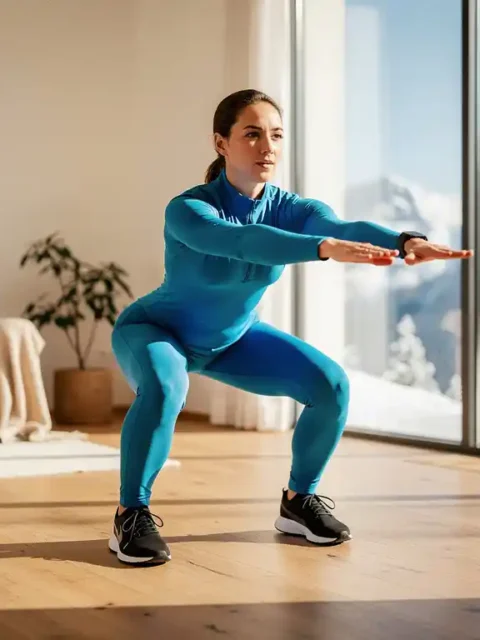
- Practice the basic stance at home: stand in front of a mirror and adopt the athletic ready position. Knees bent, upper body slightly forward, arms out in front. Feel what it feels like and remember it.
- Use the “as if you’re about to sit down” trick: imagine you are about to sit on a stool that is not quite there. That is roughly the correct knee angle.
- Always look ahead: fix your gaze on a point further down the slope, not on your skis. Your posture improves immediately once you stop looking down.
- Consciously relax: relaxing your shoulders, neck, and hands is at least as important as the position of your knees. Tension makes every movement stiffer and less effective.
- Ask for feedback: have someone film you, or ask an instructor to pay specific attention to your posture. You often do not notice your own mistakes, but on video you see them instantly.
Patience is also part of the process. Good ski posture feels strange and unnatural at first. That is normal. After a few hours of practice on the slopes, your body begins to recognize it, and from there it becomes increasingly second nature.
Does taking ski lessons really help improve your posture?
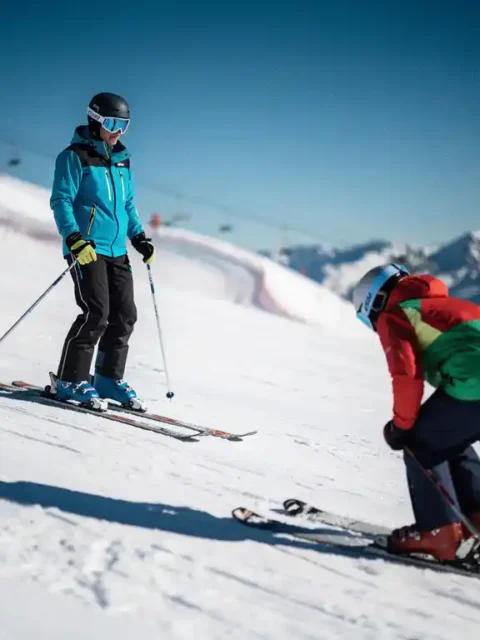
Yes, ski lessons demonstrably help improve your posture. An experienced ski instructor can see at a glance where things are going wrong and correct you on the spot — something you can barely do on your own or with friends. Targeted instruction prevents mistakes from becoming fixed and significantly accelerates your learning process.
The difference between learning on your own and taking lessons is substantial, especially for beginners. Without guidance, you ski largely by feel, and that feeling is almost never right at the start. You think you are standing upright while you are actually leaning back. You think you are bending your knees while they are largely straight. An instructor immediately breaks through that illusion with concrete corrections and exercises tailored specifically to your posture.
Private lessons offer the greatest advantage: all the attention goes to you, and the instructor fully adapts the pace and exercises to what you need. Group lessons are a great alternative for those who also value the social aspect and have a bit more time to practice.
How Ski-Pro helps you achieve the right ski posture
Good ski posture is not learned from a YouTube video, but on the slopes, with the right guidance. We understand that better than anyone. That is why we built a platform that makes finding that guidance as easy as possible.
Through our platform you can:
- Choose from more than 250 certified ski schools and instructors in the Alps
- Easily compare private and group lessons by price, location, and level
- Book lessons for destinations in Austria, Switzerland, France, and Germany
- Arrange everything from home, so you can hit the slopes on day one
Whether you are stepping on skis for the first time in Winterberg or looking to sharpen your posture ahead of a week in Tyrol, we will match you with the instructor that suits you best. Compare and book your ski lessons and take the first step toward better posture on the slopes.
Frequently Asked Questions
How long does it take before good ski posture feels automatic?
It varies from person to person, but most beginners notice a clear improvement after just two to three days of active practice. The posture starts to feel automatic once your body has stored the movement patterns — that process speeds up considerably when you receive targeted feedback from an instructor rather than skiing on instinct alone.
Does the type of ski boots or skis affect my posture?
Yes, definitely. Ski boots that do not fit properly or are incorrectly adjusted make it nearly impossible to adopt the correct posture — they restrict your freedom of movement or provide too little support at the wrong moments. Always have your equipment professionally fitted, and when picking it up, check that the ski boots feel comfortable without pinching, so your posture is not unnecessarily affected by your gear.
Can I improve my ski posture outside of ski season?
Absolutely. Exercises such as squats, lunges, and balance work on a Bosu ball strengthen exactly the muscle groups you need for a stable ski posture. Many advanced skiers train year-round to stand stronger and more agile on the slopes — even ten minutes a day in the run-up to your ski vacation makes a noticeable difference.
What is the biggest difference between private lessons and group lessons when it comes to improving my posture?
In private lessons, the instructor’s full attention is focused on you, meaning posture errors are spotted and corrected immediately without having to wait your turn. In a group lesson you also learn a great deal by observing others, but individual corrections are less frequent. For beginners who want to build a solid foundation quickly, private lessons are therefore the most efficient choice.