
How long does it take to master the basic techniques?

Most beginners master the basic techniques of skiing after three to five days on the slopes. By then, you can brake independently, steer, and descend in a controlled manner on easy runs. How quickly you progress depends on your age, physical fitness, the quality of your instruction, and how many consecutive lesson days you plan. In this article, we answer the most frequently asked questions about learning to ski as a beginner, so you can head to the mountain fully prepared.
Which basic techniques should a beginner learn first?
As a beginner, you first learn three fundamental skiing techniques: the snowplow (also called the pizza wedge), controlled braking, and making simple turns. Anyone who has mastered these three movements can safely and independently descend on green and easy blue runs. Everything that comes after builds on this foundation.
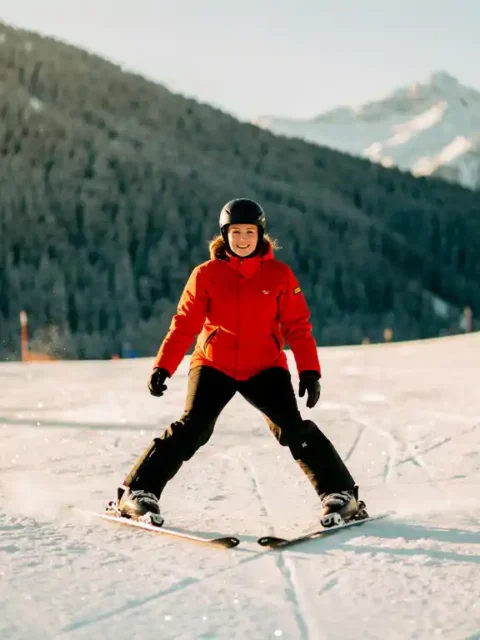
The snowplow is the absolute starting point. You point the tips of your skis toward each other and push your heels outward. This gives you control over your speed and forms the basis for all further turning techniques. It feels awkward at first, but most beginners pick it up on their very first lesson day.
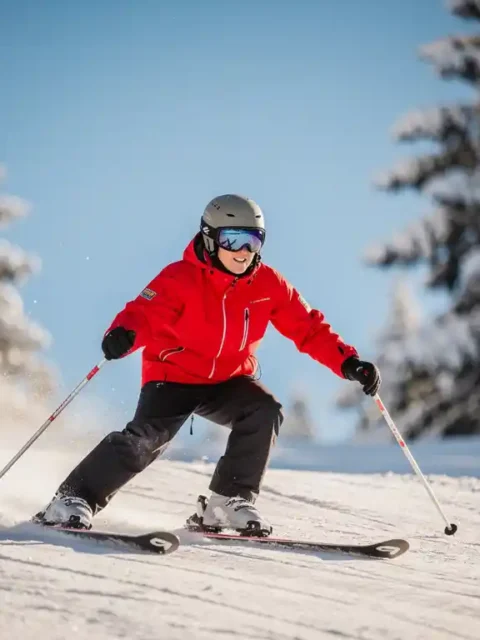
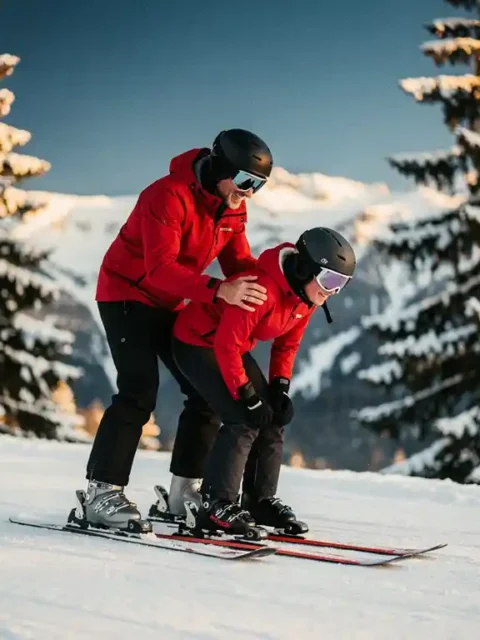
Next, you learn how to change direction by shifting your weight. You press lightly on the outside ski in a turn and lean gently in the direction you want to go. This sounds simple, but it requires feel and confidence in your own body. That is precisely why good guidance in those first few days is so valuable — an instructor can immediately tell whether your weight is in the right place.
- Snowplow (pizza wedge): braking and controlling speed
- Weight distribution: steering by shifting your weight
- Making turns: smoothly alternating from left to right
- Falling and getting up: an underestimated but essential skill
- Using the chairlift: getting on, sitting, and getting off without falling
How many days on the slopes do you need to master the basics?
Most beginners need three to five consecutive lesson days to master the basic techniques of skiing. After day one, you have the snowplow down and can brake. By day three, you are already making turns. Around day five, you are descending independently on easy runs. Consecutive lesson days are clearly more effective than spreading your learning across multiple seasons.
The body learns skiing largely through muscle memory. Building that takes repetition, and repetition works best when there is little time between practice sessions. A week of winter sports with daily lessons is therefore ideal for beginners. Anyone who skis just one day per season starts almost from scratch every year.
Children sometimes need fewer days than adults, simply because they have a lower center of gravity and less fear of falling. Adults are naturally more cautious, which is understandable but can sometimes slow down the learning process. That is not a problem — it just requires a little more patience and the right approach from a good instructor.
Do you learn to ski faster with private lessons or group lessons?
With private lessons, you generally learn to ski faster than in a group lesson. Your instructor fully adapts the pace, exercises, and explanations to your level. There is no waiting for others and no distractions. Group lessons, however, are more affordable and have their own advantages, such as the motivation that comes from learning alongside others.
Benefits of private lessons for beginners
In a private lesson, the instructor is by your side the entire time. If you make a mistake, it is corrected immediately. If you are struggling with something, extra time is devoted to it. This personal attention significantly speeds up the learning process. Many beginners who previously took group lessons notice during their first private lesson just how much faster they progress.
When is a group lesson a good choice?
Group lessons are perfect if you are learning with friends or family, if budget is a factor, or if you enjoy the social atmosphere. In a well-run group lesson with a maximum of eight participants, you can also learn the basic techniques just fine. It is also motivating to watch fellow students overcome the same challenges. For children, the group dynamic often works particularly well.
Why do some beginners progress faster than others?
The pace at which you learn skiing techniques as a beginner varies from person to person due to a combination of physical fitness, age, mindset, and experience with other sports. No single factor determines everything, but together they make a significant difference. Those who are fit, have little fear, and already have experience with balance-focused sports tend to learn the fastest.
Balance is perhaps the most decisive factor. Anyone who skates, surfs, snowboards, or skateboards will recognize the feeling of shifting weight on a moving surface. That head start is immediately noticeable on the slopes. But even without that background, you can learn quickly — especially with the right guidance.
Fear also plays a major role. Beginners who are afraid of falling unconsciously tense their muscles and stand rigid. That actually makes skiing harder and less safe. Relaxation and confidence in your own body are essential. A good instructor helps you lower that mental barrier, step by step.
- Physical fitness: strength in your legs and core helps enormously
- Balance and coordination: experience with other balance-focused sports gives you a head start
- Age: children often learn faster due to a lower fear threshold
- Mindset: learning in a relaxed state is faster than learning while tense
- Quality of instruction: a good instructor makes a world of difference
What can you do at home to learn to ski faster?
At home, you can significantly improve your preparation for the slopes by working on balance, leg strength, and body coordination. Starting your ski vacation in good physical shape means you will learn faster and suffer less from muscle soreness after the first day. Just a few weeks of targeted training can already make a noticeable difference.
Squats and lunges are the most effective exercises for skiing. They train exactly the muscles you need for the snowplow and making turns. Add balance work to that — such as standing on one leg or exercises on a balance board — and your body will already start getting used to the feeling of instability that skiing involves.
Want to be mentally prepared as well? Watch videos of beginner lessons and visualize yourself performing the movements. That may sound simple, but mental preparation genuinely works. Elite athletes have been using visualization as a training technique for years, and the same principle applies to beginners.
- Squats and wall sits for leg strength
- Lunges for stability and balance
- Balance board or Bosu ball for proprioception
- Yoga or Pilates for body awareness
- Watching videos of skiing techniques for mental preparation
When are you ready for the blue runs?
You are ready for the blue runs when you can brake independently, make controlled turns, and manage your speed on a green slope. Most beginners achieve this after three to five lesson days. A blue run is slightly steeper than a green one, but still very accessible for beginners who have mastered the basics.
It is tempting to want to move to the blue runs quickly, especially if your friends are already skiing higher up. But do not rush. Practicing on a green run may feel boring, but it is the phase in which your muscle memory is truly being built. Moving to more difficult terrain too soon leads to bad habits that are hard to unlearn later.
Your instructor is the best person to judge whether you are ready. Trust that assessment. A good instructor knows your level, sees your progress, and knows exactly when it is time to take the next step. When that moment comes, it will feel like a real achievement — and rightly so.
How Ski-Pro helps you learn the basic techniques faster
As a beginner, you want one thing: to ski down the slope with confidence and enjoyment as soon as possible. We understand that, which is why we have built a platform that makes finding the right ski lesson as straightforward as possible. Whether you choose a private lesson or a group lesson, in Tyrol or in the French Alps, we help you find the perfect match.
Through our platform, you can:
- Choose from more than 250 certified ski schools and instructors in the Alps
- Easily compare private and group lessons by price, availability, and reviews
- Book directly online, without any hassle
- Find lessons specifically tailored to beginners
- Choose your destination, from Winterberg to Zermatt
Your first ski lesson is a moment you will never forget. Make sure you get it right and start with the right instructor by your side. Compare and book your ski lesson through Ski-Pro and head to the mountain fully prepared!
Frequently Asked Questions
What equipment do I need when skiing for the first time?
As a beginner, you need at minimum ski boots, skis, poles, a helmet, and a lift pass. You can rent all of this on-site at the ski school or a rental shop in the resort, which is often the smartest choice for beginners. That way, you do not have to invest in expensive gear before you know for certain that you enjoy skiing.
How do I choose the right ski resort as a beginner?
As a beginner, look for a resort with a wide selection of green and easy blue runs, such as Saalbach, Zell am See, or Les Gets. Also check whether there is a well-organized ski school with lessons specifically for beginners. A resort with a dedicated practice area (sometimes called a beginner slope or nursery slope) is ideal, so you can practice at your own pace away from busy main runs.
Can I still learn to ski well as an adult beginner, or is it too late?
It is absolutely not too late to learn to ski as an adult. Adults do learn somewhat more slowly than children due to a higher fear threshold and greater awareness of risk, but they make up for this with better concentration and the ability to understand instructions quickly. With the right guidance and a few consecutive lesson days, adult beginners can get up and running just fine.
What are common mistakes beginners make that slow down the learning process?
The most common mistake is leaning back out of fear, when you actually need to lean slightly forward over your ski boots. In addition, many beginners try to move to more difficult runs too quickly before the basics are truly ingrained, which leads to bad habits. Another pitfall is standing too rigidly — relaxed knees and a fluid posture make skiing considerably easier and safer.