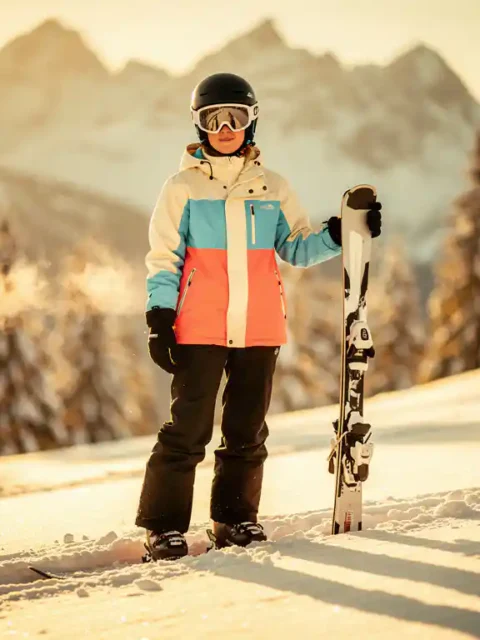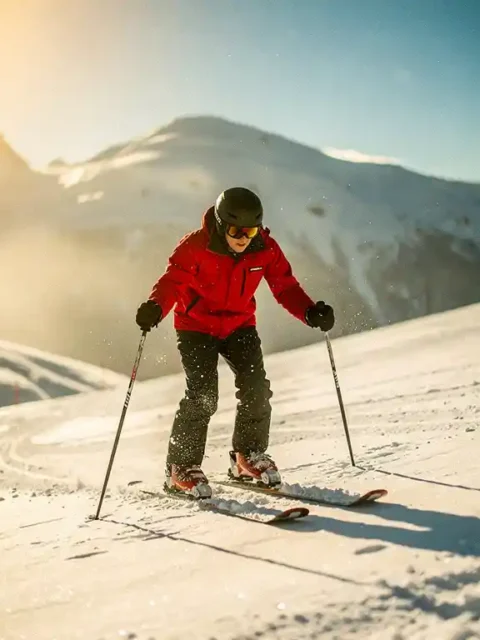

How do you learn to ski straight downhill as a beginner?

As a beginner, you can ski straight downhill by distributing your weight evenly across both skis, bending your knees slightly, and leaning your upper body gently forward in a relaxed position. This sounds simple, but it takes practice because your instincts tend to push you in exactly the wrong direction. In this article, we answer the most frequently asked questions about skiing straight downhill, from body posture to common mistakes.
Why is skiing straight downhill so difficult for beginners?
Skiing straight downhill is difficult for beginners because it goes against your natural instincts. As you pick up speed, your body automatically wants to lean back or brake, whereas good skiing technique for beginners actually requires relaxation, a forward-leaning posture, and trust in the movement.
The problem is largely psychological. The slope looks steeper than it actually is, and your brain sends an alarm signal: “lean back, slow down!” But that very reaction makes you less stable. Leaning back shifts your weight onto your heels, which reduces the grip of your skis and makes steering much harder.
On top of that, unfamiliarity with the equipment plays a major role. Skis respond differently from what your feet are used to. They are long, stiff, and glide surprisingly fast. Your muscles don’t yet know how to compensate for small irregularities in the slope. That makes every meter of straight skiing a small mental victory — and that’s exactly what makes learning it so rewarding.
What is the correct body position for skiing straight downhill?
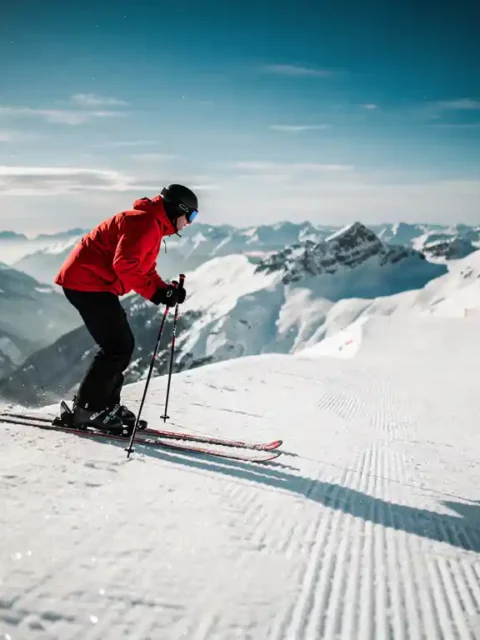
The correct body position for skiing straight downhill involves slightly bent knees, a relaxed upper body leaning slightly forward, weight distributed evenly across the full sole of your foot, and arms held slightly out to the sides for balance. This basic stance gives you control, stability, and the ability to react quickly.
Think of the stance of a basketball player ready to move: fluid, alert, not rigid. That’s exactly the energy you want to bring to the slope.
- Knees slightly bent: this acts as a shock absorber and keeps your center of gravity low
- Upper body slightly forward: prevents your weight from shifting back onto your heels
- Weight on the full sole of your foot: not on the heel, not on the toes, but centered
- Arms loosely in front of you: as balancing anchors, not stiffly at your sides
- Eyes forward: look where you’re going, not down at your skis
A commonly used exercise is the “apple in the armpit” technique: imagine you’re holding an apple under each arm. If your arms drop too low, the apple falls out. This helps you keep your upper body in the right position without having to consciously think about it.
How do you practice skiing straight downhill safely?
The safest way to practice skiing straight downhill is on a wide, quiet beginner slope with few other skiers around. Start on a nearly flat surface, build up speed gradually, and use the snowplow position to brake whenever you feel you’re going too fast. Repeated runs on a familiar slope give your muscles and brain the time they need to make the movement automatic.
Follow these steps for structured practice:
- Start on a gentle slope: find a run with almost no gradient so your speed stays naturally low
- Practice the snowplow first: make sure you can brake before you actually ski straight
- Do short runs: ski a short stretch straight, stop, assess your posture, repeat
- Gradually increase the gradient: only move to a steeper slope once you feel comfortable
- Ski behind someone: follow an instructor or experienced skier and copy their rhythm
Avoid busy slopes as a beginner — not only for your own safety, but also because distractions break your concentration. A quiet green run early in the morning is the perfect training environment.
What is the difference between group lessons and private lessons for beginners?
The main difference between group lessons and private lessons for beginners is the amount of personal attention. In a private lesson, the instructor tailors the pace and exercises entirely to you. In a group lesson, you learn alongside others at a shared pace, which is more affordable but offers less individual feedback.
Group lessons: learning together
A group lesson is ideal if you enjoy learning in company and find the social dynamic motivating. You see others making the same mistakes, which puts the learning process in perspective and helps you relax. Group lessons are also considerably cheaper than private lessons and are perfect for families or friends going on a ski holiday together. The downside is that the instructor doesn’t always have time to correct your specific mistake right away.
Private lessons: fast results, maximum attention
In a private lesson, the instructor is by your side the entire time. Every mistake is noticed and corrected immediately, the pace is perfectly matched to your level, and you make far more progress in a short amount of time. This is especially valuable if you only have one week of vacation and want to ski independently as quickly as possible. Private lessons cost more, but the investment pays off in faster improvement.
For absolute beginners who really want to learn to ski straight downhill, a private lesson is the fastest route to success. That said, a group lesson is certainly not a bad choice — especially if budget is a consideration.
What mistakes do beginners make most often when skiing straight downhill?
The most common mistakes beginners make when skiing straight downhill are leaning back, keeping their knees too stiff, looking down at their skis instead of ahead, and holding their arms too low or too rigid. These mistakes reinforce one another and make it harder to find your balance.
- Leaning back: the most common mistake, caused by fear of speed. Your weight shifts to your heels and you lose control
- Stiff knees: without bent knees, you can’t absorb shocks and you react too slowly to irregularities in the slope
- Looking at your skis: your gaze should be directed forward, not downward. Looking at your skis disrupts your balance and spatial awareness
- Arms at your sides: arms held tightly against your body offer no balance. Keep them slightly out in front of you
- Holding your breath: tension in the body often starts with held breath. Consciously exhaling helps your muscles relax
Most of these mistakes are reactions to fear or uncertainty, not a lack of skill. As you build more confidence in your equipment and the slope, they tend to disappear on their own. A good instructor will help you break these patterns quickly.
How long does it take before a beginner can ski straight downhill comfortably?
Most beginners can ski straight downhill comfortably on a green or easy blue run after two to three days of practice. With daily lessons and focused guidance, this process goes faster. Factors such as age, athletic background, and fear threshold all influence the pace, but everyone gets there eventually.
Children generally learn faster because they have a lower center of gravity, less fear, and their bodies pick up new movement patterns more quickly. Adults often think more consciously about what they’re doing, which can sometimes slow things down — but it also helps when it comes to understanding the technique.
A realistic timeline for a beginner with no athletic background looks something like this:
- Day 1: getting familiar with the equipment, walking on skis, first meters on flat terrain
- Day 2: learning the snowplow, first short stretches straight downhill on a gentle slope
- Day 3: more control, longer straight runs, first turns
- Day 4 and beyond: growing confidence, higher speeds, skiing independently on green runs
The secret is consistency and the right guidance. One week of intensive skiing with daily lessons delivers far more than the same number of hours spread across multiple seasons.
How Ski-Pro helps you learn to ski faster
If you want to learn to ski straight downhill as a beginner, it all starts with the right instructor on the right slope. That’s exactly what we help you with. Through our platform, you can easily compare more than 250 certified ski schools and instructors across the Alps — from Tyrol to the French Alps and everything in between.
- Compare group lessons and private lessons side by side on price, location, and level
- Filter by beginner level so you only see lessons that are truly suited to you
- Read reviews from other skiers who have been in your exact position
- Book directly online without any hassle, so you can focus on the snow
Whether you’re stepping onto skis for the very first time in Winterberg or dreaming of your first week in the Austrian Alps, we make sure you hit the slopes well prepared and with the right support. Compare and book your ski lesson and take those first real runs on the mountain!
Frequently Asked Questions
Should I take a ski lesson first as a beginner, or can I learn to ski straight downhill on my own?
For absolute beginners, a ski lesson is strongly recommended, even if you only take one or two. A certified instructor will immediately correct errors in your posture that you can’t see yourself, such as leaning back or keeping your knees stiff. Teaching yourself might sound appealing, but bad habits picked up early on are much harder to unlearn later.
Which slope is best for practicing skiing straight downhill as a beginner?
A green run with a gentle gradient, few other skiers, and a wide track is ideal for beginners practicing skiing straight downhill. Try to practice early in the morning when the slope is still quiet and well-groomed. Avoid blue or red runs until you feel truly comfortable on the green run at higher speeds.
What should I do if I panic while skiing straight downhill and feel like I'm going too fast?
Fall back on the snowplow: push your heels outward so the skis form a V-shape, which will automatically slow you down. That’s why you should always practice the snowplow first, before you actually ski straight, so it becomes an automatic reflex. Breathe out deliberately to release tension, and direct your gaze forward rather than downward — that alone will help you calm down quickly.
Does it matter what type of skis I use as a beginner learning to ski straight downhill?
Yes, the equipment definitely makes a difference. As a beginner, it’s best to rent shorter, softer skis that are easier to steer and less sensitive to errors in your posture. Ask the rental shop specifically for beginner skis suited to your weight and height, and make sure the bindings are correctly adjusted by a professional before you head onto the slope.