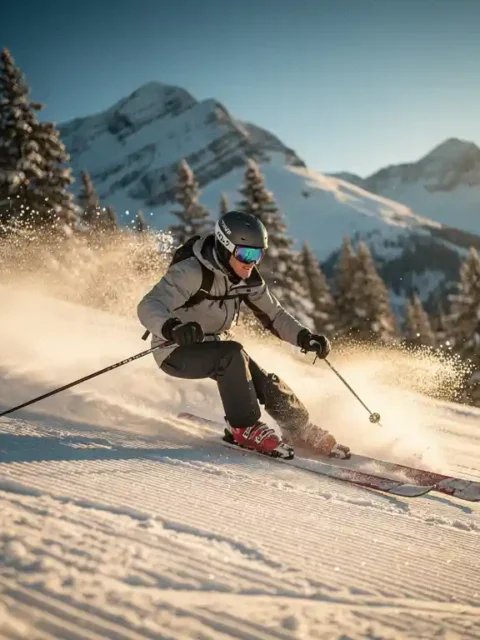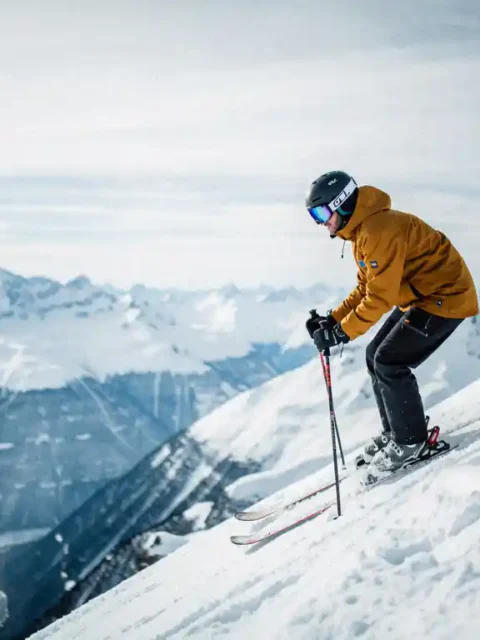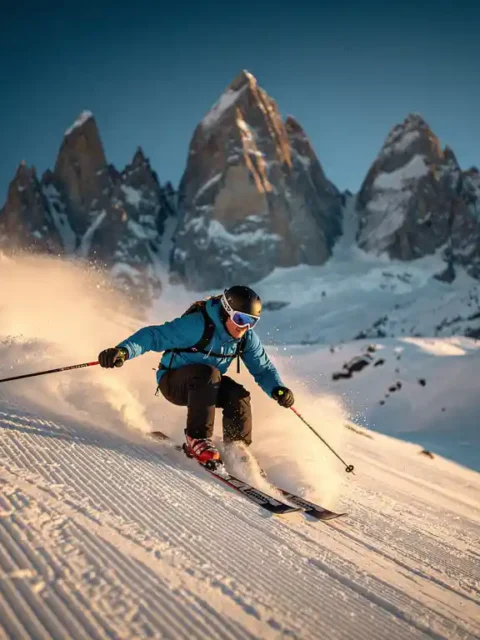

What is the secret to smooth turns as a beginner?
The secret to smooth turns as a beginner comes down to one thing: weight transfer. Anyone who learns to shift their weight from ski to ski correctly will naturally start making more fluid turns. This sounds simpler than it is, but with the right technique and guidance, you’ll quickly discover how it works. In this article, we answer the most frequently asked questions about making turns on skis — from your very first turn to the moment you’re ready for steeper slopes.
How does a beginner make their first turn?
You make your first turn by shifting your weight slightly forward, bending your knees, and putting a little more pressure on your outside ski. Rotate your hips and shoulders in the direction you want to go, and let the skis do the work. Always start on a quiet, wide, and gently sloping run so you have plenty of space.
As a complete beginner, you’ll almost always start with what’s known as the snowplow, also called the wedge or pizza shape. You point the tips of your skis toward each other and push the tails apart, which naturally slows you down and lets you steer. Putting more weight on your left ski turns you right, and vice versa. It’s an intuitive technique that you’ll pick up quickly.
Don’t forget that your posture is crucial. Straight back, knees bent, arms relaxed in front of your body. Many beginners make the mistake of leaning back out of fear of speed, but that actually makes steering harder. Lean forward, trust your skis, and let the slope work for you.
Why do beginners struggle to turn on skis?
Beginners often struggle to turn on skis because they instinctively lean back, distribute their weight incorrectly, or rotate their upper body too much. Skis respond to pressure and edge angle, not to force. Anyone who hasn’t figured that out yet ends up fighting against their skis instead of working with them.
Another common mistake is locking up the upper half of the body. When your shoulders and hips want to rotate but your skis don’t follow, an awkward twisting motion develops that blocks the turn. The solution is to let your lower body do the work while keeping your upper body calm and stable.
Fear also plays a major role. On a slope, speed can quickly feel overwhelming, causing you to instinctively brake by sitting back. But that’s exactly the opposite of what you should do. By keeping your weight forward and actively steering, you stay in control. Practice and confidence go hand in hand here.
What is the difference between a wedge turn and a parallel turn?
The difference between a wedge turn and a parallel turn lies in the position of the skis. In a wedge turn — also known as snowplow skiing — the skis are in a V-shape with the tips pointing toward each other. In a parallel turn, the skis are side by side, parallel to each other, and you steer by shifting your weight and edging the skis.
The wedge turn: stable and safe for beginners
The wedge turn is the first technique that almost every beginner learns. The V-stance creates friction and natural braking, allowing you to control your speed without requiring much technical knowledge. It’s a safe way to learn how to steer and build confidence on the slopes. Snowplow skiing might sound basic, but it’s the solid foundation on which all further ski techniques are built.
The parallel turn: smooth and efficient
The parallel turn is the next step and feels considerably more fluid. Your skis are side by side and you steer by pressing your knees inward and shifting your weight. This technique gives you more control at higher speeds and also works better on steeper slopes. The transition from wedge to parallel is gradual: first you learn to lift the inner ski slightly during a turn, until both skis eventually start running parallel automatically.
How does a good ski lesson help with learning turns?
A good ski lesson helps with learning turns because a certified instructor can see your specific mistakes and correct them on the spot. Practicing on your own based on videos or tips from friends does work, but an instructor provides personal feedback that improves your technique much faster than trial and error.
In a ski lesson, you learn not just the theory but also the feel. A good instructor explains exercises step by step, adjusts the pace to your level, and makes sure you practice on the right slopes. Group lessons are ideal if you want a social experience on a budget, while private lessons help you progress faster with intensive, one-on-one guidance.
A lesson also keeps you safer. Beginners who head out onto the slopes alone without guidance are at greater risk of injury due to poor technique. An instructor also teaches you how to interact safely with other skiers, how to use a lift, and what to do if you fall.
When is a beginner ready for steeper slopes?
As a beginner, you’re ready for steeper slopes when you can make turns comfortably and in control on blue runs, brake and stop deliberately, and adjust your speed to the conditions. It’s not about speed — it’s about control and confidence.
A good indicator is whether you’re already moving away from the wedge turn and starting to experiment with parallel turns. If you can manage that on a wide, quiet slope, you’re technically ready for something more challenging. But also listen to your instincts: if you don’t feel comfortable yet, there’s nothing wrong with spending a little more time on the blue run.
Ideally, have your instructor assess your readiness. They can objectively determine whether your technique is solid enough for a steeper slope. Heading onto a red or black run on your own before you’re ready is a common mistake that quickly leads to injury. Patience pays off on skis.
What equipment makes turning easier for beginners?
The right equipment makes a noticeable difference when it comes to turning as a beginner. Shorter, wider skis with a pronounced waist are ideal for beginners: they turn more easily and are more forgiving of mistakes than long, narrow racing skis. Well-fitting ski boots are equally important, as they form the direct connection between your movements and the skis.
When renting or buying skis, keep the following points in mind:
- Ski length: as a beginner, choose skis that roughly reach your chin or nose — shorter than what advanced skiers use
- Ski boots: they should fit snugly but not painfully, with a flex suited to a beginner (softer flex = more comfort and control)
- Bindings: always have these set by a professional based on your weight, height, and ability level
- Poles: useful for balance, but not always necessary for beginners on flat practice slopes
- Helmet: not optional — it’s a must, especially when you’re still learning
Good equipment lowers the barrier to trying new techniques. When your skis turn easily and your boots fit well, you can focus entirely on your technique instead of on discomfort.
How Ski-Pro helps you learn smooth turns
Whether you want to practice your first snowplow or you’re ready for your first parallel turns on a blue run, the right guidance makes all the difference. At Ski-Pro, we understand better than anyone how overwhelming the choice of ski schools and instructors can be — especially if you’ve never stood on skis before. That’s why we do the searching for you.
Through our platform, you can:
- Compare more than 250 certified ski schools and instructors in the Alps
- Filter by destination, level, lesson type (group or private), and budget
- Book directly online — quick and hassle-free
- Find lessons in top destinations such as Tyrol, Switzerland, and France
- Find beginner lessons specifically tailored to your pace and learning style
All you have to do is dream of that first smooth turn in fresh snow — we’ll take care of the rest. Compare and book your ski lesson through Ski-Pro and make this winter your best on the slopes yet.
Frequently Asked Questions
How long does it take a beginner to make smooth turns?
Most beginners make their first controlled turns within 2 to 4 days of ski lessons. How quickly you progress depends on your physical fitness, how often you practice, and the quality of your instruction. With a certified instructor, you’ll advance considerably faster than if you try to figure it out on your own.
Can I learn to turn without ski lessons, for example through YouTube videos?
Videos can be a great supplement for understanding techniques visually, but they don’t replace a real ski lesson. An instructor can see your specific mistakes in real time and correct them immediately — something no video can do. Especially for beginners, personal guidance is the safest and fastest way to learn turns correctly and avoid injuries.
What should I do if I lose control during a turn?
If you lose control, consciously try to shift your weight forward and bend your knees instead of stiffening up or leaning back. If you do fall, let go of your poles and try to land on your side rather than on your hands or knees. Always practice controlled stopping and falling on a flat, quiet slope before moving on to more challenging runs.
Which slope color is best for practicing turns as a beginner?
Green and blue slopes are the most suitable for beginners who want to practice turns. Green slopes are the flattest and widest, making them ideal for your very first exercises with the wedge stance. Once you’re comfortable making turns on green runs, blue slopes are the logical next step to practice more speed and technique before progressing to red.