
Which exercises help with learning basic techniques?
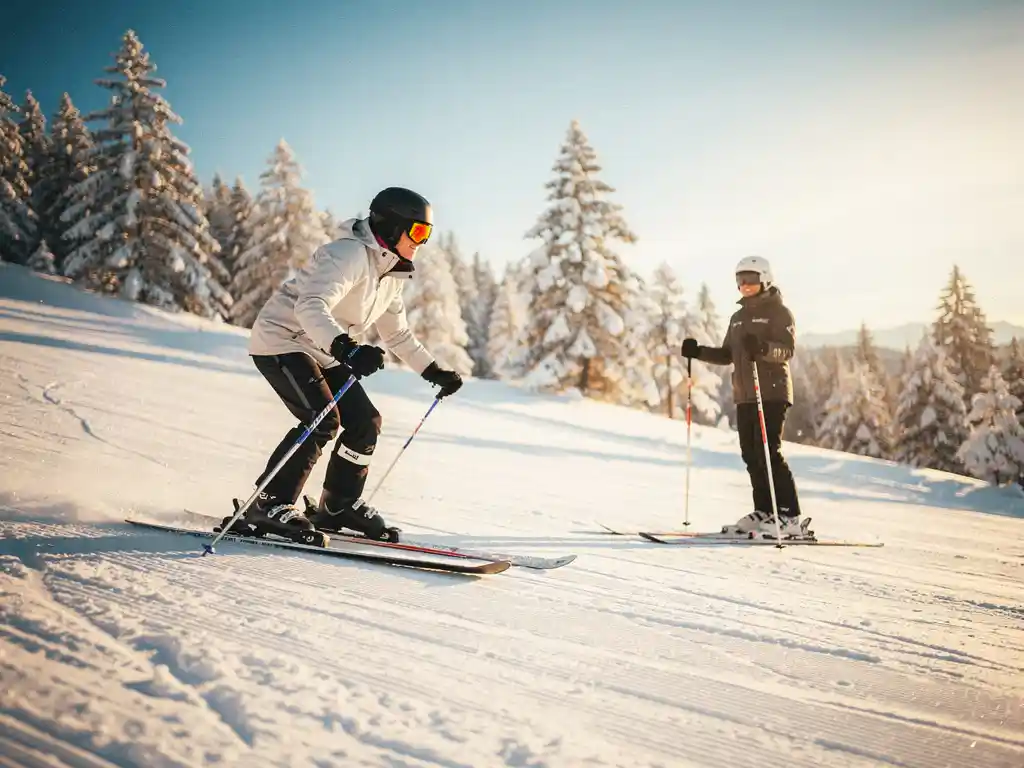
The most important basic skiing techniques are learned through a combination of targeted exercises on the slope and preparatory training at home or in the gym. Think squats for muscle strength, balance exercises for stability, and practicing the snowplow position on a beginner slope. For absolute beginners, the rule is simple: the better prepared your body is, the faster you’ll pick up skiing technique as a beginner. In this article, we answer the most frequently asked questions about exercises, lessons, and everything that helps you get down the slope with confidence as quickly as possible.
Which muscles do you use most when skiing?
Skiing primarily works your quadriceps, hamstrings, glutes, and calves. These muscle groups provide stability, control, and shock absorption through every turn. Your core muscles also play a crucial role: they keep you balanced and ensure your upper body stays calm while your legs do the work.
As a beginner, you’ll quickly notice that your legs tire faster than expected. This is because you’re constantly standing with your knees slightly bent — a position that puts significant strain on your quadriceps. The good news: you can prepare your body for this before you ever put on a ski.
- Quadriceps: the front of your thigh works continuously through every turn and when braking
- Hamstrings and glutes: provide strength and stability in the basic stance
- Calves: absorb shocks and help with steering through the ski boots
- Core muscles: keep your upper body stable and help initiate turns
- Inner thigh muscles: essential for keeping your skis together and controlling the snowplow position
The stronger these muscle groups are before your first ski lesson, the longer you’ll be able to enjoy the slopes without your legs shaking from exhaustion after just an hour.
Which exercises prepare you for your first ski lesson?
The best preparation for your first ski lesson consists of squats, lunges, planks, and single-leg balance exercises. These exercises strengthen exactly the muscle groups you need on the slope while simultaneously training your proprioception — the sense of balance and body position that is essential for skiing technique as a beginner.
You don’t need to be an elite athlete to prepare well. A few weeks of targeted training at home or in the gym makes an enormous difference. Try the following exercises at least three times a week:
- Squat: lower yourself until your knees reach a 90-degree angle and keep your back straight. This is the ultimate ski exercise.
- Wall sit: lean your back against a wall and hold the squat position. Start with 30 seconds and build up from there.
- Lunge: step forward and lower your front knee. Alternate between left and right.
- Plank: hold your body straight as a board on your forearms. Duration: 30 to 60 seconds.
- Single-leg balance: stand on one leg and try to hold it for 30 seconds. Close your eyes for an extra challenge.
Want to take it a step further? Practice on a balance board or BOSU ball. This simulates the unstable surface of a snow slope and trains your reflexes in a way that regular strength exercises simply cannot.
How do you practice the snowplow as an absolute beginner?
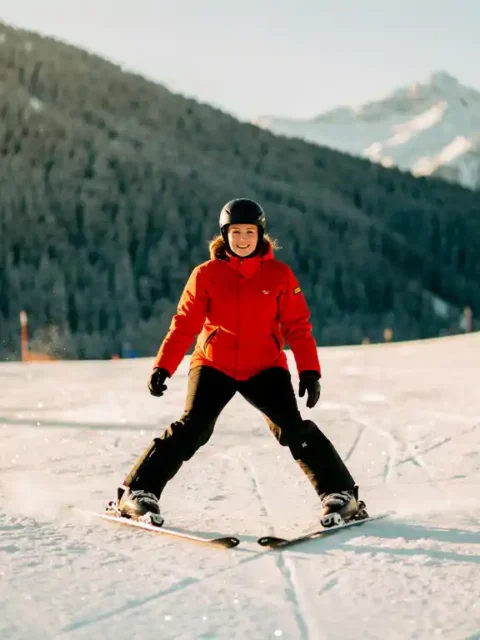
The snowplow — also known as the pizza wedge or snowplough — is best practiced as an absolute beginner on a flat or gently sloping beginner run. You point the tips of your skis toward each other and push the tails apart, forming a V-shape. By applying more pressure to the inner edges of your skis, you slow down.
The snowplow is the first technique that almost every ski instructor teaches. It is the foundation of everything: braking, controlling speed, and later steering as well. Here’s how to practice it step by step:
- Start on flat ground: position your skis in the V-shape without moving. Feel how the inner edges of the skis press into the snow.
- Gentle slope: let yourself slide slowly downhill and practice braking by widening the V.
- Steering: by shifting more weight onto your left ski, you turn right. More weight on the right steers you left.
- Repeat: repeat this dozens of times on a quiet slope until the movement feels automatic.
Patience is your best friend here. The snowplow feels awkward at first, but after a few hours of practice on the slope it becomes second nature. Don’t be tempted to rush ahead to parallel skiing — a solid snowplow is the foundation of all further skiing techniques.
What is the difference between practicing at an indoor ski slope and in the real Alps?
Practicing at an indoor ski slope or artificial snow slope is a great first step, but it differs from skiing in the real Alps in several ways. The altitude, snow quality, run lengths, and variety of terrain in the Alps are considerably greater, demanding a different mental and physical challenge.
Advantages of an indoor ski slope as preparation
An indoor ski slope offers a controlled environment free from distractions. Temperature, gradient, and snow quality are consistent. This makes it ideal for learning the absolute basics: the snowplow, your first gliding movement, and how to fall and get back up without the stress of a busy mountain slope. For children and adults who have never stood on skis before, it’s a gentle introduction to the world of winter sports.
What makes the Alps different
In the Alps, you’ll encounter real powder snow, changing weather conditions, longer descents, and a much greater variety of gradients. The altitude — often above 1,500 meters — can also affect your stamina. On top of that, the ski lifts, the crowds on the slopes, and the length of the runs are all factors you simply won’t experience at an indoor slope. Many beginners find that they progress faster in the Alps, simply because there is more space, more variety, and more snow to practice on.
The ideal scenario? Start at an indoor slope to learn the basic stance, then head to the real mountains as soon as possible for the real experience.
How do you learn to turn as a beginner?
As a beginner, you learn to turn by shifting your weight onto one ski from the snowplow position. Applying more pressure to your left ski turns you right, and vice versa. Ski instructors call this the snowplow turn, and it is the first real turning technique you learn after mastering the basic stance.
Turning is the moment when skiing really starts to become fun. You’re in control, you’re steering yourself, and you can feel the snow beneath your skis responding to your movements. Here’s how to approach it:
- Start with the snowplow: make sure you’re comfortable with the V-position before attempting turns
- Shift your weight: lean gently toward the outside ski of the turn, not inward
- Look where you want to go: your body automatically follows your gaze, so look ahead toward the exit of the turn
- Keep a steady pace: make turns in an S-shape across the full width of the slope, not too steep
- Repeat and vary: alternate between wide and tight turns to develop feel and confidence
A good ski instructor will have you practice this on a wide, quiet beginner slope. After a few sessions, the snowplow turn will become increasingly fluid and you can gradually work toward parallel turns.
How many ski lessons do you need to master the basics?
Most beginners need three to five days of ski lessons to get a solid grasp of the basic techniques. During that time, you’ll learn the snowplow, simple turns, and how to brake safely. After a week of intensive practice, most beginners can ski blue runs independently.
How many lessons you need exactly depends on a few factors:
- Your physical fitness: those who are well-trained learn faster and tire less quickly
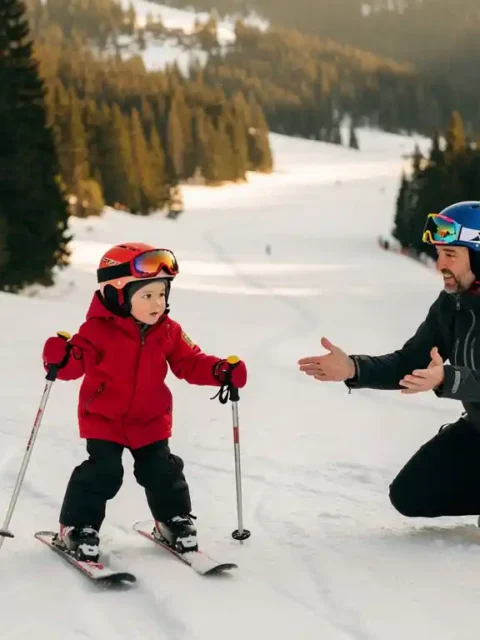
- Age: children often pick up skiing techniques faster than adults
- Group lesson or private lesson: private lessons progress faster because the instructor focuses entirely on you
- How often you practice each day: more time on the slope means faster progress
- Previous experience with board or balance sports: skating, surfing, or snowboarding gives you a head start
Want to progress really quickly? Combine group lessons in the morning with free practice in the afternoon. This gives you time to process what you’ve learned and build both muscle strength and feel. Remember: nobody learns to ski in a single day, but everyone can learn with the right guidance and enough repetition.
How Ski-Pro helps you learn the basic techniques
If you’re a beginner ready to hit the slopes, finding the right ski lesson is arguably the most important step. That’s exactly what we’re here for. At Ski-Pro, we believe that everyone — from absolute beginner to ambitious intermediate — deserves access to great ski instruction without having to spend hours searching and comparing.
Here’s how we help you get down the mountain with confidence as quickly as possible:
- More than 250 certified ski schools and instructors across the Alps, from Tyrol to the French Alps and Switzerland
- Easy comparison by price, location, language, and lesson type (group or private)
- Suitable for every level, including absolute beginners stepping onto skis for the very first time
- Transparent pricing with no surprises afterward
- Fast and easy online booking, so you have more time for what really matters: getting out on the slope!
Whether you want to practice your first snowplow on a quiet beginner run or head straight for the slopes of Tyrol, we’ll make sure you find the perfect instructor. Compare and book your ski lesson and take your first steps on the snow this season with a smile!
Frequently Asked Questions
Do I need to buy ski equipment before booking my first ski lesson?
For your first ski lesson, there's no need to purchase your own equipment right away. You can easily rent skis, boots, and poles from the ski school or a rental shop at the resort. Only once you're sure that skiing is for you and you plan to hit the slopes regularly does it make sense to invest in your own gear.
How far in advance should I start doing the preparatory exercises at home?
Ideally, you should start the preparatory strength and balance exercises four to six weeks before your first ski vacation. Three training sessions per week is enough to noticeably improve your quadriceps, core muscles, and balance. Even two weeks of targeted training will make a positive difference on the slope.
Is a private lesson or a group lesson better for an absolute beginner?
Both options work well, but a private lesson offers beginners the advantage that the instructor tailors the pace and explanations entirely to you, which generally leads to faster progress. Group lessons are a fun and more affordable choice if you also want the social aspect. A good middle ground is to start with one or two private lessons to get the basic stance right, then switch to a group lesson.
What should I do if I realize during the lesson that I can't get the hang of the snowplow?
Let your instructor know, because that's exactly what they're there for. Many beginners struggle with the snowplow at first, and that's completely normal. Ask for extra practice on a quieter slope and take your time — it's far better to truly master the snowplow before moving on to the next technique.