
How do you control your speed as a beginner skier?
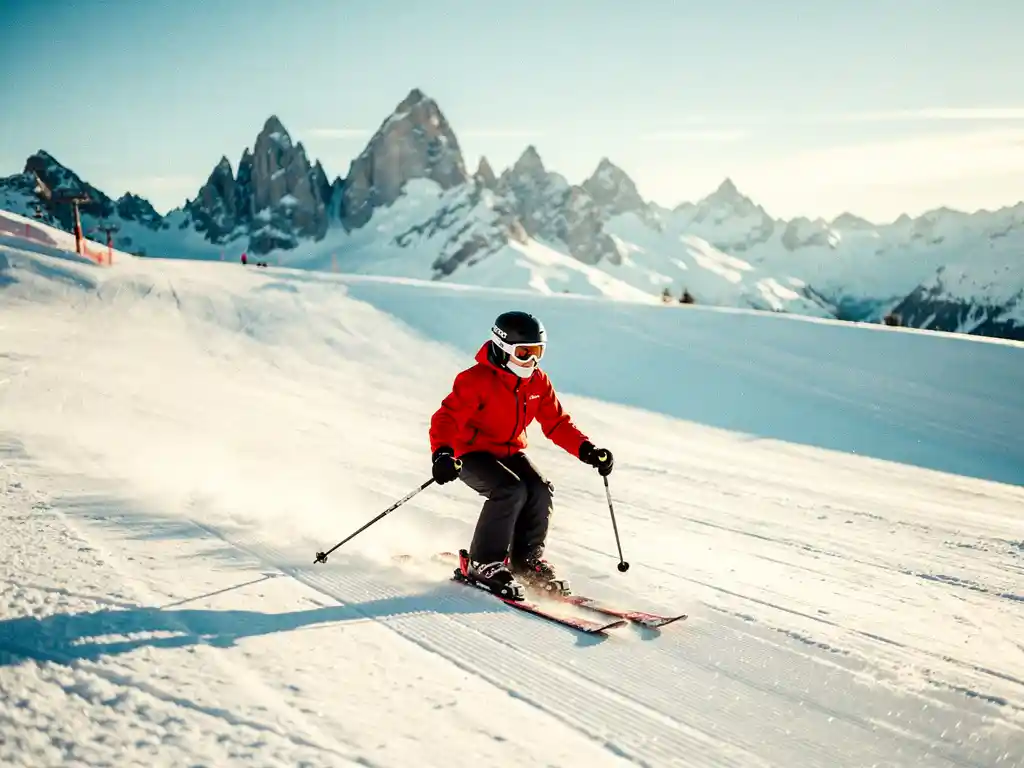
Going too fast as a beginner skier is one of the most common challenges on the slopes. The solution lies in mastering two fundamental skills: the snowplow to slow down and the use of turns to control your speed. With the right technique and a little practice, you’ll be making your first turns on skis safely and confidently in no time. In this article, we answer the most frequently asked questions about speed control for beginners.
Why do beginner skiers go too fast?
As a beginner skier, you go too fast because you haven’t yet developed automatic braking instincts. On a slope, gravity works against you constantly: without active steering, your skis naturally accelerate. Beginners lack the muscle control and technical reflexes needed to counter that acceleration in time, causing speed to build up quickly.
Several factors make this worse. First, beginners sometimes choose a slope that’s too steep, allowing gravity to take over almost immediately. Second, body posture is often off: leaning back out of fear actually causes you to lose grip and shoot forward even faster. Third, a lack of confidence in your own braking movements leads you to freeze instinctively rather than actively intervene.
The good news: this is completely normal and entirely fixable. Once you understand how your body and your skis work together, you’ll learn to keep your speed under control step by step.
What is the snowplow and how does it help with braking?
The snowplow is the first and most essential braking technique for beginners. You position your skis in a V-shape, with the tips pointing toward each other and the tails pushed outward. By pressing the inner edges of your skis lightly into the snow, you create resistance and slow down. The wider the V, the stronger the braking effect.
The snowplow gives you direct control over your speed, even on a gentle slope. By varying the pressure on your inner edges, you can gradually decelerate without coming to an abrupt stop. This makes it the perfect technique for practicing your first turns on skis: you can also steer by applying slightly more pressure to the ski on the outside of the turn.
Pay attention to your posture during the snowplow: knees slightly bent, weight forward, and eyes focused on the slope ahead of you. This keeps you stable and allows you to react quickly to whatever lies in your path.
How do you use the slope to control your speed?
You can use the slope itself as a braking tool by traversing across the hill rather than heading straight down. By skiing diagonally, you reduce the effect of gravity and automatically lower your speed. This principle is called traversing and is a powerful tool for beginners.
Combine traversing with the snowplow and you already have an effective system for managing your speed. Ski diagonally to the right, brake slightly, turn toward the left, brake again: this way you zigzag in a controlled manner down the mountain. This is exactly how making your first turns on skis works in practice.
Also be deliberate about choosing the right slope. On a blue run (the easiest category), the gradient is gentle enough for beginners to practice comfortably. A red or black run is intended for advanced skiers and makes speed control exponentially more difficult. Always start on a slope that matches your ability level.
What is the difference between slowing down and stopping on skis?
Slowing down means reducing your speed while continuing to move. Stopping means coming to a complete standstill. As a beginner, it’s important to know this distinction, because stopping requires more strength and technique than simply braking. You brake using the snowplow, but to stop completely you turn your skis perpendicular to the slope.
That sideways position is called a hockey stop or parallel stop, but it’s still a step too far for most beginners. The easiest way to come to a standstill as a beginner is to combine a wide snowplow with a gentle turn toward the slope, allowing you to naturally roll to a stop. You use the slope as a natural brake by turning uphill.
Always practice stopping on a flat or gently sloping run first. Only once you can brake comfortably does it make sense to work on a controlled full stop on steeper sections.
What mistakes do beginners make when going too fast?
The most common mistake beginners make when going too fast is leaning back. This feels instinctively safe, but it has the opposite effect: you lose grip on your skis and actually accelerate. The second major mistake is standing stiff, which means you have no control over your movements and can’t react quickly enough.
Other common mistakes include:
- Choosing a slope that’s too steep for your current level, causing speed to become unmanageable
- Not actively braking and hoping things will slow down on their own
- Panicking at speed and consequently abandoning the snowplow
- Keeping skis too parallel instead of maintaining the V-shape
- Looking down at your feet instead of ahead, causing you to react too late to obstacles
The common thread: fear leads to the wrong reflexes. The more confidence you build in your braking technique, the less you’ll panic and the better you’ll control your speed.
Does a ski lesson help with learning to brake?
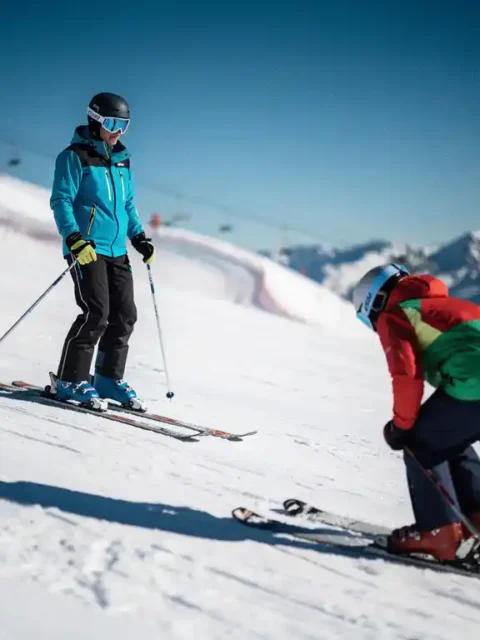
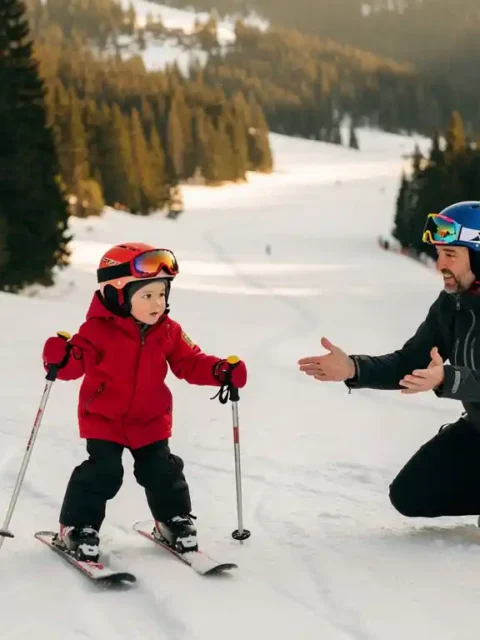
Yes, a ski lesson significantly speeds up the learning process. A certified ski instructor can immediately spot what mistakes you’re making and correct your posture and technique before bad habits become ingrained. What might take you days to figure out on your own, you can learn in just a few hours with a good lesson.
Guidance is especially valuable when learning your first turns on skis. An instructor tailors exercises to your pace and ability level, selects the right slope, and gives you concrete feedback you can apply straight away. Group lessons are ideal if you enjoy learning alongside others; private lessons offer maximum individual attention.
How Ski-Pro helps you find the right ski lesson
If you’re a beginner looking for the perfect ski lesson, you’ve come to the right place. Through Ski-Pro, you can easily compare and book lessons with more than 250 certified ski schools and instructors throughout the Alpine region. Whether you want to make your first turns on skis in the Austrian Tyrol, the Swiss Alps, or on French slopes, we’ll help you find the right match. Here’s what you can expect from us:
- Clear comparison of group lessons and private lessons by price, location, and level
- Reviews and experiences from other skiers to help you make an informed choice
- Transparent pricing with no hidden costs
- Easy online booking, including last minute
- Options for all levels, from complete beginner to advanced skier
Don’t wait any longer — take that first step on the slopes with confidence. Compare and book your ski lesson through Ski-Pro and make this season the most memorable snow adventure of your life!
Frequently Asked Questions
How quickly can you learn to brake as a beginner skier?
Most beginners grasp the basic principles of braking with the snowplow within one or two lesson days. How quickly you progress depends on your physical fitness, coordination, and how often you practice. With guidance from a certified instructor through Ski-Pro, the learning process is considerably faster, because mistakes are corrected right away before they become habits.
Which slope is best for practicing speed control as a beginner?
Always start on a blue run, the easiest category with a gentle gradient. This gives you the space to practice the snowplow and traversing at a relaxed pace without your speed building up too quickly. Avoid red and black runs until you have fully mastered the basic braking techniques and feel comfortable on a blue slope.
What should I do if I panic on the slopes due to going too fast?
Try to consciously lean forward rather than back, because leaning back makes the situation worse. Immediately adopt a wide snowplow and steer gently toward the slope to naturally roll to a stop. Practice this emergency stop in advance on a flat run so that it becomes an automatic reflex you can execute even under pressure.
Is it necessary to take a private lesson, or is a group lesson sufficient for beginners?
For most beginners, a group lesson is an excellent and affordable way to learn the fundamental skills, including braking and speed control. Choose a private lesson if you want to progress faster, overcome specific fears, or need individual attention for your technique. Through Ski-Pro, you can easily compare both options by price and location, so you can make the choice that suits you best.