
How do you shift your weight forward while skiing?

To bring your weight forward while skiing, actively press your shins against the front of your ski boots and bend slightly through your ankles and knees. This sounds simple, but for beginners it feels unnatural and requires conscious practice. In this article, we answer the most frequently asked questions about ski posture and weight distribution, so you can hit the slopes with confidence.
Why do beginner skiers automatically lean back?
Beginner skiers automatically lean back because the body instinctively searches for stability when faced with uncertainty. On a steep, slippery slope, your brain triggers a survival reflex: leaning back feels safer, as if you can slow yourself down by moving away from the mountain. However, this is precisely the opposite of what your skis need to function properly.
The ski boot also plays a role here. Beginners are not used to the stiff construction and forward lean of a ski boot. As soon as the boot pushes slightly forward, the body compensates by shifting the hips backward. The result: your weight ends up on your heels instead of the front of the ski, causing you to lose control rather than gain it.
Fear of speed is also a major factor. The faster you go, the greater the urge to pull your body backward. Unfortunately, this achieves exactly the opposite effect: the back of the ski loses grip, the front lifts slightly, and steering becomes increasingly difficult. It is a vicious cycle that can only be broken through deliberate technique training.
What does “weight forward” actually mean in skiing?
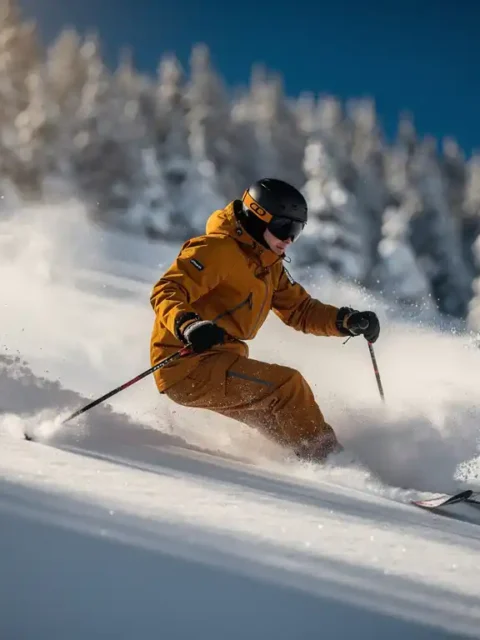
In skiing, weight forward means actively placing your body weight over the front of the ski by pressing your shins against the front of your ski boots. It is not about leaning your upper body forward, but about a subtle pressure through your ankles and knees that fundamentally changes your skiing technique.
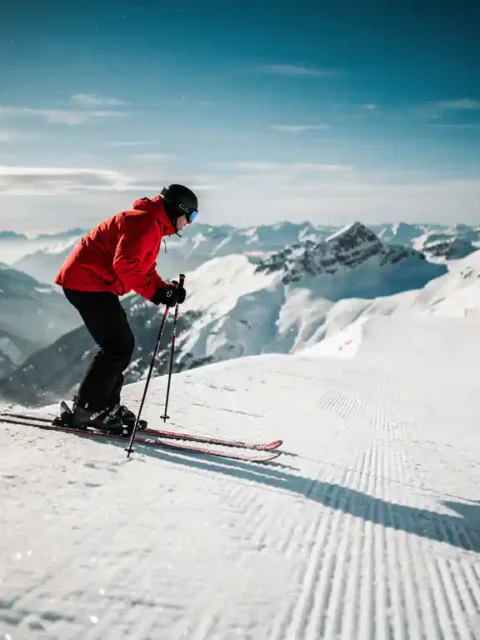
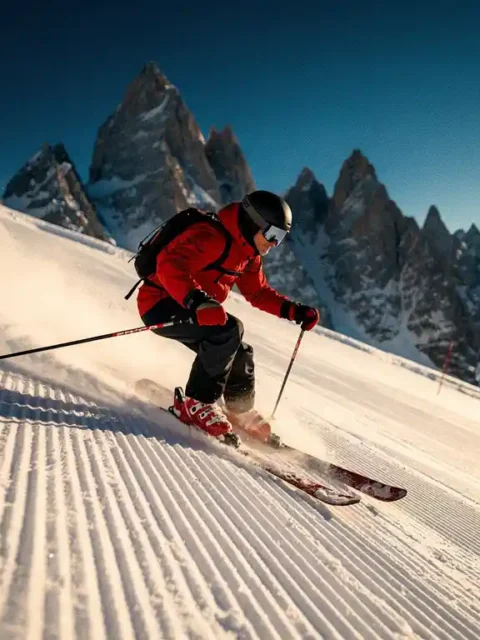
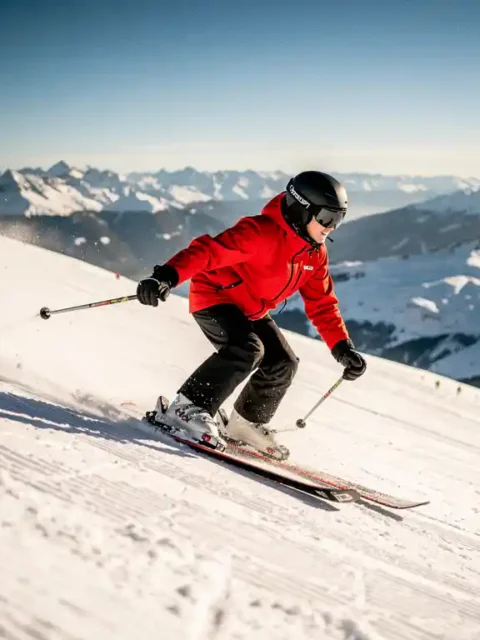
A good ski stance looks like this:
- Your ankles are slightly bent and your shins are in contact with the tongue of the ski boot
- Your knees are relaxed and bent, aligned over the tips of your boots
- Your hips are shifted slightly forward, not pushed back
- Your upper body is tilted slightly forward, but not bent from the back
- Your arms hang relaxed in front of your body, not alongside your hips
The pressure is primarily in the shins and knees, not in your back or shoulders. Many beginners think they need to lean far forward, but that is a misconception. A correct ski stance feels controlled and athletic — similar to the position you take when you are ready to catch a ball or make a jump.
How can you tell if your weight is correctly positioned forward?
You can tell your weight is correctly positioned forward when you feel clear pressure against the front of your ski boot, your toes feel light but your heels are not pressing heavily into the insole, and your skis respond smoothly to small steering inputs. If your skis respond slowly or you keep getting pulled backward, your weight is too far back.
There are a few simple self-checks you can do on the slope:
- The shin test: Can you feel the pressure of your shin against the front of the boot? If so, you are in the right position.
- The heel test: Try to lift your heel slightly inside your boot. If it comes up easily, your weight is too far back.
- The knee test: Look down. Are your knees extending slightly beyond your boot tips? If so, you have a good forward stance.
- The steering test: Make a small turn. Do your skis respond immediately and smoothly? Then your weight is in the right place.
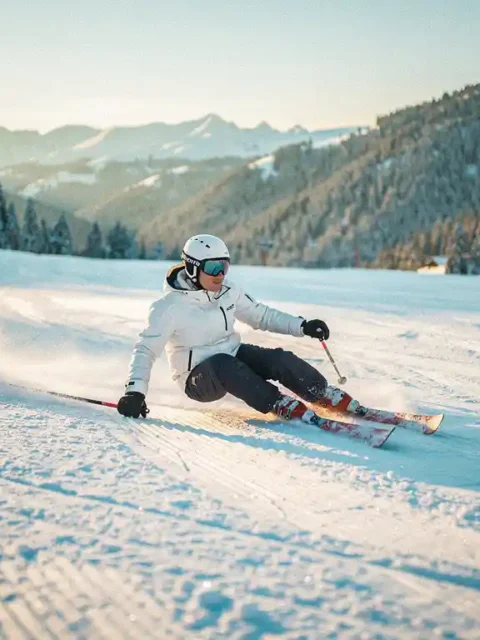
An instructor can also give you direct feedback by looking at your tracks in the snow. A skier who is too much on their heels leaves a wide, irregular trail. A skier with their weight properly forward carves clean, even arcs in the snow.
What exercises help you bring your weight forward?
The most effective exercises for bringing your weight forward are the shin-pressure drill, skiing on one ski, and the so-called “fist-in-the-boot” test. These exercises train your body to feel and maintain the correct pressure points, even as the slope gets steeper or your speed increases.
On-slope exercises
Start with the shin-pressure drill: stand still on your skis and consciously press your shins forward until you feel the pressure against the tongue of your boot. Hold this for ten seconds, then relax. Repeat until the feeling becomes familiar. Then do the same while skiing slowly on a flat run.
Another powerful exercise is lifting the ski tip: ski slowly and try to lift the tip of your ski slightly off the snow while moving. This automatically forces your weight forward. If you cannot do it, your weight is too far back.
Off-slope exercises
At home, you can start practicing the athletic stance: stand with your feet hip-width apart, bend slightly through your knees, and push your shins forward as if leaning against a wall. Feel how your weight shifts to the balls of your feet. This is exactly the pressure you want to recreate on skis.
Squats with forward knee drive are also helpful: perform a squat in which your knees deliberately travel forward over your toes. This trains both the leg muscles you need and your proprioceptive sense of weight distribution.
What are the most common mistakes when leaning forward?
The most common mistake when leaning forward is bending from the back or hips instead of seeking pressure through the ankles and shins. Other frequent mistakes include keeping the arms too far back, spreading the knees too wide, and gripping the stance too rigidly, which causes the legs to stiffen.
Here is a summary of the mistakes:
- Bending forward from the back: This looks like leaning forward, but actually misplaces your weight and puts unnecessary strain on your back.
- Arms alongside the body: When your arms hang next to your hips, your upper body automatically pulls backward. Keep your arms in front of your body.
- Stiff knees: Locked knees make it impossible to absorb shocks and immediately disrupt your weight distribution.
- Leaning too far forward: Overdoing it is counterproductive. If you hang too far forward, you lose control over the back of your skis.
- Only practicing while standing still: Your stance changes as soon as you start moving. Practice actively while skiing, not just when stationary.
Does a private lesson help correct your ski stance?
Yes, a private lesson makes a huge difference when it comes to correcting your ski stance. A certified ski instructor can see at a glance where your weight is, which muscles you are tensing unnecessarily, and what your movement pattern looks like from the outside. That direct, personal attention and immediate feedback are things no video or article can provide.
In a group lesson, the instructor divides their attention among multiple people. That is fine for learning basic skills, but for specific technique issues such as incorrect weight distribution, personal coaching is far more effective. A private lesson allows the instructor to tailor the exercises entirely to your body, your fears, and your pace.
What you can expect from a good private ski technique lesson:
- A direct analysis of your current stance on the slope
- Specific exercises tailored to your weak points
- Real-time corrections while you ski
- Explanations of why certain movements work or do not work
- A progressive build-up from easier to more challenging situations
How Ski-Pro helps you with the right ski technique
A good ski stance starts with the right guidance, and you will find that guidance with a certified instructor who knows exactly what you need. We connect you with more than 250 ski schools and instructors throughout the Alps, making it quick and easy to find the perfect match for your level, location, and budget. Whether you are looking for a private lesson to correct your weight distribution or a group lesson to learn the fundamentals of ski technique, our platform makes it effortless to compare and book:
- Private lessons with dedicated attention to your stance and technique
- Certified instructors in top destinations such as Tyrol, Switzerland, and France
- Transparent pricing and honest reviews from fellow skiers
- Easy comparison by level, language, and availability
- Lessons for all levels, from complete beginners to advanced skiers
Are you ready to come down that mountain with a stance that actually works? Compare and book your ski lesson and hit the slopes fully prepared.
Frequently Asked Questions
How long does it take before a beginner automatically maintains the correct ski stance?
For most beginners, it takes an average of 3 to 5 ski days before the forward stance starts to feel natural. This varies from person to person and depends largely on how consciously you practice. With targeted guidance from an instructor and the right exercises, you can significantly speed up this process.
Does the type of ski boot affect my weight distribution?
Yes, absolutely. A poorly fitting or too-soft ski boot makes it much harder to bring the correct pressure forward. Make sure your ski boots fit snugly enough so that your shin makes direct contact with the tongue of the boot. When renting ski boots, always ask for a boot suited to your level and skiing style, and have it properly fitted.
Can I improve my ski stance outside of ski season?
Absolutely. Exercises such as squats with forward knee drive, balance work on a BOSU ball, and the athletic stance described in this article can all be done year-round at home or in the gym. This trains both the required muscles and your proprioception, so you get back up to speed more quickly at the start of the next season.
What is the difference between a private lesson and a group lesson if I specifically want to improve my stance?
If you want to work specifically on your weight distribution and posture, a private lesson is by far the most effective choice. An instructor can focus entirely on you, immediately sees where things go wrong, and adapts the exercises to your specific body and movement pattern. In a group lesson, that individual attention simply is not available, which means technique errors can go unnoticed for longer.