
How do you practice the correct skiing posture at home?
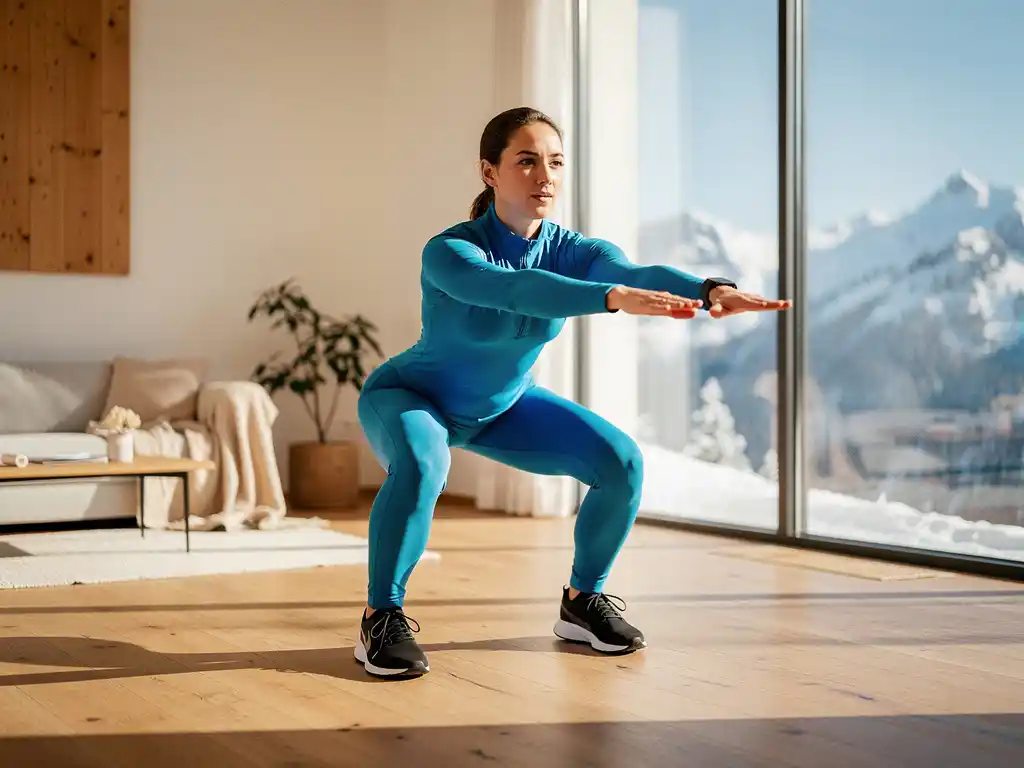
Practicing the correct ski stance at home means combining targeted strength exercises with posture training that prepares your body for the slopes. Think squats, balance exercises on a BOSU ball, and wall sits that strengthen your leg muscles and core. For beginners, training at home is a smart way to make those first days on skis go much more smoothly. In this article, we answer the most frequently asked questions about training your ski stance without snow.
Which muscles do you use in the correct ski stance?
The correct ski stance primarily engages your quadriceps (front of the upper legs), hamstrings, glutes, calves, and core muscles, including your core and lower back. These muscle groups work together to keep your body stable and controlled as you carve down the slope. Without sufficient strength in these muscles, maintaining a good stance on skis quickly becomes exhausting.
Many beginners underestimate just how physically demanding skiing actually is. You are constantly absorbing vibrations, shifting your weight, and reacting to uneven snow. The quadriceps carry the heaviest load: they keep your knees bent and prevent you from leaning back. The glutes and hamstrings help initiate turns and stabilize your hips.
Equally important is your core. A strong core keeps your upper body calm and upright while your legs do the work. Weak core muscles often lead to a rounded upper back or excessive arm swinging, which directly disrupts your balance. By training these muscle groups specifically before your ski trip, you will feel far more confident on the slopes.
What exactly does a skier’s basic stance look like?
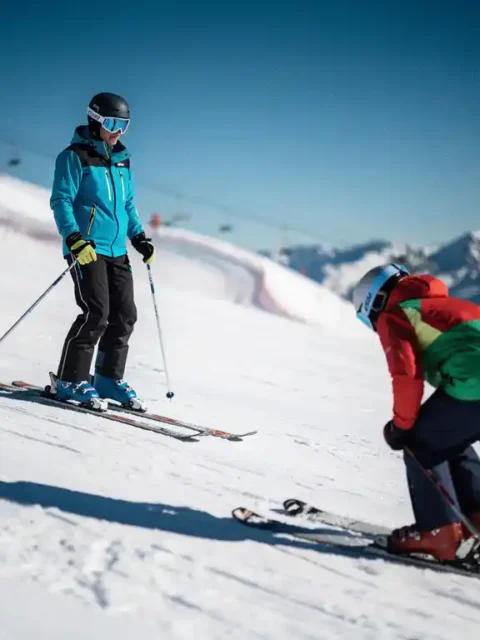
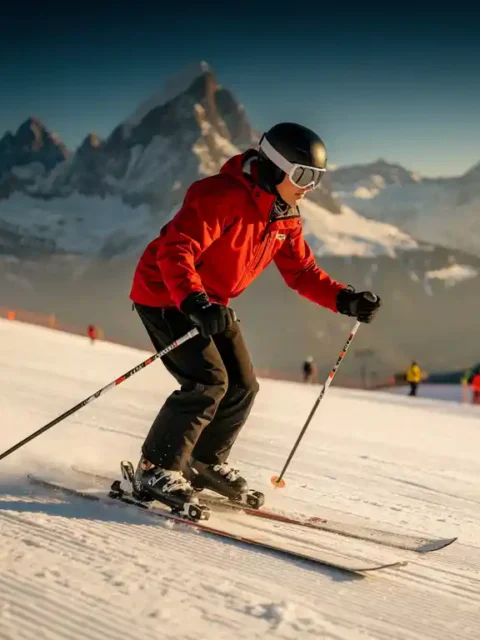
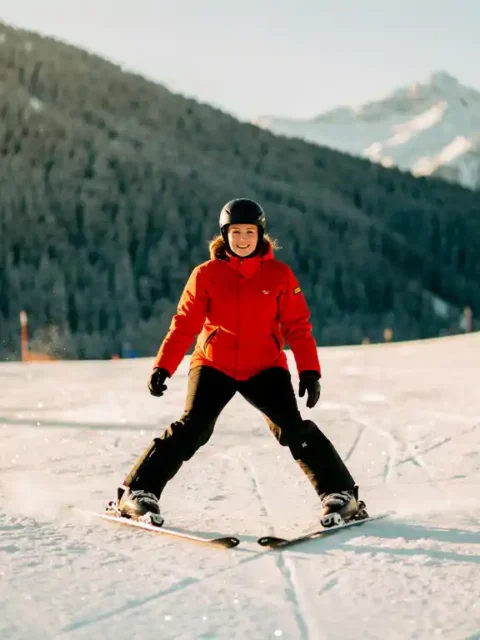
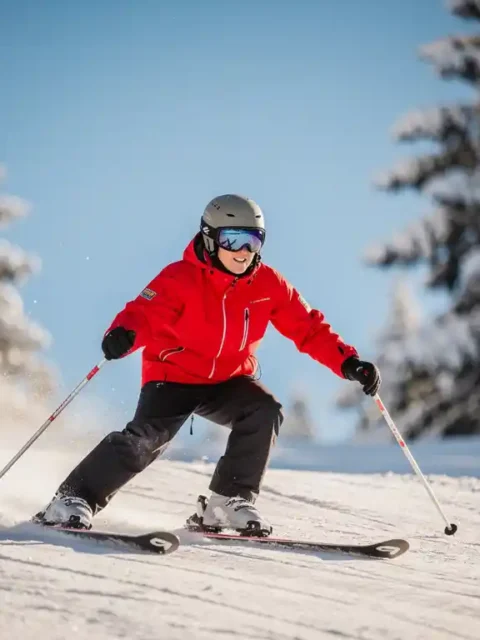
A skier’s basic stance is an athletic, slightly bent position in which the knees and hips are flexed, the weight is evenly distributed across both skis, and the upper body leans slightly forward. Your feet are hip-width apart, your arms hang relaxed in front of your body, and your gaze is directed at the slope ahead of you.
In concrete terms, it looks like this:
- Knees bent so that your shins press lightly against the ski boots
- Hips low as if you are about to sit on the edge of a chair
- Upper body slightly forward but not collapsed or rounded in the back
- Weight on the balls of your feet so that you maintain contact with the front of your boot
- Arms in front of your body with slightly bent elbows, poles angled backward
- Head up with your gaze directed at the path ahead
A common mistake among beginners is leaning back. This feels safer, but it is actually more dangerous: you lose control over your skis and cannot brake or steer effectively. The correct ski stance requires confidence and getting used to, but if your body already knows the position from home, it will come much faster on the slopes.
What exercises can you do at home to train your ski stance?
At home, you can train your ski stance with exercises such as wall sits, squats, lunges, balance board training, and holding the ski position in front of a mirror. These exercises strengthen the right muscle groups and teach your body to recognize the stance you will need on the slopes. Just five to ten minutes a day is enough to make a noticeable difference.
Strength exercises for skiers
The wall sit is the classic ski exercise: stand with your back against a wall, lower yourself until your knees are at a 90-degree angle, and hold the position for as long as possible. This perfectly mimics the load your quadriceps experience while skiing. Start with 30 seconds and work your way up to several minutes.
Squats and lunges are equally essential. Squats train both legs simultaneously, while lunges also challenge your stability and balance — much like shifting your weight when making a turn. Add a small jump to your squats for extra explosiveness, which helps with absorbing bumps on the slope.
Balance and posture training
Stand on one leg for one minute every day, with a slightly bent knee and your arms in front of your body in a ski stance. This sounds simple, but it simultaneously trains your ankles, calves, and core. Close your eyes for an extra challenge.
Also practice the basic ski stance in front of a mirror: get into the correct position and check whether your knees are aligned over your feet, your upper body is straight, and your arms are positioned correctly. Hold the position for thirty seconds and then relax. Repeat this a few times a day. Your body will learn to recognize the stance as something familiar.
Can you also use equipment at home to improve your ski stance?
Yes, there are several tools you can use at home to improve your ski stance. A BOSU ball or balance board simulates the unstable surface of snow and trains your sense of balance. A foam roller aids muscle recovery and flexibility, and resistance bands add extra load to your squats and lateral movements.
A balance board is perhaps the most effective tool for skiers. You can stand on it in a ski stance, practice subtle weight shifts from left to right (as when carving turns), and train your reaction time. Some models even feature a rocking motion that mimics the dynamics of a slope.
Resistance bands are useful for lateral squats and hip abduction exercises, which strengthen the small stabilizing muscles around your hips and knees. These are muscles you rely on heavily on the slopes, but that standard squats do not train as effectively. They are affordable, compact, and easy to use at home.
Finally: wear your ski boots at home if you have them. Simply walking around the house in ski boots gets you used to the feeling of the stiff shell and helps you feel the shin pressure that goes with the correct forward lean in your stance.
How do you know if your ski stance is good enough for the slopes?
Your ski stance is good enough for the slopes when you can hold the basic position for at least thirty seconds without wobbling, consciously shift your weight from left to right, and keep your knees stable without letting them cave inward. On the slope itself, the real test applies: a good stance feels comfortable and gives you control, not tension.
Check the following points at home:
- Can you complete a one-minute wall sit without pain in your knees?
- Does your upper body stay upright when you stand on one leg with a bent knee?
- Do your knees stay directly over your feet during a squat, or do they cave inward?
- Can you adopt the basic ski stance in front of a mirror and look relaxed doing it?
- After a few weeks of training, does the position feel familiar and less demanding?
If you can answer yes to all of these points, you are ready. That said, home training is always preparation, never a substitute. Your first day on skis will always require an adjustment period, no matter how well prepared you are. Take those first lessons seriously, even if you feel fit. A good instructor can tell at a glance whether your stance is correct and can make adjustments right away.
How Ski-Pro helps you achieve the correct ski stance on the slopes
Practicing at home is a great start, but the real breakthrough in your ski stance happens on the slopes with a good instructor. That is exactly where we come in. Through Ski-Pro, you can easily find and book the perfect ski lesson from our network of more than 250 certified ski schools and instructors in the Alps. Whether you are stepping onto skis for the first time or looking to refine your technique, we make comparing and booking simple.
What we take care of for you:
- Compare hundreds of ski schools and instructors by location, price, and level
- Choose between private lessons for personal attention or group lessons for a more social experience
- Book easily online, with transparent pricing and availability
- Enjoy guidance from certified instructors who will get your stance in shape quickly
From Winterberg to Tyrol: we make sure you hit the slopes well prepared and worry-free. Compare now and book your first ski lesson!
Frequently Asked Questions
How far in advance should I start training for my ski trip?
Ideally, you should start targeted ski training four to six weeks before your ski trip. This gives your body enough time to build strength in your quadriceps, glutes, and core without overloading yourself. Even two weeks of consistent training will make a noticeable difference on your first day on the slopes.
How quickly can a ski instructor correct my stance if I have already practiced at home?
If you have already practiced the basic stance at home, a certified ski instructor can often refine your technique significantly within the first lesson. Your body already recognizes the position, which means the instructor can focus on finer corrections straight away rather than starting from scratch. This saves you lesson time and money, and leads to faster progress on the slopes.
What are the most common mistakes when training your ski stance independently at home?
The most common mistake is training with knees that are too straight, which engages the wrong muscles and builds an unrealistic sense of the position. In addition, many people forget to actively engage their core during exercises such as the wall sit or squat, even though this is essential for a stable ski stance. Always train in front of a mirror or record yourself to check that your stance is truly correct.
Is home training also useful for advanced skiers, or is it only for beginners?
Home training is certainly valuable for advanced skiers too, although the focus shifts. While beginners benefit from learning the basic stance, advanced skiers can further develop their explosiveness, reaction speed, and single-leg strength with exercises such as single-leg squats and plyometric lunges. A stronger and more mobile foundation translates directly into better carving and greater control on steep or challenging slopes.