
When do you use the pizza wedge while skiing?
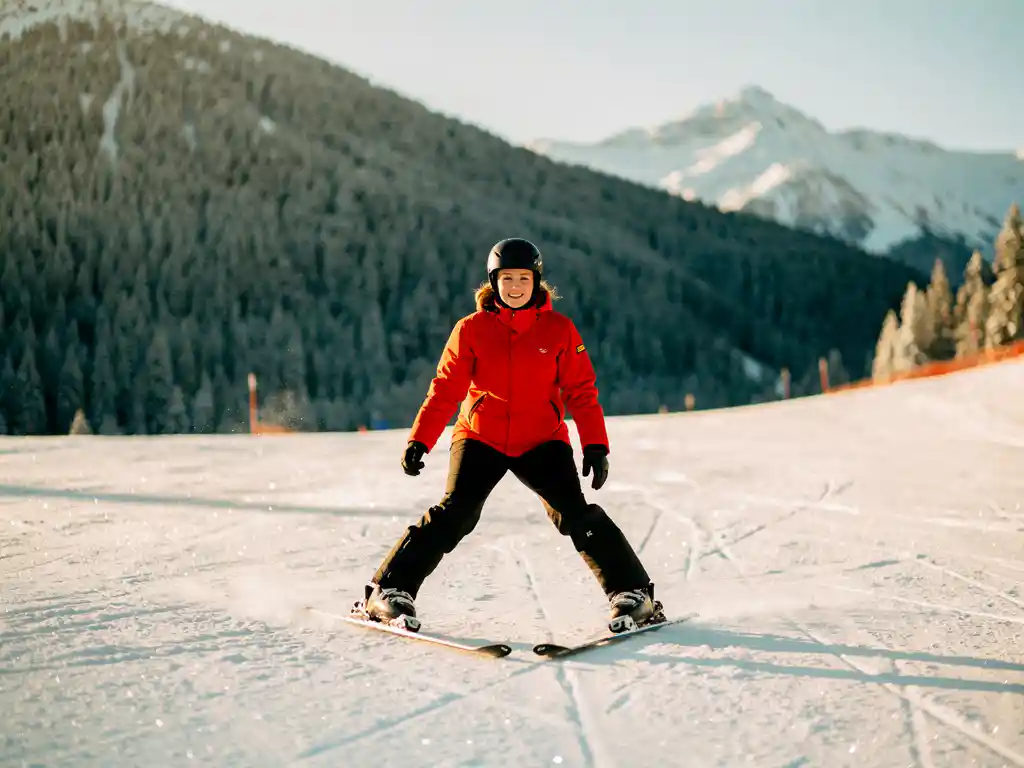
The snowplow (or wedge) is the technique beginners use to control their speed and brake safely on the slope. You point your ski tips toward each other and push your heels apart, creating a triangular shape. The more pressure you apply to the inner edges of your skis, the harder you brake. This is the first technique virtually every beginner learns, and for good reason: it gives you immediate control over your movement on the snow. In this article, we answer the most frequently asked questions about the snowplow, from the basics to the moment you’re ready to make the transition to parallel skiing.
What is the difference between the snowplow and parallel skiing technique?
The snowplow and parallel skiing are two fundamentally different ways of moving on skis. In the snowplow, the tips of your skis are close together and your heels are pushed wide apart, forming a triangle or wedge shape. In parallel skiing, both skis are side by side, parallel to each other, and you steer through weight shifting and edging rather than using a V-shape.
The snowplow is the beginner technique par excellence because it immediately gives you stability and braking power. You don’t need perfect balance, and you can easily adjust your speed by making the triangle larger or smaller. Parallel skiing requires greater body control, a better sense of balance, and confidence on the slope. Advanced skiers sometimes even combine both techniques deliberately: in tight turns or icy conditions, a slight snowplow stance can help even experienced skiers maintain control.
The key difference, then, lies in the approach to control: the snowplow is an active brake, while parallel skiing is a dynamic steering movement. Beginners always start with the snowplow because it is the safest and most intuitive way to get acquainted with ski technique for beginners.
How do you use the snowplow to brake?
You brake with the snowplow by bringing your ski tips toward each other while simultaneously applying pressure to the inner edges of your skis. The larger the V-shape and the more pressure you apply, the harder you brake. Bend your knees slightly and keep your upper body relaxed and leaning forward.
Step by step, the technique looks like this:
- Stand upright on your skis with your knees slightly bent.
- Slowly bring the tips of your skis toward each other, but don’t let them touch.
- Push your heels outward to create a clear V-shape.
- Apply pressure to the inner edge of both skis at the same time.
- The more pressure you apply, the stronger the braking effect. To stop, widen the V and increase the pressure.
A common mistake is that beginners push their knees outward instead of inward. This significantly weakens the braking effect. Also make sure you distribute your weight evenly across both skis. If you put more pressure on one ski, you will automatically start steering in that direction — which is useful for turning, but not when you want to brake in a straight line. Practice really does make a difference here: after a few hours on the slope, the movement will already feel much more natural.
When do you switch from the snowplow to parallel skiing?
You’re ready to switch to parallel skiing when you have fully mastered the snowplow, can make smooth turns, and consistently have your speed under control on blue and easy red runs. Most beginners reach this point after several days of intensive practice or after a couple of ski vacation weeks.
There are a few clear signs that you’re ready to make the transition:
- You make turns with the snowplow without thinking about it.
- You feel comfortable on blue runs and want more speed and dynamism.
- You can consciously shift your weight from ski to ski.
- You’re braking by choice, not out of fear.
The transition is often gradual. Many skiers start with a half-wedge where one ski is parallel and the other points slightly outward. This is also known as the stem turn or carving entry. A good instructor will recognize exactly when you’re ready for that next step and can guide you at the right moment. Try not to force the transition: parallel skiing with a weak foundation quickly leads to bad habits that are hard to unlearn later on.
Why does the snowplow not work well for some beginners?
The snowplow doesn’t work well for some beginners because they are too tense, distribute their weight incorrectly, or don’t execute the knee movement properly. Fear also plays a major role: those who are afraid of falling instinctively lean their body backward, which prevents the technique from working as intended.
The most common causes are:
- Weight too far back: If you lean backward, you lose grip on the front of your skis and the braking effect is minimal.
- Knees pushed outward instead of inward: The inner edge of the ski needs to make contact with the snow. Pushing your knees outward does exactly the opposite.
- Standing too stiff: Tense legs don’t absorb unevenness in the snow, making it easier to lose your balance.
- Ski tips too close together: If the tips touch, your skis will cross and you’ll fall. There must always be a small gap between them.
- Wrong ski boots or poorly fitting equipment: Boots that don’t close properly or skis that don’t match your level make every technique harder.
The solution often lies in small corrections that an instructor can point out immediately. What feels like a major problem to you is something an experienced ski instructor can spot and fix in just a few minutes.
On which slopes should you practice the snowplow?
The best place to practice the snowplow is on wide, flat to gently sloping blue runs with little traffic. A slope that is too steep makes the technique harder and more intimidating, while one that is too flat doesn’t provide enough challenge to really learn how to brake.
The ideal practice spot has the following characteristics:
- A gentle, even gradient — not too steep and not too flat.
- A wide run with plenty of room to maneuver.
- Well-groomed, soft snow — ideally no ice or moguls.
- Low crowds, so you’re not distracted or intimidated by fast skiers.
Popular beginner destinations such as Söll in Tyrol, Les Gets in France, and Saas-Fee in Switzerland have excellent practice slopes specifically for beginners. In Germany, Winterberg and Willingen are also great starting points for first-time skiers. Many ski resorts have a dedicated beginner area or “Übungsgelände” that is perfectly set up for first lessons. Always ask upon arrival about the designated beginner zones, as these are specifically designed for your level.
Do you need a private lesson or a group lesson to learn the snowplow?
You can learn the snowplow in either a private lesson or a group lesson, but which works best for you depends on your learning style, budget, and pace. Group lessons are fun, affordable, and ideal if you enjoy practicing alongside others. Private lessons progress faster and are better tailored to your specific mistakes and pace.
Group lessons: learning together is twice the fun
In a group lesson, you learn the fundamentals of skiing alongside other beginners, including the snowplow. The group usually consists of people at the same level, which creates a relaxed atmosphere. You also learn from others’ mistakes, which is surprisingly effective. Group lessons are the most affordable option and give many beginners exactly the social motivation they need to keep going.
Private lessons: faster progress, more personal attention
In a private lesson, the instructor’s full attention is on you. They immediately see where things go wrong with your knees, weight distribution, or posture, and tailor the instruction to your pace. This is ideal if you want to learn quickly, if you’ve previously picked up bad habits, or if you have children who need one-on-one guidance. Private lessons are more expensive, but progress is generally faster.
How Ski-Pro helps you find the right ski lesson
Whether you choose a group lesson or a private lesson, it all starts with the right ski school on the right slope. And that’s exactly where we, as ski enthusiasts, can help. Through Ski-Pro, you can easily compare more than 250 certified ski schools and instructors in the Alps, from Tyrol to the French Alps and the Swiss mountains. No endless searching, no surprises afterward.
Here’s what we take care of for you:
- Compare lessons by level, location, price, and availability.
- Filter by group lesson or private lesson, depending on what suits you.
- Book directly online with certified ski schools in your favorite ski resort.
- Receive transparent pricing information with no hidden costs.
- Find lessons for all ages, from the youngest slope enthusiasts to adult beginners.
Ready to make your first real snowplow on an actual Alpine slope? Compare and book your ski lesson through our platform and take your first steps on the snow this winter with complete peace of mind!
Frequently Asked Questions
How long does it take on average to master the snowplow?
Most beginners need one to two full ski days to perform the snowplow comfortably. This depends on your physical fitness, sense of balance, and how intensively you practice. With a good instructor and enough repetitions on the right slope, the learning process goes considerably faster.
Can I learn the snowplow on my own without ski lessons?
Technically, it is possible to practice the basic stance on your own, but without guidance you run a significant risk of developing bad habits that are difficult to correct later. An instructor immediately sees whether your knees, weight distribution, and posture are correct — something you cannot assess yourself on the slope. Even one or two lessons at a certified ski school will give you a much safer and faster start.
What is the best equipment for a beginner learning the snowplow?
As a beginner, you need shorter, softer skis that are easy to steer and forgiving of mistakes. Ski boots must close properly and provide firm ankle support without causing pain, as poorly fitting equipment makes every technique harder. Whenever possible, rent equipment through the ski school or a local rental shop that will help you with the right setup based on your weight, height, and level.
Is the snowplow also suitable for children, or do they learn to ski differently?
Yes, the snowplow is actually the standard starting technique for children as well and is taught first in virtually all children’s ski schools. Children often learn the technique even faster than adults because they have less fear and a lower center of gravity. It is important, however, that children receive instruction from instructors who specialize in youth lessons, so that the explanations and pace are well suited to their age and attention span.