
How do you correct your skiing posture during a lesson?
You can correct your skiing posture during a lesson by actively listening to your instructor’s feedback and immediately applying the accompanying exercises on the slope. Good posture is the foundation of everything: it determines how safely you ski, how quickly you progress, and how much fun you have on the mountain. In this article, we answer the most frequently asked questions about posture, feedback, and improvement, so you can head down the slope with confidence.
What are the most common posture mistakes beginners make when skiing?
The most common skiing posture mistakes beginners make are leaning back, keeping their knees stiff, looking down at their skis instead of ahead, and holding their arms too low or too close to their body. These mistakes almost always stem from tension and uncertainty, and they reinforce each other: leaning back causes you to lose control, and losing control makes you tense up even more.
Do you recognize yourself in this? Don’t worry — this is exactly why correct skiing posture is so central to every beginner lesson. Here are the most common posture mistakes:
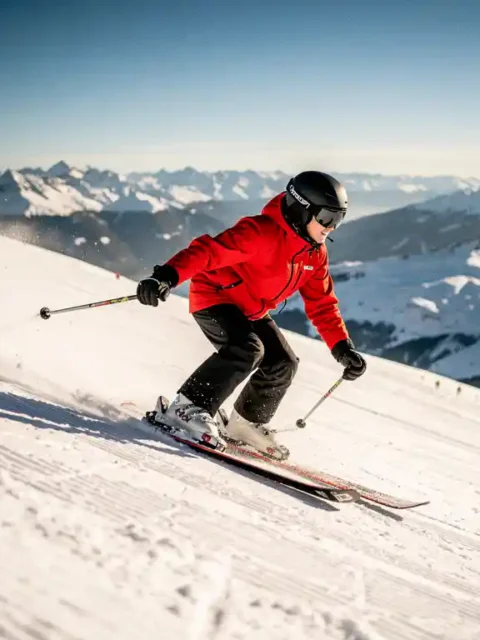
- Leaning back: Many beginners are afraid of the slope and instinctively lean backward. This actually gives you less control over your skis.
- Stiff knees: Bent knees are essential as shock absorbers and for steering. Keeping your knees straight results in rigid, uncontrolled skiing.
- Looking down: Staring at your skis causes you to lose your overview of the slope and react too slowly to what lies ahead.
- Arms too low: Ski poles hanging along your sides disrupt your balance. Your arms should be slightly bent and held in front of your body.
- Feet too close together: A slightly wider stance provides more stability, especially in the beginning.
The good news: all of these mistakes can be corrected with the right guidance. And the sooner you address them, the easier it becomes.
How does a ski instructor give feedback on your posture during a lesson?
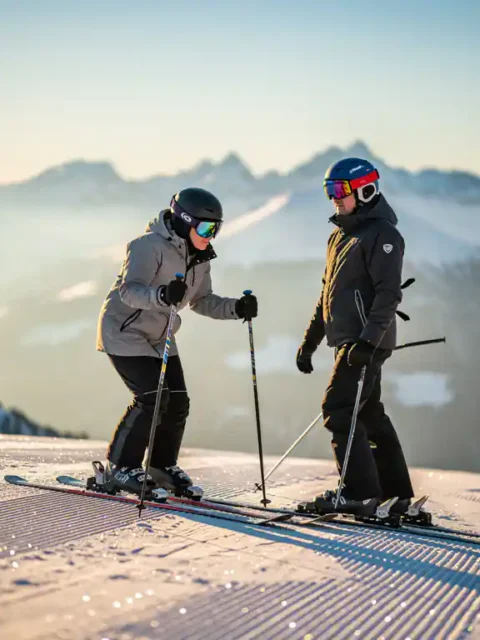
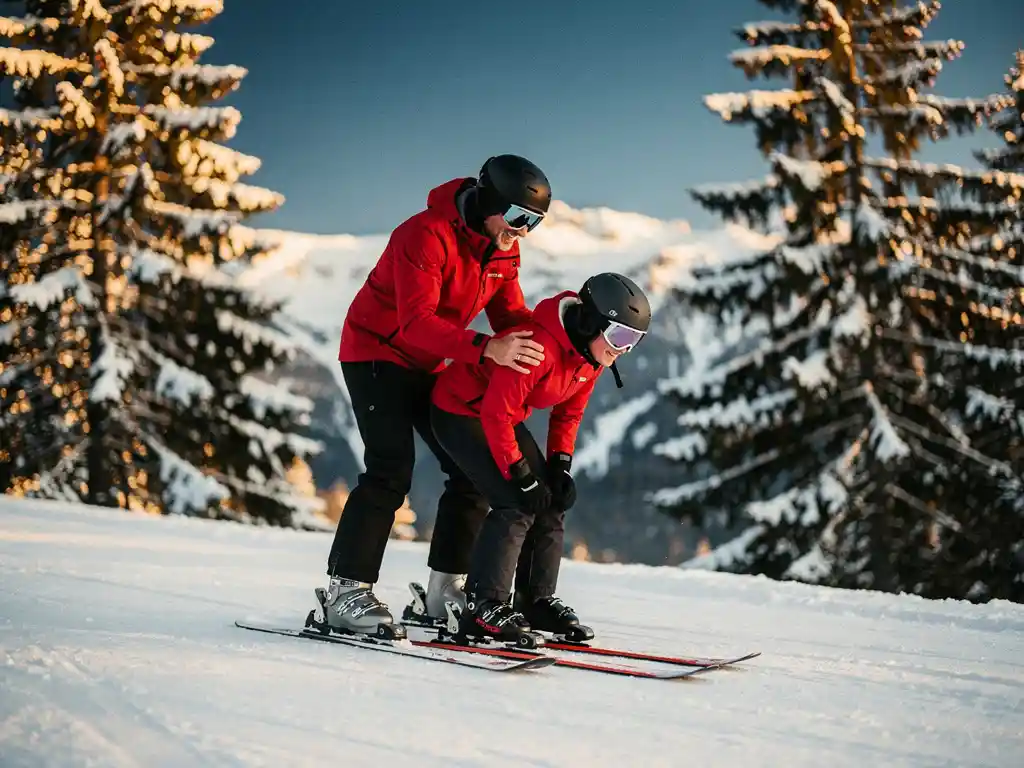
A ski instructor gives feedback on your posture by observing you live as you ski, then telling you directly and concretely what can be improved. Good instructors combine verbal explanation with visual demonstrations and short exercises, so you can feel the correction in your body right away — not just understand it in your head.
In practice, it works like this: your instructor skis alongside you or stands at the side of the slope while you descend a section. They pay attention to your knee angle, weight distribution, arm position, and where you’re looking. After the run, there’s a brief stop with targeted feedback — not a laundry list of things to improve, but one or two concrete points to focus on.
What makes good posture feedback effective?
- The instructor points out what you’re already doing well before making corrections, so you know what to keep doing.
- Feedback is specific and tangible: “bend your left knee a little more” works better than “get lower.”
- The instructor demonstrates the correct posture themselves, giving you a visual reference.
- Some instructors now use video analysis, letting you watch yourself back. This is enormously valuable for self-correction.
Don’t be afraid to ask questions yourself. A good instructor welcomes it. Feel free to ask: “Is my weight in the right position?” or “Am I looking far enough ahead?” The more actively you participate in your own learning process, the faster you’ll master correct skiing posture.
What exercises help you improve your skiing posture?
Exercises that improve your skiing posture focus on balance, knee flexion, and weight distribution. The most effective exercises are simple and can be applied directly on the slope. They train your body to adopt the correct posture automatically, even when you’re not actively thinking about your technique.
These are the exercises instructors use most often with beginners:
- The “windshield wiper”: Stand still on a flat section and alternate turning your skis left and right. This trains your feel for the edges of your skis.
- Skiing with something tucked under your arms: Clamp a ski pass or a glove under your armpits while skiing. If it drops, your arms are too low or too far back.
- The balloon exercise: Imagine you’re sitting on a balloon — not too high, not too low. This helps you find the ideal knee bend without having to think about it.
- Lifting one ski: Briefly lift one ski while skiing. This forces your weight forward and gives you immediate insight into your balance.
- The gaze exercise: Pick a point further down the slope and fix your eyes on it. Your posture improves automatically when you stop staring at your skis.
Repetition is key. Doing it right once doesn’t count — doing it right ten times starts to stick. Ask your instructor to incorporate these exercises into the lesson so you can practice them in a safe setting.
How can you tell on your own that your skiing posture is off?
You can tell your skiing posture is off when you constantly lose your balance, struggle to brake, or find that your legs and back tire quickly. Your body sends clear signals that something isn’t right, even without an instructor having to point it out.
Watch for these signals:
- Your heels feel heavy: If your weight is pressing down on your heels, you’re leaning too far back. You’ll feel this as a pulling sensation in your calves.
- Your skis go their own way: If you regularly lose control of the direction of your skis, your weight distribution or knee angle is off.
- Your back hurts after half a day: A tense, upright back is a classic sign of a posture that’s too rigid. A relaxed, slightly forward-leaning posture is far less taxing.
- You tire quickly: Skiing takes energy, but if you’re exhausted after just a few runs, you’re wasting energy on muscle tension you don’t need.
- Turns feel uncomfortable: If every turn feels like a struggle, it’s often a posture problem rather than purely a matter of technique.
Self-awareness is a powerful learning tool. The more you learn to feel what your body is doing, the faster you can make corrections on your own — even without your instructor standing right there.
Does a private lesson help more than a group lesson when correcting your posture?
Yes, a private lesson generally helps you correct your posture more quickly than a group lesson, because the instructor focuses their full attention on you and can tailor feedback directly and personally. In a group lesson, that individual attention is more limited — but group lessons have their own advantages for beginners.
In a private lesson, the instructor literally skis alongside you. They see every movement, correct you immediately, and adapt the exercises to your specific mistakes. Do you struggle with stiff knees? They’ll work on that directly. Do you lean back? You’ll get exercises that target exactly that. This tailored approach makes private lessons particularly effective for correcting posture.
In a group lesson, you share the instructor’s attention with five to ten other participants. That means less personal feedback, but also more time to observe how others ski. Beginners learn a great deal from watching their classmates, especially when they recognize that someone else is making the same mistake they are.
What suits you best? Consider a private lesson if you want to address specific posture issues quickly, or if you’ve already taken a few group lessons and are now looking for more targeted development. A group lesson is ideal if you’re stepping onto skis for the first time and want to learn the fundamentals in a social, relaxed atmosphere.
How quickly can you unlearn a bad skiing posture?
In most cases, you can significantly improve a bad skiing posture within one to three days of lessons, provided you actively work on your instructor’s feedback. Fully unlearning it and replacing it with an automatic, correct posture takes more time — but the first noticeable improvement comes quickly if you take the right approach.
The speed at which you unlearn a bad habit depends on a few factors:
- How long you’ve been making the mistake: Someone who has only skied once before has fewer ingrained patterns than someone who has been skiing with poor posture for ten years.
- How consciously you practice: Passively going down the mountain reinforces existing habits. Practicing actively with a specific goal speeds up improvement enormously.
- Frequency of lessons: Daily lessons during a ski vacation produce results much faster than one lesson per year.
- Quality of instruction: A good instructor who gives targeted, clear feedback makes the difference between stagnating and improving.
Be patient with yourself. Skiing is a physical skill, and your body needs repetition to store new movement patterns. Celebrate small victories: if you notice after a day that you’re leaning back less than yesterday, that’s already a huge step forward.
How Ski-Pro helps you with the right skiing posture
Good skiing posture isn’t something you learn from a book — you learn it on the slope, with the right instructor by your side. That’s exactly where we come in. Through our platform, you can quickly and easily find the perfect ski lesson, whether you choose a private lesson for maximum personal attention or a group lesson to learn the fundamentals alongside others.
Here’s what we do for you:
- Access to more than 250 certified ski schools and instructors in the Alps
- Easy comparison by price, location, level, and lesson type (private or group)
- Transparent information so you know exactly what you’re booking
- Available for all destinations, from Winterberg to Tyrol and the French Alps
Ready to work on your skiing posture? Compare and book your ski lesson through Ski-Pro and hit the slopes fully prepared!