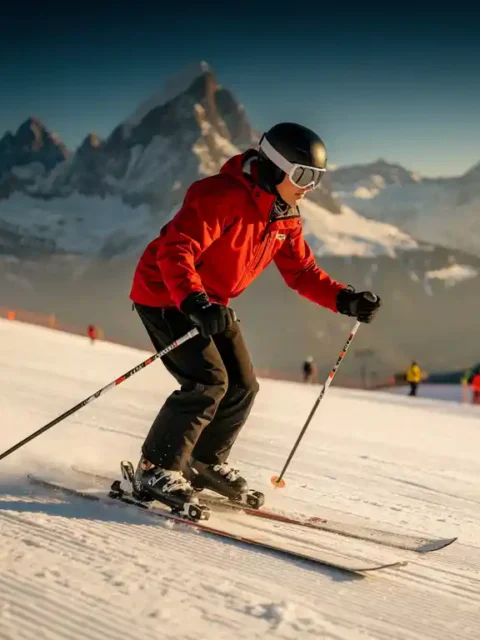

What does black run mean?
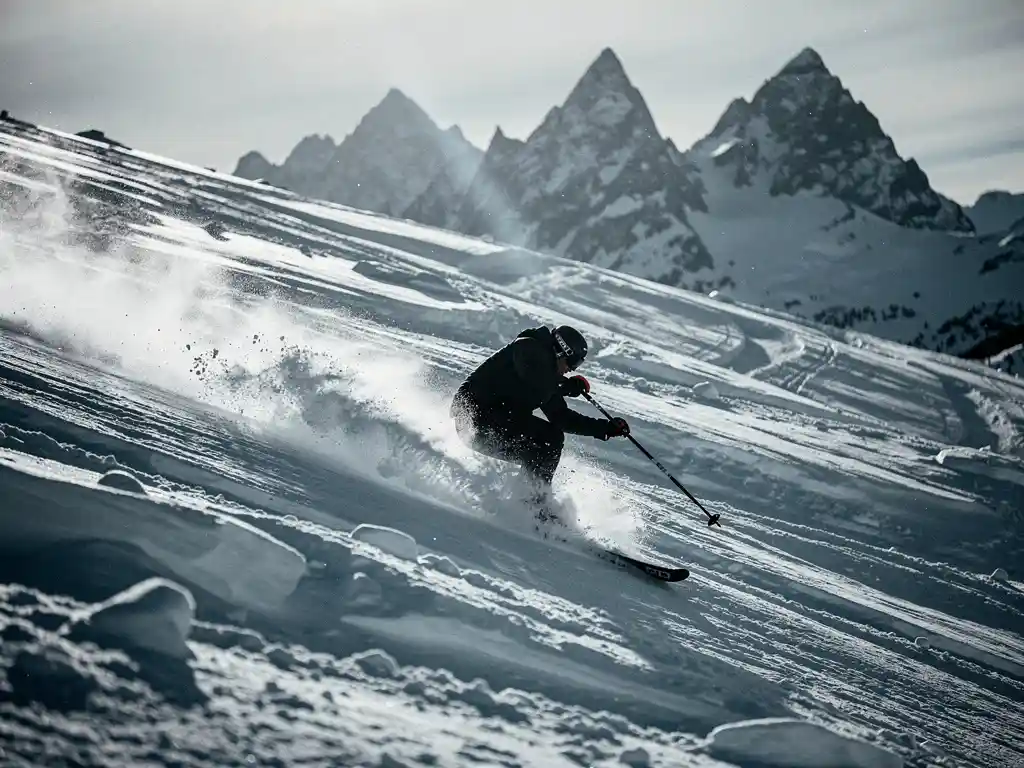
A black run is the most difficult category in the standard Alpine piste color system. Black runs typically have a gradient of more than 40 percent, which corresponds to a slope angle of approximately 22 degrees or steeper. They are intended for advanced and experienced skiers who have complete control over their technique at high speeds and on challenging terrain. In this article, we answer the most frequently asked questions about black runs, from the official piste colors to how to train yourself to be ready for them.
How steep is a black run, exactly?
A black run has an average gradient of more than 40 percent, corresponding to a slope angle of approximately 22 degrees. On the steepest sections, the gradient can reach 70 percent or more. For comparison, a blue run typically has a gradient of 10 to 25 percent, and a red run 25 to 40 percent.
What those numbers mean in practice only truly hits you when you’re standing at the top. On a black run, the pressure on your knees and legs is considerably greater, and your speed builds up much faster than on a red or blue run. Small technical errors are punished immediately, because you have less time and space to correct them. That makes the steep gradient not only a physical challenge, but a mental one as well.
In addition, black runs are often narrower, less well-groomed, and have more irregularities in the snow surface, such as moguls, icy patches, and sharp edges. The combination of gradient and terrain variation is precisely what makes black runs so demanding.
What are the official piste colors and their order?
The official Alpine piste color system consists of four categories, ranked from easiest to most difficult: green, blue, red, and black. This system is used in virtually all Alpine countries, including Austria, Switzerland, France, and Italy, though there are minor regional differences.
- Green: Ideal for complete beginners. Flat terrain with a gradient of less than 10 percent. Often found at children’s slopes and practice areas.
- Blue: Suitable for beginners who have mastered the basic skills. Gradient of 10 to 25 percent, wide and well-groomed.
- Red: For advanced beginners and intermediate skiers. Gradient of 25 to 40 percent, sometimes narrower and less even in surface.
- Black: Exclusively for experienced skiers. Gradient of more than 40 percent, technically demanding terrain.
In some areas, such as France, you may also encounter double-black runs, which are even more extreme than standard black runs. These are sometimes referred to as hors-piste or off-piste terrain and fall outside the regular piste color system. The piste color classification is intended as a universal guideline, but the level of difficulty can vary from one ski resort to another.
What level do you need to ski a black run?
To ski a black run safely, you need to be able to make parallel turns at high speed, have full control over your braking position, and be comfortable skiing steep red runs. You need several years of skiing experience and must also be able to handle irregular and ungroomed terrain.
In concrete terms, this means you need to have a solid command of the following skills:
- Parallel turns without a snowplow, even at higher speeds
- Short, controlled turns on steep slopes
- Skiing on hard snow and icy patches without losing control
- Absorbing moguls and terrain irregularities with your legs
- Staying mentally calm during a steep descent
Skiers who have just moved from blue to red are nowhere near ready for black. The transition from red to black is greater than from blue to red, both technically and mentally. Take the time to fully consolidate your skills on red runs before making the move to black.
Are all black runs equally difficult?
No, black runs vary considerably in difficulty. The “black” designation is a relative classification determined by each individual ski resort. A black run at a small ski area in Germany may be comparable to a red run at a large Alpine resort in Austria or France.
This is because ski resorts classify their own runs based on the terrain they offer. A resort with predominantly flat terrain will quickly label its steepest run as black, even if it would be considered red in a more mountainous area. Conversely, the black runs at well-known ski resorts such as Val d’Isère, Verbier, or St. Anton are notorious for their extremely steep gradients and technical challenges.
Pay attention to the length of a black run as well. A short, steep black run of 200 meters demands a different approach than a long descent of 3 kilometers with varying gradients. Both are black, but the challenge is fundamentally different. Always read the trail map of the specific resort carefully and ask local instructors for advice on which black runs are suitable as a first introduction.
When is a black run dangerous for inexperienced skiers?
A black run is dangerous for inexperienced skiers when they lack the technical skills to control their speed on steep slopes. Without parallel turns and a reliable braking position, a skier can quickly pick up too much speed, lose control, and fall on terrain where a fall can have serious consequences.
There are specific conditions that make the situation even more dangerous:
- Icy snow: On hard or icy surfaces, it is much more difficult to get grip and brake, even for advanced skiers.
- Crowded slopes: Black runs are sometimes narrower, making collisions with other skiers a greater risk.
- Poor visibility: In fog or snowfall, the edges of the run and changes in terrain are harder to see.
- Fatigue: At the end of a long day on the slopes, muscles are tired and reaction times are slower, which creates additional risks on steep terrain.
Beginners and intermediate skiers who venture onto a black run risk not only their own safety but also that of other skiers on the slope. A skier who cannot control their speed is a danger to everyone around them. The golden rule: if you’re in doubt, the run is too difficult for your current level.
How do you train effectively to handle a black run?
The most effective way to prepare for a black run is to systematically improve your technique on red runs, under the guidance of an experienced ski instructor. Good technique is the foundation: without solid parallel turns and a reliable braking position, more strength or courage won’t help you on steep slopes.
An effective training plan looks like this:
- Master the red run completely: Ski a variety of red runs in different conditions (hard, soft, busy, quiet) until you feel completely at ease.
- Work on short turns: Practicing short, quick turns on steeper slopes gives you the control you need on black terrain.
- Build leg strength: Squats, lunges, and other leg exercises outside the ski season help you handle the extra demands of black runs.
- Take private lessons: An instructor can give targeted feedback on your specific weaknesses, which is far more efficient than practicing on your own without guidance.
- Start with the easiest black run: At a new resort, always choose the shortest or least steep black run as your first test, ideally early in the morning when the slope is still well-groomed.
Patience is your best friend here. The step from red to black doesn’t happen in a single week. Skiers who take their time and make progress step by step ultimately enjoy black runs far more than those who rush into them too soon.
How Ski-Pro helps you conquer black runs
Whether you’re just starting out on skis or already skiing red runs and ready to take the next step, the right guidance makes all the difference. At Ski-Pro, we connect you with more than 250 certified ski schools and instructors across the Alps, so you can find exactly the lesson that matches your level and ambitions. Here’s what we do for you:
- Compare ski schools and instructors by location, price, and specialization
- Find private lessons for targeted technique improvement on the road to black runs
- Book group lessons at popular ski resorts in Austria, Switzerland, and France
- Read reviews from fellow winter sports enthusiasts to make the best choice
From your very first day on the slopes to the day you fly down that black run with total confidence, we’re right there with you. Compare and book your ski lesson today and take the first step toward that black sign!
Frequently Asked Questions
How do I know if I'm truly ready for my first black run?
A good self-test is to ask yourself whether you are fully in control on a red run — even at higher speeds, on icy surfaces, and in busy conditions. If you still regularly get caught off guard by your speed on red runs, or struggle with short turns, you're not ready yet. Also ask a ski instructor for an honest assessment of your level — they can see in a single lesson exactly where your technique still needs work.
What is the biggest technical mistake skiers make on a black run?
The most common mistake is leaning back out of fear of the steep slope, which paradoxically leads to a loss of control and even higher speed. On a black run, it is essential to keep your weight forward and actively steer through your turns. A private lesson with a certified instructor is the fastest way to identify and correct this mistake.
Does it matter which ski resort I choose for my first black run?
Absolutely — the choice of resort makes a big difference. Ideally, start at a resort with a wide variety of terrain so you can choose the easiest black run as a stepping stone. Avoid the notorious black runs at resorts like Val d'Isère or St. Anton as your first experience — they are technically demanding even for advanced skiers. Ask local instructors or consult the trail map to find the most accessible black run in the area.
Are there specific ski techniques I need to master before attempting a black run?
Yes — the two most critical techniques are making short, controlled parallel turns and managing your speed through an active braking position, without falling back on the snowplow. You also need to be able to absorb terrain variations such as moguls and icy patches by using your knees as shock absorbers. If you can't yet execute these techniques smoothly on a red run, a targeted private lesson is the most efficient way to bridge that gap.